Tech & Wi-Fi
Role of Wi-Fi in Ship Operations: Empowering Modern Travel
Role of Wi-Fi in ship operations—discover how it enables passenger connectivity, remote work, digital services, costs, risks, and onboard innovations.
20 January 2026
Role of Wi-Fi in Ship Operations: Empowering Modern Travel
Keeping in touch with family, streaming the latest shows, or sending a work report often depends on one thing for Mediterranean cruise ship passengers and remote workers: stable ship Wi-Fi. Reliable onboard Wi-Fi is more than a luxury, it is now considered a core part of the modern travel experience, fueling both leisure and productivity at sea. This guide highlights onboard Wi-Fi as a critical infrastructure component, spotlighting how advanced networks make remote work and entertainment possible as you sail between iconic European ports.
Table of Contents
- Wi-Fi In Maritime Operations: Core Concepts
- Types Of Ship Wi-Fi And How They Work
- Passenger Experience And Remote Work Benefits
- Costs, Security Risks, And Operational Challenges
- Innovations In Digital Services And Connectivity
Key Takeaways
| Point | Details |
|---|---|
| Importance of Wi-Fi in Maritime Operations | Wi-Fi is essential for navigation, cargo management, and real-time communication, enhancing decision-making and operational continuity on vessels. |
| Types of Maritime Wi-Fi Systems | Various Wi-Fi systems, including satellite, cellular, and marine networks, provide tailored connectivity solutions, each with unique coverage and limitations. |
| Operational Challenges | Maritime Wi-Fi faces challenges such as cybersecurity vulnerabilities, bandwidth constraints, and the need for crew training in network security. |
| Emerging Technologies | Advancements like IoT platforms and software-defined radios are transforming maritime operations, promising improved connectivity and operational efficiency. |
Wi-Fi in Maritime Operations: Core Concepts
Modern maritime operations have been fundamentally transformed by digital connectivity technologies, with onboard Wi-Fi emerging as a critical infrastructure component. Advanced communication networks now integrate complex technologies including satellite links, mobile networks, and wireless systems to support intelligent transportation and maritime safety.
The strategic importance of Wi-Fi in maritime environments extends far beyond simple internet access. Ships now rely on wireless networks for essential functions like navigation tracking, cargo management, crew communication, and real-time operational coordination. Satellite links and onboard Wi-Fi are pivotal in maintaining continuous connectivity that enables efficient decision-making and enhances overall operational continuity.
Key technical considerations for maritime Wi-Fi include robust cybersecurity protocols, signal stability in challenging oceanic environments, and seamless integration with existing communication infrastructure. Maritime wireless networks must handle extreme conditions including significant signal interference, rapidly changing geographic locations, and the need for secure, uninterrupted data transmission across international waters.
Pro tip: Always verify your ship’s Wi-Fi security protocols and bandwidth limitations before assuming consistent internet connectivity during maritime journeys.
Types of Ship Wi-Fi and How They Work
Ship Wi-Fi technologies have evolved significantly, offering multiple connectivity solutions tailored to maritime environments. Maritime wireless networks encompass a sophisticated array of communication systems that enable seamless internet access and operational connectivity across different marine settings.
The primary types of ship Wi-Fi systems include satellite-based networks, cellular maritime networks, and specialized marine wireless infrastructures. These systems differ in their technical approach and coverage capabilities. Wireless multi-hop networks are particularly innovative, leveraging complex communication protocols to maintain consistent internet connectivity in challenging oceanic conditions.
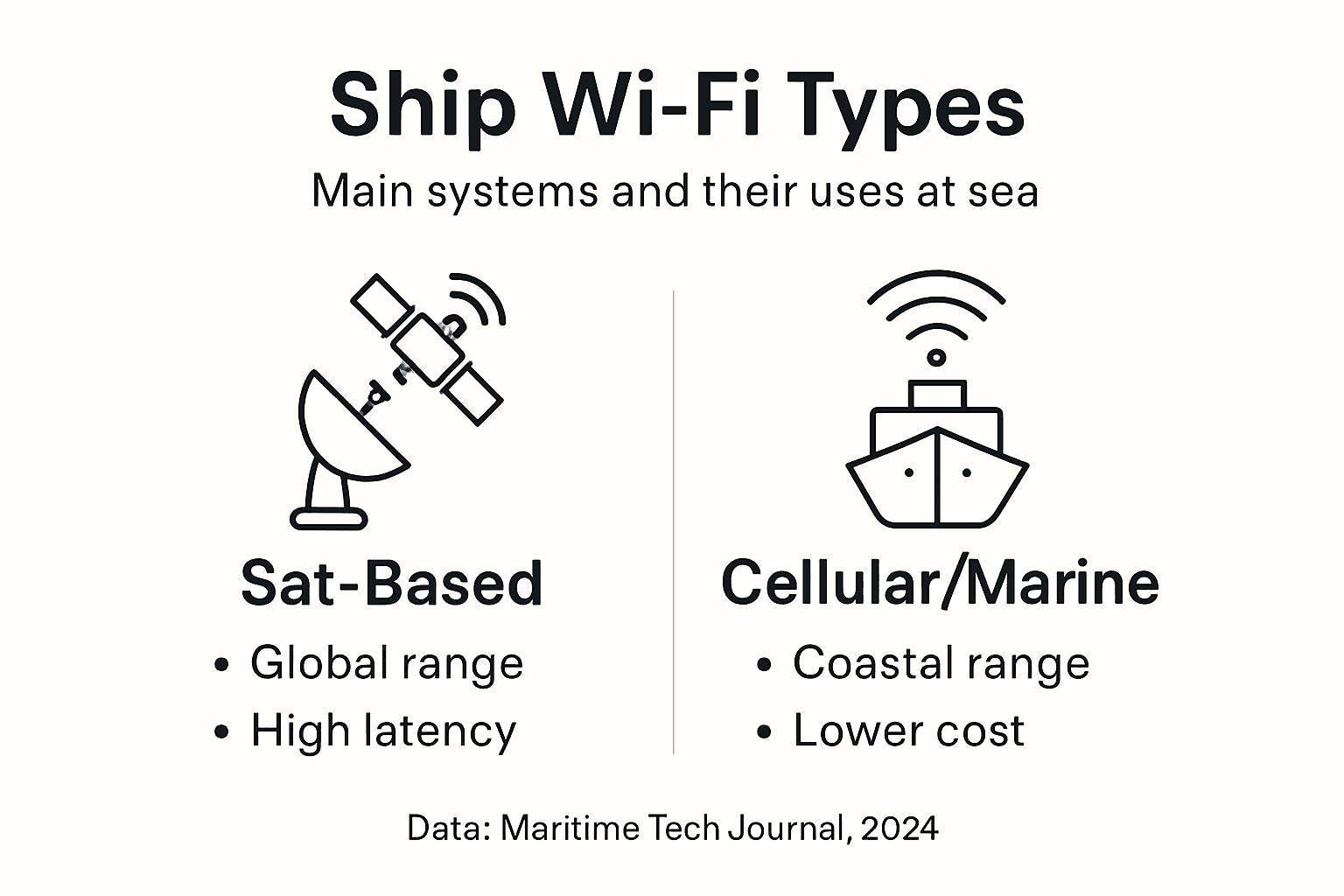
Technical configurations of maritime Wi-Fi systems typically involve multiple redundant communication channels to ensure reliable signal transmission. Key components include marine-grade wireless access points, satellite transceivers, signal amplifiers, and robust cybersecurity mechanisms. These systems must withstand extreme environmental conditions like salt water exposure, significant temperature variations, and constant mechanical vibrations while maintaining high-performance data transmission.
Ship Wi-Fi networks are categorized into different performance tiers, ranging from basic connectivity solutions for smaller vessels to advanced broadband systems for large cruise ships and commercial maritime operations. Each tier offers varying bandwidth, signal stability, and geographic coverage capabilities, carefully engineered to meet specific maritime communication requirements.
Here’s a concise comparison of ship Wi-Fi network types and their main features:
| Network Type | Coverage Range | Primary Use | Key Limitation |
|---|---|---|---|
| Satellite-Based | Global, open ocean | Long-distance, continuous coverage | Can be expensive |
| Cellular Maritime | Near coastal areas | Fast speeds close to shore | Limited offshore range |
| Marine Wireless Systems | Inside vessel/local | Internal crew and passenger networks | Range limited to vessel |
| Multi-Hop Networks | Ship-to-ship relays | Extended coverage with many vessels | Needs coordinated ships |
Pro tip: Always verify your ship’s specific Wi-Fi infrastructure capabilities and potential connectivity limitations before planning critical communication needs during maritime journeys.
Passenger Experience and Remote Work Benefits
Wi-Fi has revolutionized maritime travel, transforming ships from isolated environments into dynamic, connected spaces. Modern vessels now function as floating offices, providing passengers unprecedented opportunities to work, communicate, and stay entertained during their journeys.

The impact of onboard connectivity extends far beyond simple internet access. Remote workers can now seamlessly conduct professional tasks while traversing oceans, breaking down traditional barriers of workplace location. Continuous internet connectivity supports crew welfare by mitigating feelings of isolation and enabling personal communications with family and friends, significantly improving overall travel experience and mental well-being.
Key benefits of maritime Wi-Fi for passengers include real-time communication, access to cloud-based work platforms, streaming entertainment, and staying connected with social networks. The technological infrastructure supports diverse digital activities, from video conferences and collaborative project management to streaming movies and playing online games, effectively transforming maritime travel into a productive and enjoyable experience.
Technological advancements have made these connectivity solutions increasingly sophisticated, with improved bandwidth, reduced latency, and more reliable signal transmission. Passengers can now expect high-speed internet that rivals land-based connections, making long sea journeys more comfortable and professionally productive.
Pro tip: Invest in a portable Wi-Fi signal booster and download critical work files before embarking to maximize your remote work potential during maritime travel.
Costs, Security Risks, and Operational Challenges
maritime Wi-Fi networks present complex challenges that extend far beyond simple connectivity. Cybersecurity vulnerabilities pose significant operational risks, particularly when vessels are docked in ports where external threats can compromise network integrity.
Network security demands sophisticated strategies to protect against potential breaches. Encryption and intrusion detection systems are critical for mitigating risks, with maritime networks requiring more robust protection than traditional land-based systems. The unique challenges include signal attenuation, limited bandwidth, and the constant movement of maritime environments, which create complex technical obstacles for maintaining secure and reliable connections.
The financial implications of implementing comprehensive maritime Wi-Fi systems are substantial. Organizations must balance the costs of advanced networking equipment, satellite communication technologies, cybersecurity infrastructure, and ongoing maintenance with the operational benefits of constant connectivity. This economic calculation involves not just hardware expenses, but also recurring costs for bandwidth, security updates, and technical support personnel trained in maritime communication technologies.
Operational challenges extend beyond technical limitations. Crew training becomes crucial in maintaining network security, as human error can often be the weakest link in cybersecurity protocols. Maritime organizations must develop comprehensive training programs that educate personnel about potential security risks, proper network usage, and emergency communication protocols.
Below is a summary of common operational challenges and their impacts on maritime Wi-Fi:
| Challenge | Example Impact | Mitigation Strategy |
|---|---|---|
| Signal Interference | Disrupted communications | Advanced antennas and filtering |
| Bandwidth Constraints | Slow access for passengers | Prioritize critical data traffic |
| Cybersecurity Threats | Data breaches or downtime | Multi-layered encryption |
| Crew Training Gaps | Security protocol failures | Regular specialized training |
Pro tip: Always implement multi-layered network segmentation and conduct regular security audits to minimize potential vulnerabilities in maritime Wi-Fi systems.
Innovations in Digital Services and Connectivity
The maritime industry is experiencing a technological revolution driven by advanced digital services and connectivity solutions. Maritime IoT platforms are transforming traditional shipping operations by integrating cutting-edge wireless technologies that enable smarter, more responsive maritime ecosystems.
Wireless communication technologies are pushing the boundaries of what’s possible in maritime connectivity. Software-defined radios represent a breakthrough in flexible network infrastructure, allowing maritime operators to dynamically reconfigure communication systems to meet changing operational requirements. These innovations support emerging technologies like autonomous vessels, smart port management, and real-time global tracking systems.
The convergence of satellite, aerial, and terrestrial networks is creating unprecedented opportunities for seamless digital services. Advanced network architectures now support high-bandwidth applications, enabling everything from crew welfare services to complex operational management tools. This technological integration allows for more efficient route planning, enhanced safety monitoring, and improved operational decision-making across maritime sectors.
Emerging technologies such as 6G networks and intelligent IoT platforms are set to revolutionize maritime connectivity. These systems promise dramatically improved bandwidth, lower latency, and more robust communication links that can support increasingly sophisticated digital services, from advanced telemedicine capabilities to real-time environmental monitoring and predictive maintenance systems.
Pro tip: Stay informed about emerging maritime communication technologies and continuously assess how new digital services can optimize your vessel’s operational efficiency.
Stay Connected at Sea with Seafy
Navigating the challenges of onboard Wi-Fi connectivity in ship operations can feel overwhelming. From ensuring stable satellite-based networks to managing cybersecurity and bandwidth constraints, the need for reliable, high-speed internet aboard ferries and cruise ships is clear. Passengers and crew alike demand seamless communication, entertainment, and remote work capabilities without frustration or interruption.
Seafy understands these critical pain points and is dedicated to transforming your maritime travel experience. By partnering with leading ferry lines like Corsica Ferries and Grimaldi Lines Seafy integrates advanced satellite technologies such as Starlink to provide consistent and secure Wi-Fi coverage even far from coastal areas. Discover how easy it is to stay fully connected through Seafy’s intuitive platform, offering flexible Wi-Fi packages activated with just a few clicks.
Ready to elevate your journey with worry-free maritime internet?
Explore Seafy’s onboard Wi-Fi solutions now and unlock uninterrupted connectivity tailored for modern travel. Don’t let spotty internet hold you back book your Wi-Fi package today and make your next voyage productive and enjoyable with Seafy.
Frequently Asked Questions
What types of Wi-Fi technologies are used in ship operations?
Ship Wi-Fi technologies include satellite-based networks, cellular maritime networks, and specialized marine wireless infrastructures. These systems provide varying levels of coverage, speed, and performance suited to different maritime environments.
How does Wi-Fi improve the passenger experience on ships?
Wi-Fi significantly enhances the passenger experience by enabling real-time communication, access to cloud-based work platforms, streaming entertainment, and social networking. It transforms ships into connected spaces that support both leisure and remote work activities.
What are the main challenges associated with maritime Wi-Fi?
Key challenges include cybersecurity vulnerabilities, bandwidth limitations, signal interference, and the need for crew training to properly handle network security. These factors can affect the integrity and reliability of maritime connectivity.
How can mariners mitigate security risks in Wi-Fi networks?
Mariners can mitigate security risks by implementing sophisticated cybersecurity strategies, such as encryption, intrusion detection systems, and regular security audits. Crew members should also receive specialized training to recognize and respond to potential security threats.