Tech & Wi-Fi
From the first mobile phone to smartphones at sea
Discover how mobile phones evolved from 30-minute battery life in 1973 to today's smartphones, and how this technology now enables reliable internet connectivity for cruise and ferry passengers crossing the Mediterranean.
06 March 2026
From the first mobile phone to smartphones at sea
The first mobile phone in 1973 offered just 30 minutes of talk time and required 10 hours to recharge. This bulky device weighed over two pounds, making true mobility nearly impossible. Today’s smartphones connect us anywhere, yet cruise and ferry passengers still struggle with reliable internet at sea. Understanding how mobile technology evolved from those early limitations helps modern maritime travelers choose better connectivity solutions for leisure and remote work during Mediterranean voyages.
Table of Contents
- The Birth Of Mobile Phones: 1973 And The DynaTAC
- Commercialization And Early Limitations In The 1980s
- The Digital Revolution: From Analog To 2G
- Emergence Of Smartphones: The 1990s And Early 2000s
- Smartphone Revolution And The App Era
- Next-Gen Connectivity: 5G And Beyond
- Challenges Of Connectivity At Sea
- Maritime Connectivity Solutions With Satellite Integration
- Common Misconceptions About Early Mobile Phones
- Practical Connectivity Implications For Maritime Passengers
- Enhance Your Onboard Internet With Seafy
- Frequently Asked Questions
Key takeaways
| Point | Details |
|---|---|
| Mobile phones began as bulky business tools | The 1973 DynaTAC prototype weighed 2.4 pounds with only 30 minutes of talk time, limiting practical use. |
| Digital networks enabled mass adoption | 2G networks in the 1990s introduced SMS, made phones affordable, and reduced device size dramatically. |
| Smartphones transformed into computing platforms | The 2007 iPhone created app ecosystems that turned phones into multimedia hubs for work and entertainment. |
| 5G and satellite tech enhance maritime connectivity | Modern networks offer gigabit speeds and low latency, improving onboard internet for cruise passengers. |
| Specialized platforms address sea-based challenges | Services like Seafy integrate satellite and cellular technologies to provide stable Wi-Fi on ferries and cruise ships. |
The birth of mobile phones: 1973 and the DynaTAC
The first mobile phone call was made in 1973 by Martin Cooper at Motorola using the DynaTAC prototype, marking the birth of mobile telephony. This revolutionary device weighed around 2.4 pounds and offered only 30 minutes of talk time before dying. Charging took approximately 10 hours, making true mobility limited despite the “mobile” name.
The DynaTAC was initially a business and status symbol device due to its size and astronomical cost. Only corporate executives and wealthy individuals could justify purchasing one. The technology was groundbreaking but far from practical for everyday communication needs.
Key specifications of the first mobile phone:
- Weight of 2.4 pounds made extended calls physically exhausting
- 30 minutes of talk time required careful usage planning
- 10 hour charging cycle meant overnight preparation
- Limited to voice calls with no data capabilities
- Range restricted to areas with cellular tower coverage
This primitive technology laid the foundation for today’s connectivity solutions, including platforms like Seafy that help maritime passengers stay connected during Mediterranean voyages. Understanding these early limitations shows how far mobile technology has progressed in enabling seamless communication at sea.
Commercialization and early limitations in the 1980s
The commercially available first mobile phone, Motorola DynaTAC 8000X, launched in 1983 was large, expensive at $3,995, and provided about 30 minutes of talk time. This high cost, equivalent to $10,000 today, limited consumer access to wealthy professionals and businesses. The device remained a luxury item rather than a practical tool for most people.
Heavy devices with short battery life challenged daily use throughout the 1980s. Users had to plan calls carefully and carry spare batteries for extended trips. The phones were primarily business tools and status symbols rather than communication necessities.
Commercial mobile phone challenges in the 1980s:
- Price point of $3,995 excluded middle-class consumers
- Brick-like form factor made pocket carrying impossible
- Limited network coverage restricted usage to major cities
- Analog technology produced poor call quality and frequent drops
- Battery technology lagged far behind processor development
These limitations mirror challenges maritime passengers face today with unreliable onboard connectivity. Just as early phones struggled with battery life and coverage, modern cruise internet deals with signal obstruction and bandwidth constraints. Solutions offering seamless internet on ferries address these persistent connectivity challenges with advanced technology.
The digital revolution: from analog to 2G
The transition from 1G analog to 2G digital networks in the early 1990s enabled text messaging and made phones smaller, cheaper, and more accessible. Digital GSM networks improved call quality and introduced data capabilities beyond simple voice communication. The introduction of SMS in 1992 revolutionized messaging by allowing short text exchanges without voice calls.
Phones became smaller, more affordable, and accessible to average consumers. Improved coverage and digital services enabled growing adoption throughout the decade. By the late 1990s, mobile phones had transformed from luxury items to common communication tools.
Major improvements during the digital transition:
- Digital signal processing reduced interference and dropped calls
- SMS messaging created new communication patterns
- Phone size decreased by 50% compared to analog models
- Battery life extended to several hours of talk time
- Network coverage expanded to suburban and rural areas
| Feature | 1G Analog | 2G Digital |
|---|---|---|
| Call quality | Poor, static-prone | Clear, consistent |
| Messaging | Voice only | SMS enabled |
| Battery life | 30-60 minutes | 2-3 hours |
| Device weight | 1-2 pounds | 0.5 pounds |
| Cost | $2,000-4,000 | $500-1,000 |
This digital revolution parallels modern maritime digital connectivity solutions that use advanced satellite and cellular integration. Just as 2G made mobile phones practical, today’s hybrid systems make reliable internet possible during sea voyages.
Emergence of smartphones: the 1990s and early 2000s
The IBM Simon Personal Communicator launched in 1994 is considered the first true smartphone, offering touchscreen, email, fax capabilities, and basic applications like calendar and notepad. This device combined phone functionality with personal digital assistant features in a single package. The touchscreen allowed direct interaction without physical keyboards for most functions.
The Simon offered email, fax, calendar, and notepad apps years before competitors. High cost of $899 limited consumer adoption but demonstrated possibilities for multifunction mobile devices. This marked a shift from voice-only phones to computing platforms that could handle multiple tasks.
Groundbreaking features of early smartphones:
- Monochrome touchscreen enabled direct input
- Email and fax capabilities connected business users
- Calendar and address book replaced paper organizers
- Third-party apps expanded functionality beyond core features
- Stylus input allowed handwriting recognition
These early smartphones proved that mobile devices could serve multiple purposes beyond calling. Modern cruise passengers benefit from this evolution by using smartphones for remote work and entertainment during Mediterranean ferry trips. The multifunction approach pioneered by devices like the Simon made today’s connected maritime experience possible.
Smartphone revolution and the app era
The launch of the Apple iPhone in 2007 revolutionized the smartphone market by introducing a capacitive touchscreen and app ecosystem, making smartphones mainstream and multifaceted. The user-friendly interface eliminated the stylus and made touch interaction intuitive. The App Store created a robust ecosystem for games, productivity tools, and connectivity applications.
Smartphones became multimedia hubs for communication, entertainment, and work. Widespread adoption transformed how people stay connected on the go, including at sea. By 2010, smartphones had become essential tools for both personal and professional life.
How the iPhone transformed mobile technology:
- Capacitive touchscreen eliminated physical keyboards and styluses
- App Store ecosystem allowed third-party developers to create millions of applications
- Mobile Safari brought full web browsing to handheld devices
- Visual voicemail changed how users managed phone messages
- iTunes integration made media synchronization seamless
- Multi-touch gestures created intuitive interaction patterns
Pro Tip: When traveling on Mediterranean ferries, download offline content and productivity apps before boarding to maximize your smartphone’s utility even during connectivity fluctuations.
This app ecosystem enabled smartphone use for work at sea, allowing remote professionals to maintain productivity during cruise voyages. The iPhone’s impact on mobile computing directly enabled today’s connected maritime lifestyle.

Next-gen connectivity: 5G and beyond
5G network rollout in the 2020s brought gigabit speeds, ultra-low latency, and massive device connectivity, enhancing mobile internet experience including maritime connectivity. 5G offers up to 10 Gbps speeds and latency under 1 millisecond in ideal conditions. This technology supports large numbers of connected devices simultaneously, perfect for cruise ships and ferries with hundreds of passengers.
5G enables high-quality video calls, streaming, and remote work onboard vessels. Foldable devices and AI integration represent the next frontiers for smartphone technology. These advances make maritime internet more reliable and capable than ever before.
Key benefits of 5G for maritime connectivity:
- Download speeds up to 100 times faster than 4G networks
- Latency reduction enables real-time video conferencing
- Network slicing allows prioritization of critical applications
- Massive IoT support connects ship systems and passenger devices
- Improved spectrum efficiency handles dense user populations
Pro Tip: Check if your ferry operator offers 5G-enabled onboard Wi-Fi before booking, as this technology significantly improves streaming quality and video call reliability during voyages.
Modern onboard Wi-Fi solutions with 5G integration provide cruise passengers with connectivity rivaling land-based networks. This advancement makes working remotely or streaming entertainment during Mediterranean crossings finally practical.
Challenges of connectivity at sea
Onboard internet connectivity on cruise and ferry ships faces unique challenges such as signal obstruction, satellite handoff, and weather interference, requiring specialized networking solutions. Ship structures create physical barriers that block cellular signals from coastal towers. Metal hulls and decks act as Faraday cages, preventing radio waves from penetrating interior spaces.
Frequent satellite handoff leads to variable connectivity and latency as vessels move between coverage zones. Bandwidth fluctuates with weather conditions and user load throughout the day. Latency can range from 20 to over 100 milliseconds, affecting real-time communication like video calls.
Major obstacles to reliable maritime internet:
- Steel ship construction blocks cellular and satellite signals
- Distance from coastal towers limits cellular network availability
- Satellite handoffs create connection drops during zone transitions
- Weather conditions degrade signal quality and bandwidth
- Shared bandwidth among hundreds of passengers causes congestion
- Wave motion affects antenna alignment with satellites
These technical challenges explain why many passengers experience frustrating connectivity challenges on ferries during Mediterranean voyages. Understanding these limitations helps travelers set realistic expectations and choose appropriate connectivity packages.
Maritime connectivity solutions with satellite integration
Satellite internet provides broad coverage beyond cell towers, enabling connectivity anywhere at sea. Seafy partners with ferry operators to deliver stable, high-speed Wi-Fi through integrated satellite and cellular systems. Hybrid systems switch between satellite and cellular networks to optimize signal strength and speed.
Real-world metrics show reduced latency and better streaming performance compared to traditional satellite-only solutions. Users benefit from flexible Wi-Fi packages designed for both leisure streaming and remote work needs. These solutions address the unique challenges of maritime connectivity through specialized technology.
How modern maritime Wi-Fi systems improve connectivity:
- Satellite coverage maintains internet access beyond coastal cell tower range
- Hybrid switching uses cellular when available for lower latency
- Load balancing distributes traffic across multiple satellite links
- Onboard caching reduces bandwidth usage for popular content
- Quality of service prioritization ensures critical applications work reliably
| Metric | Traditional Satellite | Seafy Hybrid Solution |
|---|---|---|
| Average latency | 600-800 ms | 40-120 ms |
| Peak download speed | 5-10 Mbps | 50-100 Mbps |
| Connection stability | 85% uptime | 98% uptime |
| Cost per GB | $15-25 | $8-12 |
| Video streaming quality | 480p max | 1080p capable |
These nautical Wi-Fi solutions represent significant advances over previous generation systems. Modern passengers can now enjoy connectivity experiences similar to land-based internet while crossing the Mediterranean. Learn more about how Seafy improves connectivity through its integrated platform approach.
Common misconceptions about early mobile phones
Contrary to popular belief, early mobile phones were not intended for mass communication but primarily served as business status symbols due to their size, cost, and limited battery life. Many people incorrectly assume the first mobile phones were designed for everyday consumers. In reality, manufacturers targeted corporate executives and wealthy individuals exclusively.
Early mobile phones were expensive and bulky, not for all consumers. Battery life was about 30 minutes of talk time, requiring long recharge times of 8 to 10 hours. Usage was primarily for business elites, not mass communication as we know it today.
Myths versus reality about first-generation mobile phones:
- Myth: Early phones were affordable for middle-class families
- Reality: Prices equivalent to $10,000 today excluded most consumers
- Myth: Mobile phones quickly replaced landlines in the 1980s
- Reality: Landlines remained dominant until the late 1990s
- Myth: Early phones had features similar to modern smartphones
- Reality: Smartphones offering multifunctionality emerged decades later
Understanding this history helps maritime passengers appreciate how far connectivity technology has progressed. Modern solutions correcting early mobile phone myths provide reliable internet that would have seemed impossible during the analog mobile phone era.
Practical connectivity implications for maritime passengers
Smartphones have transformed from pure communication devices to essential portable computers, supporting leisure, business work, entertainment, and social connectivity in maritime travel. Modern devices serve as tools for streaming, networking, and remote work during sea voyages. Choosing the right Wi-Fi package and optimizing smartphone settings maximizes connectivity value.
Flexible day passes or priority bandwidth packages should match your trip duration and connectivity needs. Testing connectivity solutions before travel and using onboard portals ensures smooth access. Adjusting smartphone settings like Wi-Fi preferences and data management optimizes connection quality.
How to maximize smartphone connectivity during ferry trips:
- Purchase appropriate Wi-Fi packages before boarding to avoid connection delays
- Disable automatic app updates and cloud backups to conserve bandwidth
- Download maps, entertainment, and work files for offline access
- Use airplane mode when not actively using internet to preserve battery
- Connect to official ferry Wi-Fi networks, avoiding unsecured alternatives
- Schedule bandwidth-intensive tasks for off-peak hours when fewer passengers are online
Pro Tip: Set your smartphone to forget the onboard network after disembarking to prevent automatic reconnection attempts that drain battery during future trips near the same port.
Following these best practices for onboard internet ensures reliable connectivity throughout your Mediterranean voyage. Smart planning transforms smartphones into effective tools for both work and leisure at sea.
Enhance your onboard internet with Seafy
Staying connected during Mediterranean ferry and cruise trips no longer requires frustration or compromise. Seafy integrates satellite and cellular technology to deliver stable, high-speed onboard Wi-Fi that addresses the unique challenges of maritime connectivity.
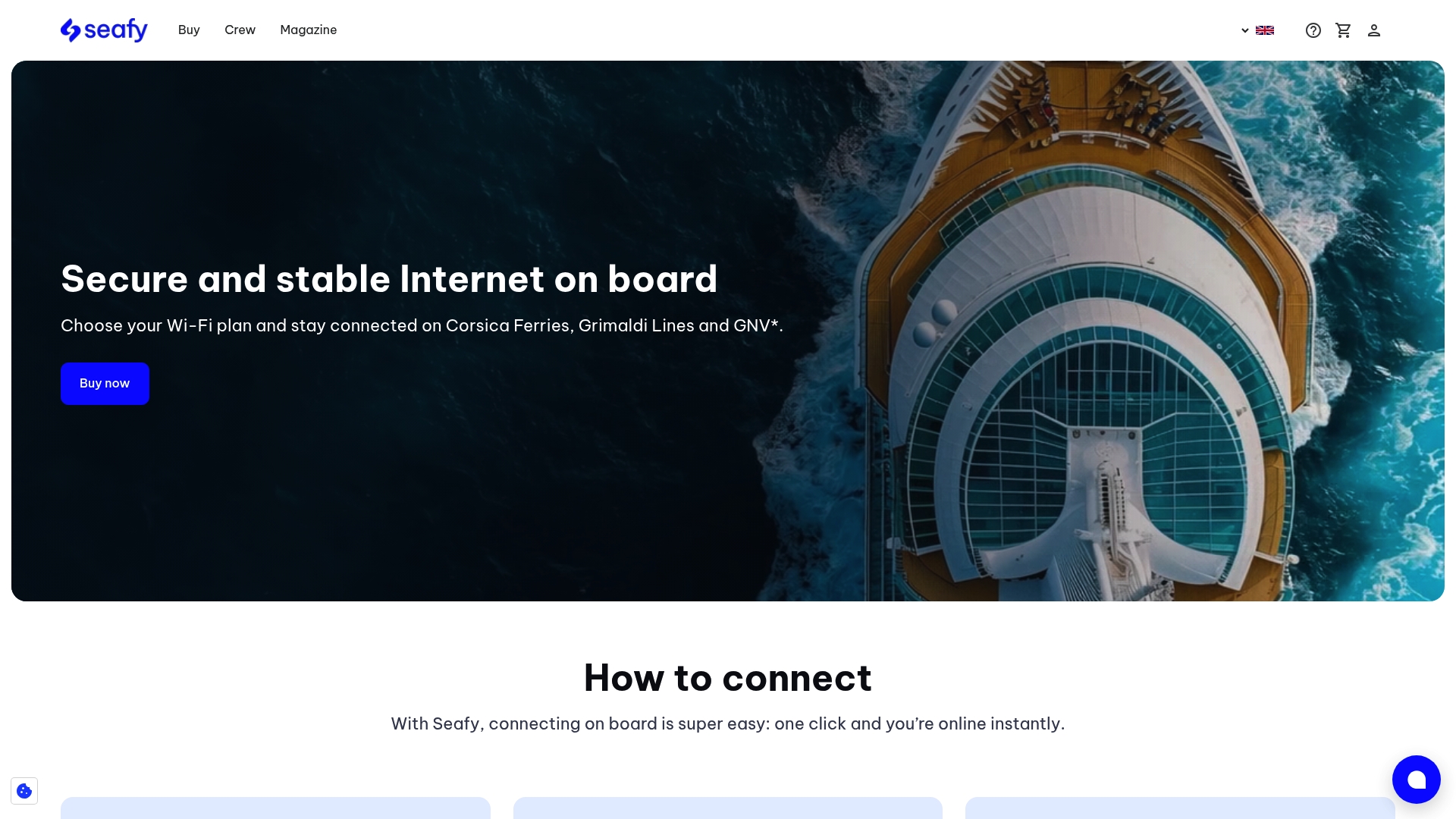
Flexible plans accommodate everything from casual social media browsing to bandwidth-intensive remote work. User-friendly portals enable seamless connection management without technical expertise. Trusted partnerships with major Mediterranean ferry operators including Corsica Ferries, Grimaldi Lines, and GNV ensure reliable service across popular routes.
Explore comprehensive onboard Wi-Fi solutions designed specifically for maritime environments. Discover how to maintain uninterrupted internet with Seafy during your next voyage. Learn about specialized Wi-Fi for remote work at sea that keeps professionals productive while traveling.
Frequently asked questions
How did the first mobile phones work compared to today?
The 1973 DynaTAC used analog signals to transmit voice through cellular towers, offering only 30 minutes of talk time. Modern smartphones use digital 4G and 5G networks to transmit voice, data, video, and apps with hours of battery life. Today’s devices function as portable computers with internet access, while early phones handled only basic voice calls.
What caused slow internet on cruise ships historically?
Historical cruise internet relied solely on satellite connections with latency of 600-800 milliseconds and limited bandwidth shared among all passengers. Physical distance from satellites, weather interference, and outdated compression technology created bottlenecks. Modern hybrid systems combining satellite with coastal cellular networks and advanced load balancing dramatically improve speed and reliability.
How does Seafy improve internet access on ferries?
Seafy uses hybrid technology that switches intelligently between satellite and cellular networks to maintain optimal connectivity. The platform offers flexible Wi-Fi packages tailored to different usage needs, from basic browsing to remote work. Partnerships with major Mediterranean ferry operators ensure consistent service quality and coverage across popular routes.
Can smartphones handle remote work effectively at sea?
Yes, modern smartphones with 5G capabilities and apps like Microsoft Office, Slack, and Zoom support full remote work functionality. Reliable onboard Wi-Fi through services like Seafy provides the bandwidth needed for video conferencing and file transfers. Proper planning including offline file downloads and strategic bandwidth usage makes maritime remote work practical.
Are there affordable internet options for short maritime trips?
Most ferry operators offer day passes and hourly packages starting at reasonable rates for short crossings. Seafy provides tiered options allowing passengers to purchase only the bandwidth they need. These flexible packages make staying connected during brief Mediterranean ferry trips economical compared to expensive satellite phone alternatives.
What smartphone settings optimize onboard internet performance?
Disable automatic updates, cloud syncing, and background app refresh to conserve bandwidth. Connect only to official ferry Wi-Fi networks and forget the network after disembarking. Use airplane mode when not actively browsing to preserve battery and reduce unnecessary connection attempts that waste data.