Tech & Wi-Fi
Crew Internet Safety Explained for Maritime Professionals
Understand crew internet safety explained: protect your ship and crew from growing cyber threats with essential training and compliance.
19 May 2026
Crew Internet Safety Explained for Maritime Professionals
TL;DR:
- Crew members must recognize that onboard networks, including personal devices, pose cyber risks under IMO 2026 regulations. Regular training, secure practices like VPNs, and using verified maritime internet platforms like Seafy are essential for safety. Proper cybersecurity habits and infrastructure choices protect vessel operations and crew welfare at sea.
Most crew members assume that once they’re connected to the ship’s Wi-Fi, they’re in safe hands. That assumption is wrong, and in 2026, it carries real consequences. Crew internet safety explained properly means understanding that onboard networks sit at the crossroads of personal welfare and critical ship operations. A single phishing click or rogue access point can expose navigation systems, crew data, and the vessel’s Safety Management System. The rules have changed, the threats have grown, and your habits at sea need to keep pace.
Table of Contents
- Key takeaways
- Crew internet safety explained: the 2026 regulatory picture
- Common onboard internet risks you need to know
- Best practices for secure crew internet use
- How maritime Wi-Fi platforms support crew safety
- My perspective on crew internet safety in 2026
- Stay safely connected at sea with Seafy
- FAQ
Key takeaways
| Point | Details |
|---|---|
| IMO 2026 mandates are live | SOLAS vessels must integrate cyber risk management into their SMS, with full compliance required by 2028. |
| Crew are the last line of defense | Training to spot phishing, suspicious devices, and GPS anomalies is now a regulatory requirement, not optional. |
| Onboard Wi-Fi carries unique risks | Rogue access points, packet sniffing, and shadow IT with personal devices are top threats in maritime environments. |
| Practical habits reduce most risk | VPNs, multi-factor authentication, and network verification stop the majority of common attacks. |
| Platform choice matters for safety | Using a verified maritime internet provider like Seafy reduces exposure to unmanaged and insecure connections onboard. |
Crew internet safety explained: the 2026 regulatory picture
The regulatory ground shifted significantly this year. IMO compliance for SOLAS vessels began July 1, 2026, requiring that cyber risk management be fully integrated into each vessel’s Safety Management System. This is not a soft recommendation. It is a binding mandate with documented requirements and an audit trail.
What does this mean day to day? The framework requires several concrete things from ship operators and their crews:
- Documented asset inventories covering all connected devices onboard, including personal smartphones and tablets
- Network segmentation separating crew welfare internet from operational technology systems
- Annual crew cybersecurity training that is role-specific and scenario-based
- Full implementation of all technical and procedural controls by 2028
The most important shift in thinking is this: crew are the last line of defense against maritime cyber threats. The ISM Code now treats cybersecurity as a core element of ship safety, which means your ability to recognize a phishing attempt or a suspicious USB device is as operationally significant as any other safety drill.
Pro Tip: Ask your ship’s safety officer for a copy of the vessel’s cyber risk management annex to the SMS. Knowing what your vessel’s specific protocols cover helps you understand exactly where your responsibilities begin and end.
Crew cybersecurity training works best when it is repeated regularly, grounded in real scenarios, and formally documented. One annual briefing is the minimum, not the target.
Common onboard internet risks you need to know
Here is where the reality of maritime connectivity diverges sharply from anything you experience on land. Ships rely on intermittent satellite links, carry legacy systems that rarely get security patches, and host a mix of passengers, crew, and operational technology all sharing the same physical network infrastructure.
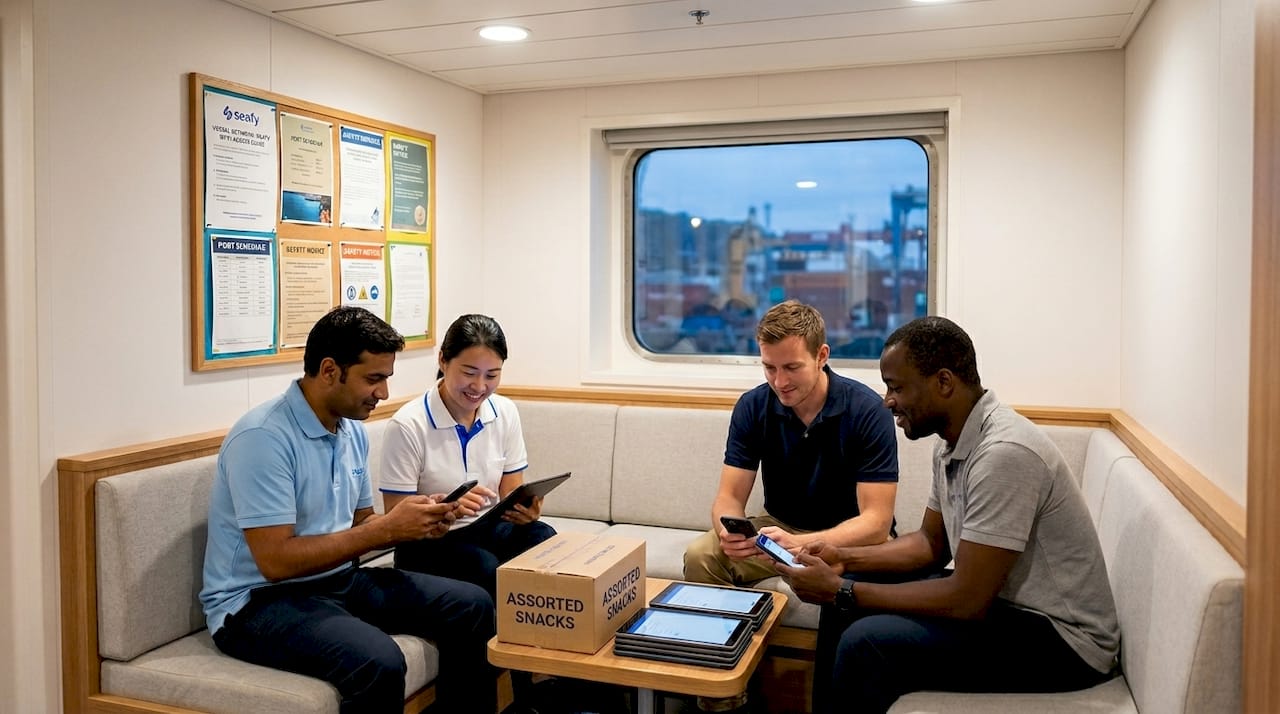
Network segmentation and secure remote access are critical precisely because threats can move laterally from a crew welfare connection to navigation or engine management systems. Legacy equipment makes that problem worse, since older systems often cannot be patched during typical port windows.
The most common threats crew face onboard include:
- Rogue Wi-Fi access points set up by bad actors or passengers to mimic legitimate ship networks
- Packet sniffing on unsecured or poorly configured networks, capturing login credentials and sensitive data
- Phishing emails targeting crew welfare accounts, often spoofing HR departments, payroll services, or union communications
- Man-in-the-middle and DNS hijacking attacks on public or open Wi-Fi networks
Shadow IT deserves special attention here. Unauthorized personal devices connected to onboard networks create unmanaged entry points into operational technology environments. Under the 2026 IMO guidelines, this is no longer just a policy violation. It can trigger audits and disciplinary action. If your personal phone is connecting to the same network segment as the ship’s ECDIS or AIS, you are creating a risk the entire crew will be held accountable for.
The price crew pay for internet access also shapes behavior. Crew on many cruise lines pay around $120 monthly for basic Wi-Fi, which pushes some to seek out cheaper or unverified alternatives. That workaround is exactly where attackers wait.
Best practices for secure crew internet use
Good digital habits aboard a ship follow a clear logic. You cannot control the network architecture, but you can control how you connect and what you expose. Follow these steps consistently and you will eliminate the majority of risk you personally face onboard. 🌐
- Verify the network SSID before connecting. Check the exact name of the ship’s official Wi-Fi network with the communications officer before your first login. Rogue access points often use names that differ by one character.
- Use a VPN with a kill switch. A VPN encrypts your traffic on any network. The kill switch feature cuts your connection entirely if the VPN drops, preventing your data from being exposed unprotected. Combining VPNs with strong device hygiene is the single most effective technical step you can take.
- Enable multi-factor authentication on all sensitive accounts. This applies to email, banking, crew welfare portals, and any work-related platform. A stolen password is useless without the second factor.
- Browse HTTPS-only. Most modern browsers flag non-HTTPS sites. If you see a warning, close the tab.
- Disable auto-join for Wi-Fi networks. Your device should never connect to a network without your explicit approval.
- Turn off Bluetooth discoverability when you are not actively pairing a device.
- Keep personal and work device use separate. Do not access operational systems from personal devices and do not install unauthorized apps on any device that touches the ship’s network.
- Report anything suspicious immediately. An unfamiliar network appearing in your device’s Wi-Fi list, an unexpected login prompt, or a strange email asking for credentials are all worth flagging to the officer in charge.
Pro Tip: Password managers like Bitwarden or 1Password remove the temptation to reuse credentials across accounts. One compromised password should never unlock multiple services, especially at sea where IT support response times are measured in hours, not minutes.
For crew members who want a deeper walkthrough on accessing the internet safely aboard vessels, Seafy’s secure maritime internet guide covers compliance-aligned steps in practical detail.
How maritime Wi-Fi platforms support crew safety
Not all onboard internet solutions are created equal. Choosing a verified, professionally managed maritime platform matters as much as your own safe browsing habits.
| Factor | Unmanaged personal connection | Verified platform like Seafy |
|---|---|---|
| Network segmentation | None | Crew traffic separated from operational systems |
| Rogue AP risk | High | Reduced through centralized management |
| Coverage reliability | Unpredictable | Satellite-backed, consistent at sea |
| Crew welfare compliance | Not addressed | Aligned with MLC requirements |
| Activation process | Manual, often insecure | Easy portal-based activation at seafy.com |
Verified maritime internet platforms like Seafy reduce crew exposure to rogue access points and eliminate the need to rely on unmanaged personal hotspots. Seafy operates across major ferry lines including Corsica Ferries, Grimaldi Lines, and GNV, providing connectivity that is both stable and managed. The platform integrates with Starlink satellite technology, which means your connection stays reliable even on longer Mediterranean crossings. ⚡
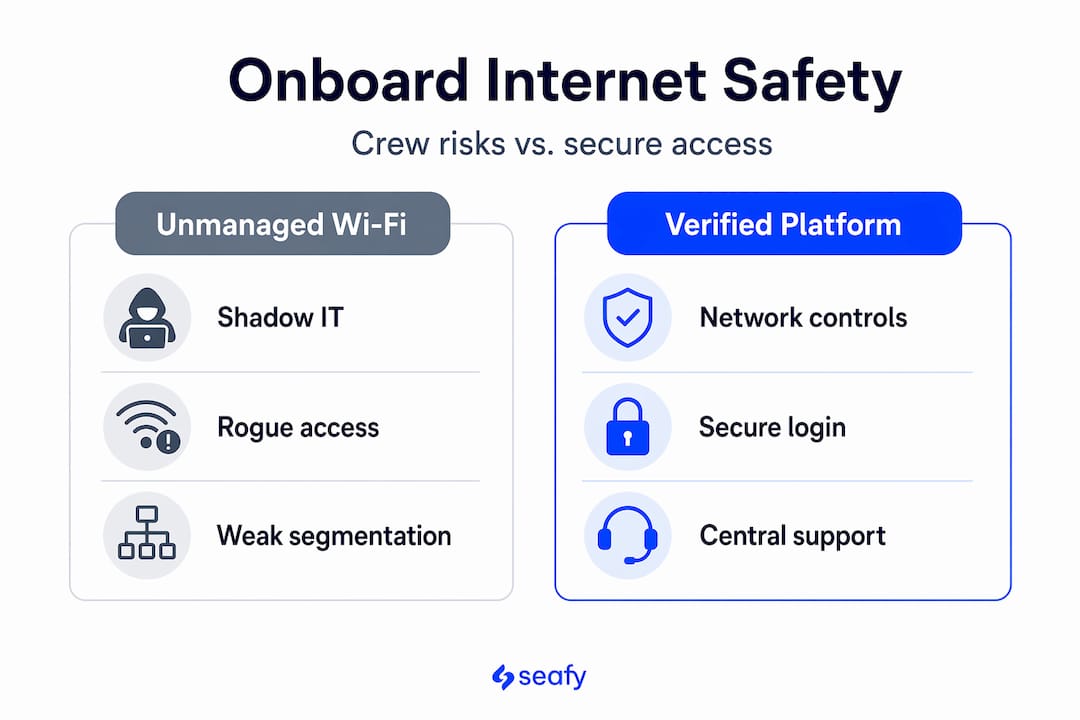
For crew members, this is directly relevant to the 2026 compliance picture. Using a centrally managed, network-segmented Wi-Fi solution means the vessel’s SMS cyber requirements are supported at the infrastructure level, not just through individual good habits.
My perspective on crew internet safety in 2026
I’ve spent a lot of time working through maritime cybersecurity scenarios, and the pattern I keep seeing is the same. Crew members are knowledgeable and safety-conscious about everything physical onboard. Digital threats get treated as someone else’s problem, usually IT or management.
That thinking is genuinely dangerous now. The 2026 IMO mandates did not create new risks; they acknowledged that the risks were already there and that crew behavior was the most critical variable. What I’ve found is that the biggest gap is not technical knowledge. It’s the assumption that “the ship handles it.” Networks onboard are not self-defending systems.
The practical lesson from real maritime cyber incidents is almost always the same: the initial breach was a human action, a wrong click, a borrowed device, a skipped update. The internet’s role in vessel safety is now inseparable from the physical kind. Treating your online habits onboard with the same discipline you apply to a safety drill is not overcaution. It’s the job.
— Raffaele
Stay safely connected at sea with Seafy
Knowing the risks is the first step. Having a reliable, secure connection is the second.

Seafy makes it straightforward for crew and maritime professionals to access high-quality internet onboard vessels operated by Corsica Ferries, Grimaldi Lines, and GNV. Whether you need to stay in touch with family, work remotely, or stream during off-hours, Seafy’s portal-based activation gets you connected fast without compromising your ship’s security posture. Visit seafy.com to explore crew internet packages and see which routes and vessels are covered. Safe browsing starts with choosing the right platform.
FAQ
What does crew internet safety mean on a ship?
Crew internet safety refers to the practices, policies, and technical measures that protect crew members and vessel operations when using onboard internet connections. It covers everything from recognizing phishing attempts to using approved networks and following the vessel’s cyber risk management protocols under the IMO 2026 framework.
Is cybersecurity training mandatory for crew in 2026?
Yes. Under the IMO 2026 mandate, SOLAS-regulated vessels must integrate cyber risk management into their Safety Management Systems, including documented annual cybersecurity training for crew members.
What is the biggest internet safety risk for crew onboard?
Rogue Wi-Fi access points and phishing emails targeting crew welfare accounts are among the top threats. Shadow IT with personal devices also creates serious risk by introducing unmanaged entry points into the vessel’s operational technology network.
Can a VPN protect crew using ship Wi-Fi?
A VPN significantly reduces risk by encrypting your traffic on any network, including poorly secured onboard connections. Using one with a kill switch feature, combined with multi-factor authentication, covers the most common attack vectors crew face at sea.
How does Seafy support crew internet safety onboard?
Seafy provides managed, satellite-backed Wi-Fi on major ferry lines with network segmentation that separates crew traffic from operational systems. This reduces exposure to rogue access points and supports the vessel’s compliance with MLC welfare requirements and IMO cyber risk guidelines.