Tech & Wi-Fi
Why reliable onboard internet matters for ferry and cruise travelers
Discover why reliable onboard internet matters for ferry and cruise travelers, ensuring seamless communication and entertainment at sea.
11 May 2026
Why reliable onboard internet matters for ferry and cruise travelers
TL;DR:
- Losing Wi-Fi at sea affects communication, work, and entertainment, with no reliable backup like on land.
- Maritime internet reliability depends on factors such as latency, congestion, and satellite handoffs, not just speed.
- Advances like hybrid satellite systems and onboard traffic management are improving connectivity, but costs remain high and performance varies.
Losing your connection mid-voyage isn’t just a minor annoyance. It can mean missing a deadline, cutting off a video call with family, or arriving at your destination without the information you needed. Unlike a dropped signal on land, where switching to mobile data takes seconds, losing Wi-Fi at sea leaves you with almost no fallback. As cruise passengers increasingly rely on onboard internet for communication, entertainment, and remote work, the quality of that connection has become one of the most important parts of the travel experience. This article breaks down exactly why reliability is what matters most, and what’s really happening beneath the waves.
Table of Contents
- Why reliable onboard internet is more than a convenience
- What does ‘reliable’ really mean at sea?
- The unique technical challenges of maritime internet
- How operators are making ship internet more reliable
- Cost, expectations, and your experience onboard
- What most cruise passengers get wrong about internet at sea 🌐
- Take control of your onboard internet experience ⚡
- Frequently asked questions
Key Takeaways
| Point | Details |
|---|---|
| Reliability is essential | Shipboard internet supports much more than entertainment—it’s critical for work and staying connected. |
| Maritime tech challenges | Satellite links and shared bandwidth make marine internet uniquely difficult to deliver at high quality. |
| Smart choices matter | Choosing the right options and understanding limitations maximizes your onboard experience. |
| Operators are innovating | Hybrid system upgrades and smarter network management are making sea internet better every year. |
Why reliable onboard internet is more than a convenience
There was a time when bringing a book on a ferry felt like the natural thing to do. That time has passed. Today, passengers board ships expecting to stay connected, not as a luxury, but as a basic need. Passengers use onboard internet for everything from messaging and streaming to attending virtual meetings and filing work reports while crossing the Mediterranean.
The consequences of unreliable internet at sea are far more serious than on land because you have no backup. Your cellular plan stops working miles from shore. There’s no nearby café with Wi-Fi. The ship’s connection is all you have.
Here’s what modern passengers depend on onboard connectivity for:
- Staying in touch with family and friends via messaging apps and video calls
- Streaming entertainment including movies, music, and podcasts during long crossings
- Working remotely, from answering emails to joining live video conferences
- Getting real-time updates about weather, travel logistics, and destination news
- Sharing experiences instantly through social media and photo uploads
“Ship Wi-Fi is no longer a perk. For many travelers, it’s the difference between a productive, connected journey and a frustrating, isolated one.”
The stakes are simply higher at sea. That’s why seamless internet at sea isn’t a marketing phrase. It reflects a real shift in what travelers need. Understanding why high-speed internet matters starts with recognizing that disruption onboard has no workaround.
What does ‘reliable’ really mean at sea?
Most people think reliability means speed. Fast internet equals good internet, right? Not quite. At sea, you can have a connection that browses pages fine but completely breaks down the moment you try to video call. That’s because reliability involves several factors, not just raw bandwidth.
For remote work specifically, the variables that matter most are latency, congestion, and handoffs. Latency is the delay between sending and receiving data, measured in milliseconds. Even a moderate latency of 600ms can make a video call feel choppy and unusable. Congestion happens when too many users compete for the same limited connection. Handoffs occur when the ship moves between satellite coverage zones or switches between satellite and coastal cellular signal.
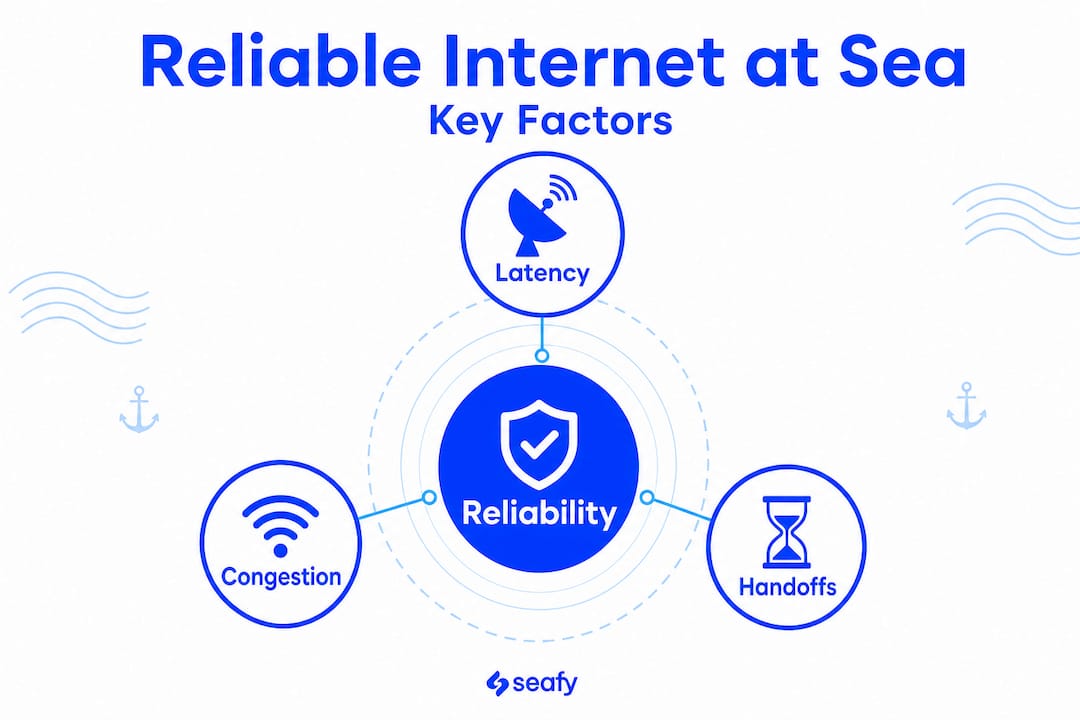
As maritime Wi-Fi design experts note, latency, network congestion, and satellite handoffs all directly determine whether real-world tasks like video calls and large file uploads actually succeed, independent of advertised speed.
| Factor | What it affects | Why it matters |
|---|---|---|
| Latency | Video calls, gaming, live streaming | High delay makes real-time apps fail |
| Bandwidth | Download/upload speeds | Affects streaming quality and file transfers |
| Congestion | All users simultaneously | Slows everything during peak hours |
| Handoffs | Connection continuity | Brief drops when switching satellite zones |
| Packet loss | Data delivery accuracy | Causes buffering and call quality issues |
Pro Tip: If you need to video call onboard, try scheduling it for early morning or late evening. Fewer passengers are online at those times, and congestion tends to drop significantly.
The unique technical challenges of maritime internet
To understand why ship internet is different, you need to picture what’s actually happening. On land, your phone connects to a nearby cell tower that’s linked to a fiber-optic network through underground cables. It’s fast, consistent, and high-capacity. At sea, none of that infrastructure exists.
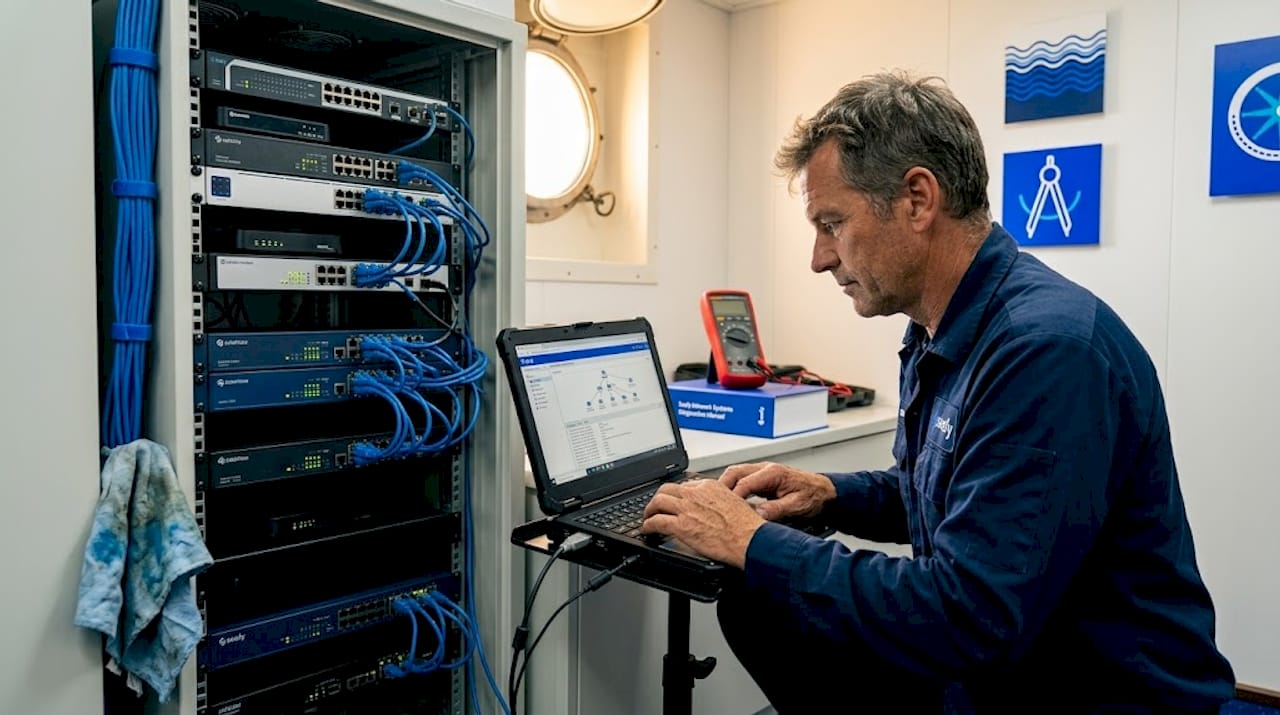
Ship Wi-Fi relies almost entirely on satellite connections, meaning data travels from the ship up to a satellite in orbit and back down to a land-based gateway, then returns the same way. Every single data request makes that round trip.
The bandwidth situation is even more constrained than most passengers realize. A ship may have as little as 50 to 150 Mbps of total satellite capacity shared across hundreds or even thousands of passengers and crew members at once. Compare that to a home fiber connection delivering 500 Mbps to a single household.
Beyond bandwidth, here are the core challenges maritime operators face:
- Satellite orbit constraints: Traditional geostationary (GEO) satellites sit 35,000 km above Earth, causing inherent latency. Newer low-Earth orbit (LEO) satellites like Starlink orbit at around 550 km, dramatically reducing delay.
- Weather interference: Rain, storms, and rough seas can degrade satellite signal quality, causing unexpected slowdowns or drops.
- Coverage gaps: Open ocean stretches, especially outside major ferry corridors, may fall into satellite coverage transition zones.
- Ship movement: Antenna alignment must constantly adjust as the vessel moves, which can occasionally disrupt signal lock.
Knowing these realities helps you follow best practices for reliable internet at sea and understand when to use troubleshooting Wi-Fi onboard tips to get the most from the connection available to you.
How operators are making ship internet more reliable
The good news is that operators aren’t standing still. The technology behind maritime connectivity has advanced significantly over the past few years, and passengers are starting to feel the difference. Here’s what’s actually changing:
- Multi-orbit satellite networks: Operators now combine LEO satellites (like Starlink) for low latency with traditional GEO satellites for broad coverage. This hybrid approach means the ship can switch to whichever system performs best at any given moment.
- Coastal cellular integration: As ships travel near shore, systems automatically switch to 4G or 5G cellular networks, which are often faster and more stable than open-sea satellite connections.
- Onboard traffic management: Smart systems prioritize certain types of traffic, such as voice calls, and throttle lower-priority activities like background app updates, keeping the experience smooth for everyone.
- Dedicated passenger bandwidth: Some operators now guarantee separate allocations for passengers versus crew systems, so heavy crew usage doesn’t degrade what you experience.
Multi-orbit connectivity upgrades represent a genuine leap forward. Operators using hybrid LEO and GEO systems with onboard traffic shaping are delivering measurably more consistent experiences. If you want to explore what’s available, check out the onboard Wi-Fi solutions that different ferry operators currently offer.
Pro Tip: When purchasing a Wi-Fi package, ask whether the ship uses LEO satellites. Routes served by Starlink or similar LEO systems tend to have significantly lower latency, which is especially important if you plan to video call or work remotely.
Cost, expectations, and your experience onboard
Here’s something most travelers don’t factor in until they’re already on the water: onboard Wi-Fi isn’t just technically different from land-based internet. It’s also priced very differently, and that gap affects how you plan your usage.
Wi-Fi pricing and limited alternatives make reliable connectivity more valuable than ever. When prices rise, passengers feel it more acutely because there’s no cheaper competitor offering service on the same ship. You either pay or disconnect.
When choosing a package, keep these points in mind:
- Match the package to your actual needs: A basic messaging plan costs far less than a full streaming package. If you only need to check in with family, don’t pay for streaming speeds.
- Watch fair-use policies: Many “unlimited” packages cap speeds after a certain usage threshold. Read the fine print before purchasing.
- Expect performance to vary: During peak hours, usually evenings and meal times, the shared connection gets congested. Plan data-heavy tasks accordingly.
- Consider route and timing: Coastal routes close to shore often deliver better performance than open-ocean crossings because cellular supplements the satellite connection.
Understanding how internet influences journeys means accepting that the value of any package depends as much on when and how you use it as on the package itself.
What most cruise passengers get wrong about internet at sea 🌐
Here’s the honest truth that most connectivity guides won’t say directly: passengers routinely judge ship Wi-Fi by the standards of their home fiber connection or their 5G phone plan, and that comparison is fundamentally unfair to the technology involved.
Even best-in-class ship Wi-Fi solutions can’t replicate the performance of fiber or 5G on land because the physics and economics are completely different. A fiber connection delivers gigabits through a cable to your home. A ship connection bounces data off a satellite floating in orbit. These are not comparable systems.
The smarter mindset is this: stop asking “why isn’t this as fast as home?” and start asking “what can I actually accomplish reliably with what’s available?” Most modern ferry connections handle messaging, email, light browsing, and even video calls during off-peak hours without issues. The passengers who plan around those strengths come away satisfied. The ones who try to stream 4K video during dinner rush come away frustrated.
A few practical mindset shifts that make a real difference:
- Download before you board: Grab your playlists, podcasts, movies, and documents before you embark. Reduce your live-streaming dependency by preparing offline content.
- Use lightweight apps: WhatsApp voice notes use far less bandwidth than a full video call. Text over video when connection quality is uncertain.
- Stay flexible on timing: The best connection windows are early morning and late at night. Working remotely? Plan your most bandwidth-heavy tasks then.
Exploring Wi-Fi hotspot onboard tips can also help you position yourself for the strongest signal in common passenger areas, which often host better access points than cabins.
Take control of your onboard internet experience ⚡
You now understand the real forces shaping your connection at sea. That knowledge puts you in a much stronger position than most passengers who board without a plan.

Seafy helps you turn that knowledge into action. Whether you’re crossing the Mediterranean on Corsica Ferries, Grimaldi Lines, or GNV, Seafy gives you a straightforward way to browse, compare, and activate Wi-Fi packages before or during your journey. No confusion, no surprises. Just a reliable connection tailored to how you actually travel. If you’re ready to stay connected on your next crossing, get internet at sea through Seafy and make your next voyage smooth from start to finish.
Frequently asked questions
Why is shipboard internet less reliable than on land?
At sea, internet relies on satellites with limited, shared bandwidth and no wired infrastructure backup, making consistent speeds and low latency much harder to guarantee than with fiber or 5G on shore.
Can I do video calls or stream shows using ferry or cruise Wi-Fi?
It depends on the ship and timing. Latency, congestion, and handoffs directly impact whether these real-time activities succeed, so off-peak hours give you the best chance of a smooth experience.
How do ship operators improve internet reliability?
They use hybrid multi-orbit satellite systems combining LEO and GEO satellites with coastal cellular connections and onboard traffic management to deliver more consistent service across the voyage.
Why does onboard Wi-Fi cost more than typical land-based plans?
The cost of satellite access, equipment, and maintaining coverage across open-ocean routes means maritime operators face significantly higher infrastructure costs than land-based internet providers.
Is it possible to get unlimited data or high speeds while at sea?
Some ships offer premium packages, but bandwidth as low as 50 to 150 Mbps shared across thousands of passengers means unlimited, high-speed performance cannot be consistently guaranteed under real-world conditions.