Tech & Wi-Fi
What Is Onboard Connectivity? A Maritime Guide
Discover what onboard connectivity really means for your sea travel. Learn how it enhances streaming, work, and communication on ships.
26 May 2026
What Is Onboard Connectivity? A Maritime Guide
TL;DR:
- Onboard connectivity is a comprehensive digital infrastructure that integrates hardware, software, and satellite networks to provide reliable internet access at sea. It enables passenger activities like streaming and work, while supporting critical ship operations and crew communication. The shift to LEO satellite technology and open system architectures is transforming maritime internet into a faster, more flexible, and essential service.
Most people assume onboard connectivity just means “there’s Wi-Fi on the ship.” That assumption undersells the technology by a wide margin. What is onboard connectivity, really? It’s an integrated system of hardware, software, and satellite networks working together to keep you connected whether you’re streaming a movie, finishing a work report, or video-calling home from the middle of the Mediterranean. For anyone traveling at sea today, understanding how this technology works makes the difference between a frustrating crossing and a genuinely productive one.
Table of Contents
- Key Takeaways
- What is onboard connectivity and how it works
- Industry trends reshaping maritime internet
- Technical challenges behind reliable sea connectivity
- Benefits of onboard connectivity for passengers and crew
- How to choose the right onboard Wi-Fi solution
- My take on where onboard connectivity is headed
- Stay connected at sea with Seafy
- FAQ
Key Takeaways
| Point | Details |
|---|---|
| More than just Wi-Fi | Onboard connectivity combines antennas, routers, satellite links, and digital services into one integrated system. |
| LEO satellites are a game changer | Low Earth Orbit satellites like Starlink reduce latency and improve speeds significantly compared to older systems. |
| Access models vary widely | Carriers offer free, freemium, and loyalty-gated internet access depending on route and operator. |
| Seafy simplifies the process | Seafy lets you purchase and activate maritime Wi-Fi packages directly onboard with major ferry partners. |
| Connectivity powers operations too | Beyond passenger use, onboard internet supports crew welfare, telemetry, and real-time ship operations. |
What is onboard connectivity and how it works
Onboard connectivity refers to the integrated network of communication hardware and software installed in vehicles like ships, ferries, and aircraft to deliver real-time digital access. This includes everything from the antennas mounted on the hull or superstructure to the routers distributing the signal across the cabin.
The core hardware stack includes:
- Antennas that track and lock onto satellites or ground-based towers
- Modems that convert satellite signals into usable data streams
- Onboard routers that distribute the signal as a Wi-Fi hotspot across the vessel
- Captive portals that handle passenger authentication and package activation
On a satellite-based system, antennas lock onto orbiting satellites tens of thousands of miles above the vessel, then relay the signal to an onboard modem and router. The result is a cabin-wide Wi-Fi hotspot you can connect to from your phone, laptop, or tablet.
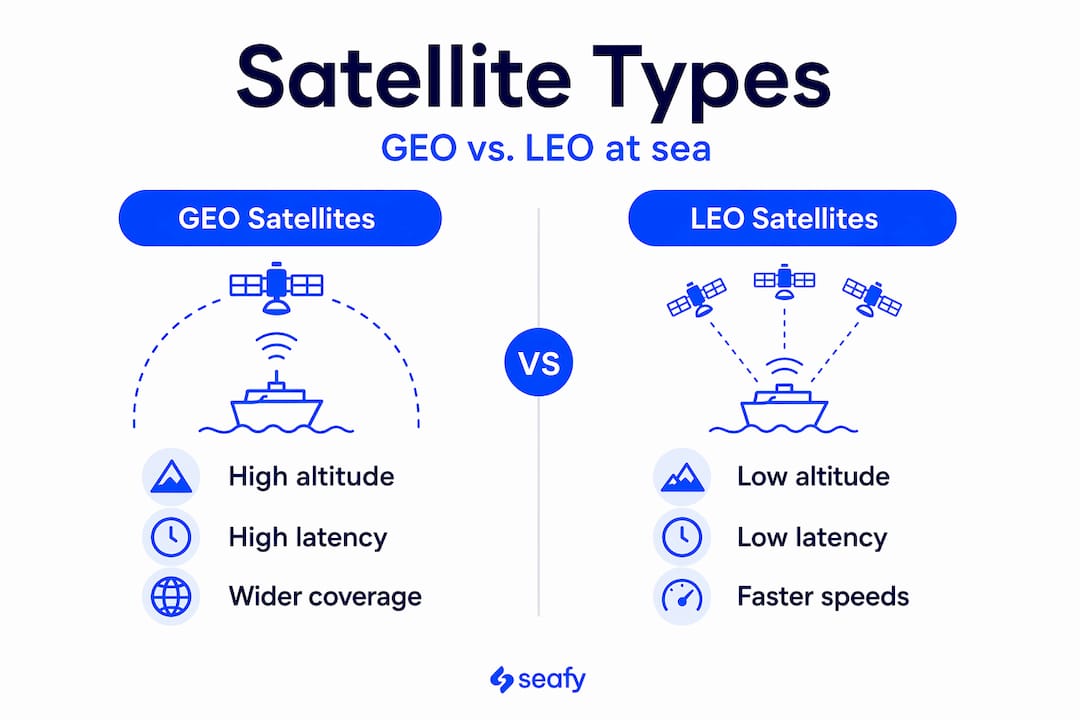
Here’s a quick comparison of the main satellite technologies in use today:
| Technology | Altitude | Latency | Best use case |
|---|---|---|---|
| GEO (Geostationary) | ~35,786 km | 600ms+ | Broad coverage, lower bandwidth |
| MEO (Medium Earth Orbit) | ~8,000 km | ~150ms | Balanced coverage and speed |
| LEO (Low Earth Orbit) | ~550 km | Under 50ms | High speed, low latency, real-time use |
LEO networks like Starlink are rapidly becoming the preferred choice for maritime operators precisely because of that latency advantage.
Industry trends reshaping maritime internet
The onboard internet access market is growing fast. Revenues are projected to exceed USD 3 billion by 2036, driven by passengers who now treat broadband as a basic travel expectation rather than a luxury add-on.
Several key trends are driving this shift right now:
- LEO satellite adoption. Operators like Qatar Airways already offer up to 500 Mbps speeds using Starlink’s constellation of 7,000+ satellites. Maritime carriers are following a similar path.
- Open, modular architectures. Airbus is moving away from closed vendor systems to allow operators to mix satellite providers and upgrade hardware without full replacements. Maritime operators benefit from the same philosophy.
- Unified management platforms. A single control layer across a fleet reduces costs, improves user experience, and gives operators better data on how passengers use their connection.
- Complimentary and freemium models. 58% of carriers now offer freemium access, with premium tiers available for passengers who need more speed or data.
Pro Tip: When booking a ferry crossing, check the carrier’s Wi-Fi policy in advance. Some routes on Corsica Ferries or Grimaldi Lines offer tiered packages you can pre-purchase for a better deal than buying onboard at the last minute.
You can get more context on how these changes affect your ferry experience in Seafy’s breakdown of high-speed ferry Wi-Fi trends.
Technical challenges behind reliable sea connectivity
Deploying onboard internet on a ship is significantly harder than it looks from the passenger side. The physics alone create obstacles that land-based internet never faces.
Antennas on vessels require elaborate engineering. Aerodynamic and marine-grade certified hardware must continuously track fast-moving satellites while the ship pitches and rolls. Signal switching between satellites happens automatically, but every handover is a potential point of failure.
Beyond the hardware, operators face real structural tensions:
- High upfront costs for antenna installation, certification, and modem infrastructure
- Ongoing spectrum and bandwidth costs that vary by satellite provider and region
- Passenger monetization pressure. Connectivity systems face constant tension between capital investment and what passengers are actually willing to pay
- Fleet standardization. A carrier operating 30 ships may have three different hardware generations, making unified user experience difficult
Connectivity also plays a direct safety role. Real-time telemetry, GPS tracking, crew communications, and port coordination all depend on the same underlying network that delivers your passenger Wi-Fi. That dual-purpose nature means reliability is non-negotiable, not just a nice feature.
Pro Tip: If your connection drops suddenly during a crossing, move closer to a Wi-Fi repeater or access point, usually marked with signage near common areas. Cabin walls and decks attenuate signal significantly on larger ferries.

Benefits of onboard connectivity for passengers and crew
The practical benefits of onboard connectivity go well beyond checking social media. Here’s what a reliable maritime internet connection actually enables:
For passengers:
- Video calls with family or colleagues during longer crossings
- Remote work with access to cloud tools, email, and collaborative platforms
- On-demand streaming of movies, music, and podcasts
- Real-time navigation updates and travel information
For crew:
- Personal communication with families during long deployments
- Access to training materials and operational updates
- Direct coordination with port authorities and logistics teams
Platforms like Seafy make this access practical and easy. You purchase a Wi-Fi package directly through the onboard portal, activate it in seconds, and connect your devices without needing to contact crew or navigate complicated instructions. Seafy partners with Corsica Ferries, Grimaldi Lines, and GNV to deliver this experience across popular Mediterranean routes.
Connectivity also unlocks smarter ship operations. A modular digital ecosystem lets operators deploy IoT sensors for predictive maintenance, smart catering systems that adjust menus based on passenger data, and energy monitoring tools. This kind of digital platform turns connectivity from a passenger perk into a full operational infrastructure layer.
How to choose the right onboard Wi-Fi solution
Whether you’re a passenger planning your next Mediterranean crossing or an operator evaluating infrastructure, a few practical factors determine which solution actually delivers.
For passengers, prioritize:
- Coverage. Does the package cover your full route, including open-water segments?
- Speed tiers. A basic package may limit streaming; a premium tier unlocks full broadband speeds.
- Device limits. Most packages allow two to five connected devices. Check before you buy.
- Ease of activation. Platforms like Seafy offer one-click activation through a simple web portal.
For operators, the key considerations are different:
- Scalability. Can the system grow as you add vessels or upgrade satellite providers?
- Vendor flexibility. Open architectures prevent expensive lock-in with a single satellite provider.
- Management tools. A unified dashboard across the fleet saves significant operational overhead.
Pro Tip: As a passenger, connecting to the ship’s Wi-Fi portal immediately after boarding is the fastest way to activate your package before the most congested hours of the crossing. Early activation means you get the best available bandwidth.
For a curated look at leading solutions, Seafy’s guide to the top onboard Wi-Fi solutions in 2026 is worth bookmarking before your next trip.
My take on where onboard connectivity is headed
What strikes me most about this technology right now is how completely it has shifted from “premium amenity” to “basic expectation.” I’ve watched that transition happen over a few short years, and it’s accelerating.
The operators who still treat onboard internet as a revenue line item rather than a service investment are falling behind. Passengers don’t forget a bad connection. They leave reviews, they talk, and they book differently next time.
What genuinely excites me is the LEO satellite generation. LEO systems deliver latency under 50ms, which means real-time video calls and cloud work are finally feasible at sea without the frustrating delays that plagued older GEO-based systems. For ferries crossing the Mediterranean, that’s transformative.
I also think the open architecture shift matters more than most operators realize. Locking into a single satellite vendor today means paying a premium for tomorrow’s upgrades. The carriers that build modular, flexible infrastructure now will adapt faster and cheaper when the next generation of satellites arrives.
The real opportunity is in owning the digital experience between the network and the passenger. Connectivity is the foundation. What you build on it, from smart services to crew welfare tools, is where the strategic value lives.
— Raffaele
Stay connected at sea with Seafy
Ready to experience what reliable onboard internet actually feels like? Seafy offers high-speed maritime Wi-Fi on ferries and cruise ships across the Mediterranean, with packages you can purchase and activate in minutes through a simple onboard portal.

Seafy partners with Corsica Ferries, Grimaldi Lines, and GNV to bring you consistent broadband coverage on popular routes. Whether you’re working remotely, streaming, or just staying in touch, Seafy has a package that fits your crossing. Visit seafy.com to explore current Wi-Fi options and get connected before your next departure. ⚡
FAQ
What is onboard connectivity in simple terms?
Onboard connectivity is an integrated system of antennas, modems, routers, and satellite links that delivers internet access to passengers and crew on ships, ferries, or aircraft. It’s much more than basic Wi-Fi — it includes the full digital infrastructure supporting everything from streaming to ship operations.
How does onboard connectivity work on a ferry?
A maritime antenna mounted on the vessel locks onto a satellite signal, which is converted by an onboard modem and distributed as Wi-Fi throughout the ship. Passengers connect through a portal, purchase a package, and access the internet just like they would on land.
What types of onboard connectivity are available at sea?
The three main types are GEO (geostationary), MEO (medium Earth orbit), and LEO (low Earth orbit) satellite systems. LEO networks like Starlink are increasingly preferred for their low latency, with latency under 50ms making them ideal for real-time use.
Why invest in onboard connectivity as an operator?
Connectivity is shifting from a cost center to a strategic asset. Operators who offer reliable onboard internet see higher passenger satisfaction, new revenue streams through tiered packages, and operational efficiencies through real-time ship monitoring and crew communications.
How can I get onboard Wi-Fi on a Mediterranean ferry?
Platforms like Seafy make it straightforward. You connect to the ship’s Wi-Fi network, access the Seafy portal, choose a package suited to your crossing, and activate it instantly. Seafy works with major ferry lines including Corsica Ferries, Grimaldi Lines, and GNV.