Tech & Wi-Fi
Why Remote Work at Sea Is Rising in 2026
Discover why remote work at sea is rising in 2026. Explore how satellite internet and maritime communities are reshaping work-life balance.
08 July 2026
Why Remote Work at Sea Is Rising in 2026
TL;DR:
- Remote work at sea is increasingly possible thanks to satellite internet like Starlink, which supports professional tasks on cruises and ferries. Planning schedules around sea and port days, along with strong community support, enhances productivity and reduces isolation. Reliable onboard Wi-Fi and deliberate workspace choices make maritime remote work a practical and fulfilling option.
Remote work at sea is rising because satellite internet, shifting work cultures, and maritime co-living communities have made ocean-based productivity genuinely viable. Since january 2024, major cruise lines like Seabourn have deployed Starlink fleet-wide, attracting younger professionals who want to combine long voyages with real work output. The result is a growing class of digital nomads who no longer treat the sea as a vacation backdrop. They treat it as an office with a view.
Why remote work at sea is rising: the connectivity revolution
Reliable internet was the single biggest barrier to working remotely on boats. That barrier is largely gone. Starlink’s low-earth-orbit satellite network delivers speeds that support video calls, cloud uploads, and real-time collaboration, even hundreds of miles from shore. Cruise lines and ferry operators across the Mediterranean have integrated this technology into their onboard Wi-Fi infrastructure, and the difference is significant.
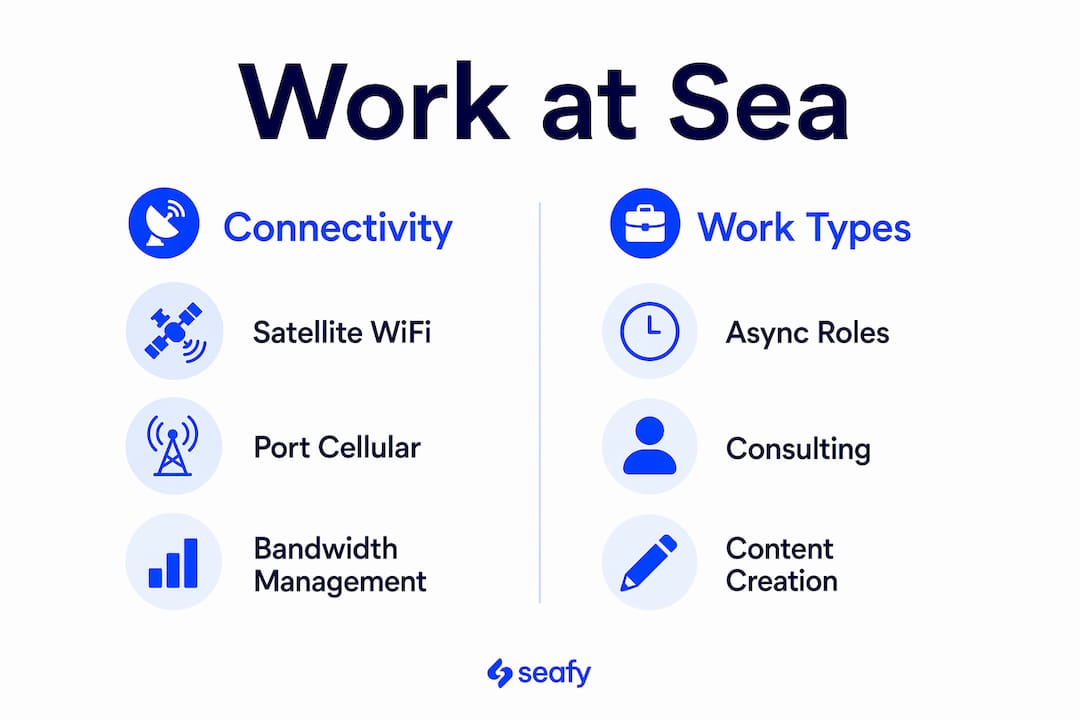
The old model of maritime internet was slow, expensive, and rationed. Passengers paid high per-megabyte fees for connections that dropped constantly. The new model, powered by satellite constellations, offers all-inclusive Wi-Fi packages that remote workers can activate before departure and rely on throughout a voyage.
That said, connectivity quality still varies by location and sea conditions. Smart remote workers plan around this reality rather than ignoring it.
- Sea days: Satellite internet is your primary connection. It handles email, async collaboration tools, document editing, and light video calls.
- Port days: Shore-based cellular data and local Wi-Fi networks provide higher bandwidth for uploads, video-heavy meetings, and large file transfers.
- Hybrid approach: Many professionals keep a local SIM card for port stops, treating it as a backup and a boost for bandwidth-intensive tasks.
Pro Tip: Schedule your most data-heavy work for port days. Use sea days for writing, planning, and async communication. This single habit removes most connectivity frustration.
What types of remote work actually fit a maritime schedule?
Not every remote role translates well to a ship or ferry. The clearest rule comes from the 60/40 async guideline: if more than 60% of your work is asynchronous, maritime remote work is a strong fit. If your role depends on back-to-back synchronous meetings, shared bandwidth on a vessel will create friction.
Roles that thrive at sea include content writing, software development, graphic design, data analysis, and consulting work that runs on deliverables rather than presence. These jobs produce output on flexible timelines and tolerate occasional connectivity gaps without consequence.
Roles that struggle include live customer support, real-time trading, and any position requiring constant video presence. These roles demand stable, high-speed connections at predictable hours, which maritime environments cannot always guarantee.
Planning your work week around the ship’s itinerary makes a measurable difference. Here is a practical framework:
- Map your itinerary before departure. Identify sea days and port days for the full voyage.
- Assign task types to each day. Reserve async tasks for sea days and bandwidth-heavy work for port days.
- Research time zones along the route. Calendar mismatches are the most common scheduling failure for maritime remote workers.
- Communicate your schedule to your team. Tell colleagues which hours you are reliably reachable and which days you may have limited access.
- Build buffer time into deadlines. Assume one disruption per week and plan accordingly.
How maritime co-living communities are changing the experience
The shift from isolated digital nomadism to intentional maritime co-living is one of the most underreported drivers of this trend. Traditional remote work isolation, the kind that comes from working alone in a rented apartment in a foreign city, is a real problem. Maritime co-living solves it through proximity and shared purpose.
On organized co-living voyages, remote workers share meals, social activities, and sometimes even coworking spaces onboard. The community forms quickly because the environment is contained and the group self-selects for similar values. People who choose to work from a ship are already curious, flexible, and open to collaboration.
This social structure also produces practical benefits. Members share knowledge about connectivity workarounds, local SIM options at each port, and cabin setup tips. The group becomes a resource, not just company.
- Shared coworking hours create accountability and reduce the isolation that derails solo remote workers.
- Organized port excursions give the group a reason to step away from screens together, which improves focus when they return.
- Peer knowledge sharing accelerates problem-solving for connectivity, time zone management, and client communication.
Pro Tip: Set clear work hours and protect them, even in a social co-living environment. The biggest risk onboard is not poor Wi-Fi. It is the temptation to socialize during your most productive hours.
Practical considerations before you commit to working at sea
Choosing the right cabin matters more than most first-timers expect. Balcony cabins provide natural light and ventilation, both of which improve focus and reduce fatigue during long work sessions. Interior cabins save money but create a windowless environment that wears on productivity over days or weeks.
Time zone management is the other underestimated challenge. A Mediterranean ferry route may cross only one or two time zones, but a longer cruise can shift your calendar by four or more hours over a voyage. Proactive time zone research before departure prevents the scheduling conflicts that damage client relationships.
Communication with your employer or clients requires more deliberate effort at sea. Building trust without face-to-face contact depends on consistent output, clear status updates, and reliable response times. Remote work at sea is less about vacation and more about demonstrating that location does not affect results.
| Factor | Sea days | Port days |
|---|---|---|
| Primary internet source | Satellite Wi-Fi onboard | Shore cellular or local Wi-Fi |
| Best task types | Async writing, coding, design | Video calls, large uploads |
| Connectivity reliability | Good, weather-dependent | High, location-dependent |
| Recommended tools | Email, Notion, Slack | Zoom, Google Drive, Loom |
The cultural shift toward results-based work is what makes all of this possible. Organizations that measure output rather than hours logged give their people the freedom to work from anywhere, including the open sea.
Key Takeaways
Remote work at sea succeeds when satellite connectivity, async-first work habits, and deliberate planning replace the assumptions built for land-based offices.
| Point | Details |
|---|---|
| Connectivity is now viable | Starlink-powered Wi-Fi on cruise ships and ferries supports real professional work. |
| Match your role to the format | Roles with over 60% async tasks fit maritime schedules far better than meeting-heavy positions. |
| Plan by sea vs. port days | Assign async tasks to sea days and bandwidth-heavy work to port days for consistent output. |
| Cabin and time zone choices matter | Balcony cabins and pre-trip time zone research prevent the two most common productivity failures. |
| Community reduces isolation | Maritime co-living groups provide accountability and peer support that solo nomadism cannot replicate. |
The sea changes how you think about work
I have watched the remote work conversation shift dramatically over the past few years. The early debate was about whether remote work was legitimate. Now the debate is about where remote work is best done. That is a meaningful upgrade.
What strikes me about maritime remote work specifically is how effectively it removes the low-grade stress that accumulates in urban environments. Removing urban stressors like commutes, noise, and social obligation clears mental space that most workers do not realize they were spending. The sea provides a clean break from that friction.
The professionals who thrive at sea are not the ones chasing novelty. They are the ones who treat it as a serious work environment that requires planning, discipline, and clear communication. The view is a bonus. The structure is the point.
Platforms like Seafy make the connectivity side of this equation much simpler. Knowing you can activate reliable Wi-Fi before you board, without negotiating with ship staff or hunting for signal, removes one more variable from an already complex setup. That reliability matters more than most people admit until they experience the alternative.
— Raffaele
Seafy keeps you connected while the sea does the rest
Remote workers need one thing above everything else: a connection they can count on. Seafy delivers exactly that across Mediterranean ferry and cruise routes, with partnerships spanning Corsica Ferries, Grimaldi Lines, and GNV.

You can purchase and activate a Wi-Fi package directly through seafy.com before you board, so your workday starts the moment you step onboard. No hunting for signal, no surprise fees, no gaps in your schedule. Seafy’s portal is built for both passengers and crew, with plans that fit a single crossing or an extended voyage. If you are serious about working remotely at sea, reliable onboard internet is not optional. Seafy makes it straightforward.
FAQ
Why is remote work at sea rising so fast?
Satellite internet services like Starlink have made onboard connectivity reliable enough for professional use, while organizations increasingly measure results over presence, giving workers the freedom to choose their location.
Is remote work at sea viable for full-time professionals?
Yes, for roles where over 60% of tasks are asynchronous. Writers, developers, designers, and analysts consistently report productive voyages when they plan their schedules around sea and port days.
What are the biggest challenges of remote work at sea?
Time zone shifts across long voyages and managing bandwidth on sea days are the two most common obstacles. Both are solvable with pre-trip planning and a clear task-scheduling system.
Do cruise ships and ferries offer reliable Wi-Fi for work?
Major operators have upgraded to satellite-based systems, including Starlink, which support video calls and cloud work. Seafy provides easy Wi-Fi activation on Mediterranean ferry routes through its onboard portal.
What cabin type works best for remote workers onboard?
Balcony cabins are the top choice. Natural light and ventilation improve focus during long work sessions, and the outdoor space provides a break from the screen without leaving your workspace.