Tech & Wi-Fi
Advantages of Digital Onboard Services for Sea Travel
Discover the advantages of digital onboard services for sea travel. Enhance connectivity, convenience, and the overall passenger experience.
24 June 2026
Advantages of Digital Onboard Services for Sea Travel
TL;DR:
- Digital onboard services enhance passenger experience through seamless Wi-Fi, integrated retail, and efficient crew onboarding systems. They improve ship operations by providing real-time monitoring, offline transactions, and virtual testing environments that reduce risks and costs. The next frontier includes AI-powered network prediction models and subscription connectivity for frequent travelers.
Digital onboard services are defined as the integrated suite of connectivity, entertainment, retail, and operational tools that run across a ferry or cruise ship to serve both passengers and crew. The advantages of digital onboard services go well beyond fast Wi-Fi. They include automatic login across decks, offline-capable retail transactions, and crew onboarding systems that cut time-to-productivity by 60%. Platforms like Seafy, operating across Mediterranean routes with partners such as Corsica Ferries, Grimaldi Lines, and GNV, are at the center of this shift. The result is a measurably better experience for every person on board.
1. Advantages of digital onboard services: seamless Wi-Fi connectivity
Consistent, friction-free internet is the foundation of every other digital service on a ship. When passengers move from the deck to the restaurant to their cabin, they expect their connection to follow. Without the right technology, that means repeated logins and dropped sessions.
AIDA Cruises deployed Wireless Broadband Alliance OpenRoaming across its 11 ships to eliminate exactly that problem. The system supports 1.5 million annual guests and handles mission-critical crew workflows without interruption. That scale proves that automatic, secure roaming is no longer a luxury feature. It is a baseline expectation.
The benefits split cleanly between passengers and crew:
- Passengers can stream video, share to social media, and access onboard services without reauthenticating between decks.
- Crew rely on the same network for safety communications, inventory updates, and operational coordination.
- Remote workers traveling on ferries can maintain video calls and file transfers throughout the crossing.
Pro Tip: When choosing a ferry route, check whether the operator uses a roaming-enabled network. A ship with OpenRoaming or equivalent technology means you will never need to log back in after visiting the buffet.
Successful seamless connectivity depends on more than bandwidth. Identity and session management are the real bottlenecks. Getting those right is what separates a frustrating onboard experience from a genuinely good one.
2. Integrated digital cabin ecosystems and their impact on operations
A connected cabin is more than a screen on the seatback. When entertainment, retail, payments, and operational data share a single platform, the entire ship runs more efficiently.
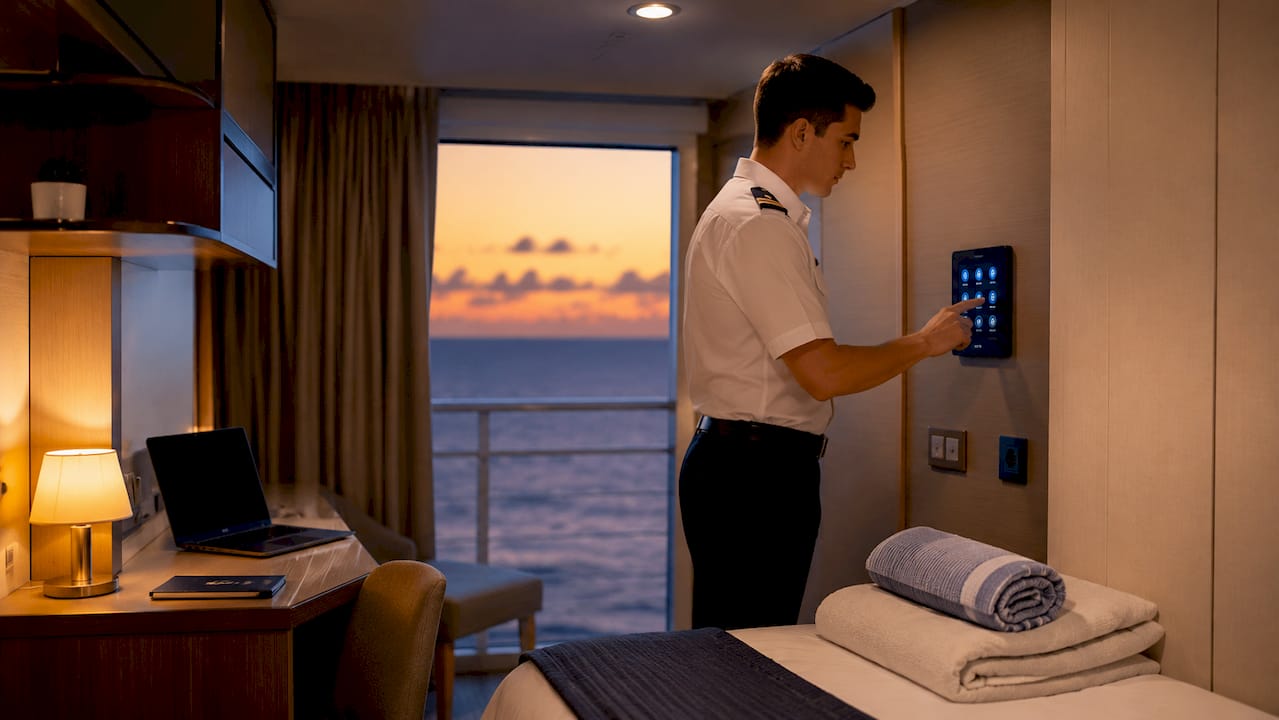
Integrated digital cabin ecosystems connect these functions and enable offline-capable transactions. A passenger can order food or purchase a Wi-Fi upgrade even when satellite bandwidth dips. The transaction completes once the connection restores. Early results from deployments show higher commercial conversion rates and fewer manual tasks for crew.
The operational gains are concrete:
- Fewer errors. Data flows automatically between systems, removing manual entry.
- Faster service. Crew spend less time on reconciliation and more time with passengers.
- Better stock accuracy. Real-time order visibility aligns inventory with actual demand, reducing waste and missed sales.
- Smarter provisioning. Operational data sharing between cabin and ship management systems can improve weight planning and fuel efficiency.
“Integrated digital cabin ecosystems reduce manual reconciliation work for crew by automatically tracking orders, payments, and inventory during the journey.” — Immfly
The efficiency of digital services in this context is not theoretical. Carriers that connect retail, payments, and operations on one platform see measurable cost savings and stronger passenger satisfaction scores.
3. How digital onboarding improves crew integration and retention
Digital onboarding systems are the structured, technology-driven processes that bring new crew members up to speed before or during their first voyage. The standard industry term is “digital onboarding,” and it covers everything from document signing to compliance training to role-specific task tracking.
Structured digital onboarding reduces time-to-productivity by 60% compared to informal processes. That is a significant operational gain on a vessel where every crew member has a defined role from day one. Poor onboarding has a direct cost. Research shows 50% of new hires plan to leave soon if their onboarding experience is poor, and replacement costs range from 50% to 200% of annual salary.
| Onboarding approach | Time-to-productivity | Compliance tracking | Consistency across vessels |
|---|---|---|---|
| Informal / paper-based | Baseline | Manual, error-prone | Low |
| Digital onboarding system | 60% faster | Automated, auditable | High |
Automated compliance tracking handles document signing, training completions, and certification renewals. Automated reminders keep crew on schedule across different jurisdictions. This matters especially in maritime, where regulatory requirements vary by flag state and route.
Pro Tip: If you manage crew operations, look for a digital onboarding platform that generates auditable trails automatically. Regulators and insurers both ask for this documentation, and manual records rarely hold up under scrutiny.
4. Operational advantages for ship management and passenger safety
Digital services do more than improve the guest experience. They give ship operators real-time visibility into systems that directly affect safety and service reliability.
AIDA Cruises validated network configurations using a digital twin environment before deploying changes to live ships. A digital twin is a virtual replica of the ship’s network. Testing changes in that environment first means problems are caught before passengers ever notice them. This approach, developed with Cisco Solution Validation Services, significantly lowers deployment risk.
Proactive monitoring adds another layer of protection. Continuous anomaly detection allows crew to resolve emerging issues before they escalate into full service outages. The difference between a brief blip and a two-hour connectivity failure often comes down to whether the team saw the warning signs in time.
Additional safety and operational benefits include:
- Location-based services for wayfinding and occupancy management across large vessels.
- Sensor integration supporting fire patrol systems and evacuation assistance.
- Centralized dashboards giving the bridge team a single view of network health, passenger load, and service status.
The role of Wi-Fi in ship operations now extends well beyond passenger convenience. It is infrastructure that operators depend on for safe, efficient voyages.
Key takeaways
Digital onboard services deliver their strongest results when connectivity, digital cabin tools, crew onboarding systems, and operational monitoring work together as one integrated platform.
| Point | Details |
|---|---|
| Seamless Wi-Fi drives satisfaction | Automatic roaming across decks removes login friction for passengers and crew alike. |
| Offline-capable retail increases revenue | Transactions complete even on low bandwidth, reducing missed sales for operators. |
| Digital crew onboarding cuts costs | Structured digital onboarding reduces time-to-productivity by 60% and lowers turnover costs. |
| Digital twins reduce deployment risk | Testing network changes virtually before going live prevents service disruptions at sea. |
| Proactive monitoring prevents outages | Anomaly detection lets crew fix issues before passengers experience any disruption. |
Why the “invisible” experience is the real goal
I have spent a lot of time watching passengers interact with onboard technology, and the pattern is consistent. When the Wi-Fi works without effort, nobody talks about it. When it fails, it becomes the only topic at the dinner table. The best digital onboard services are the ones you never notice because they never give you a reason to.
What strikes me most about the current wave of maritime digital transformation is how much of the value is operational rather than visible. The digital twin validation that AIDA Cruises uses, the offline transaction models from integrated cabin ecosystems, the automated compliance trails in crew onboarding. None of these are features passengers see. All of them directly shape the quality of the experience passengers have.
The next frontier is AIops applied to maritime networks, where predictive models flag infrastructure issues days before they surface. Subscription-based connectivity packages are also gaining ground, giving frequent travelers a reason to choose one ferry line over another. The operators who invest in the full digital stack now will have a structural advantage as those models mature.
— Raffaele
Seafy: reliable onboard internet for passengers and crew
Seafy makes it straightforward to get connected the moment you board a ferry or cruise ship across the Mediterranean.

Whether you are a passenger catching up on work, streaming a show, or a crew member staying in touch with family, Seafy has a Wi-Fi package that fits your crossing. The platform works with major ferry lines including Corsica Ferries, Grimaldi Lines, and GNV, and integrates satellite technology like Starlink for stable coverage at sea. You can purchase and activate your package directly through the onboard Wi-Fi portal at seafy.com. No complicated setup, no repeated logins. Just connect and go. ⚡
For passengers who want to understand what good internet at sea actually looks like before they board, the Seafy blog covers connectivity guides, travel tips, and onboard news for every kind of traveler.
FAQ
What are the main advantages of digital onboard services?
Digital onboard services provide seamless Wi-Fi connectivity, integrated retail and entertainment, automated crew onboarding, and real-time operational monitoring. Together, these improve passenger comfort, crew productivity, and ship management efficiency.
How does seamless Wi-Fi roaming work on a cruise ship?
Technologies like Wireless Broadband Alliance OpenRoaming authenticate passengers and crew automatically as they move between decks. AIDA Cruises uses this system across 11 ships, supporting 1.5 million annual guests without repeated logins.
Why does digital onboarding matter for maritime crew?
Structured digital onboarding reduces crew time-to-productivity by 60% and automates compliance tracking across jurisdictions. Poor onboarding drives turnover, and replacement costs can reach up to 200% of an employee’s annual salary.
Can onboard digital services work without a constant internet connection?
Yes. Offline-capable transaction models allow passengers to purchase services and content even when bandwidth is limited. Transactions sync and complete automatically once the connection is restored.
How does Seafy support passengers on Mediterranean ferries?
Seafy offers Wi-Fi packages that passengers purchase and activate directly through the onboard portal at seafy.com. The platform partners with Corsica Ferries, Grimaldi Lines, and GNV, and uses satellite technology including Starlink for reliable coverage at sea.