Tech & Wi-Fi
The Role of Connectivity in Modern Cruising
Discover the vital role of connectivity in modern cruising. Explore how seamless internet access transforms your onboard experience and enhances enjoyment.
07 July 2026
The Role of Connectivity in Modern Cruising
TL;DR:
- Connectivity is essential for the modern cruise experience, supporting automated services, operational safety, and passenger lifestyles. Modern hybrid satellite networks and upgraded ship infrastructure deliver high-speed, low-latency internet across global routes, especially on newbuild ships. Seafy simplifies onboard Wi-Fi access, enabling passengers to stay connected from port to port.
Connectivity is the backbone of the modern cruise experience, delivering reliable internet access and integrated digital services that shape everything from how you board to how you spend your evenings at sea. The role of connectivity in modern cruising extends far beyond checking email. It powers automated guest services, real-time navigation, crew communication, and onboard entertainment. Up to 85% of standard passenger questions and tasks on tech-enabled ships are now handled through automated self-service systems. That number tells you how deeply digital infrastructure has embedded itself into daily life at sea. Seafy is one platform making this connectivity real and accessible for passengers across the Mediterranean and beyond.
What technologies enable modern cruise connectivity?
The gap between old and new cruise internet is structural, not cosmetic. Legacy VSAT systems deliver download speeds under 5 Mbps with latency around 800 ms. Modern multi-provider hybrid architectures achieve symmetrical 1 Gbps throughput with latency below 50 ms. That difference is the gap between a frustrating video call and a smooth one.

Modern ships layer three satellite types to achieve this performance. LEO (Low Earth Orbit) satellites, including Starlink-ready systems, deliver low latency because they orbit close to Earth. MEO (Medium Earth Orbit) satellites provide geographic redundancy and consistent regional coverage that LEO alone cannot guarantee. GEO (Geostationary) satellites fill coverage gaps in remote ocean zones. Together, these three layers form a resilient connectivity fabric that keeps the ship online regardless of location.
Hardware alone does not guarantee good Wi-Fi. Upgrading internal ship networks to modern IP backbones with adequate access point density is a prerequisite for realizing the benefits of high-throughput satellite links. Skipping this step means passengers experience poor performance even when the ship has advanced satellite hardware installed.
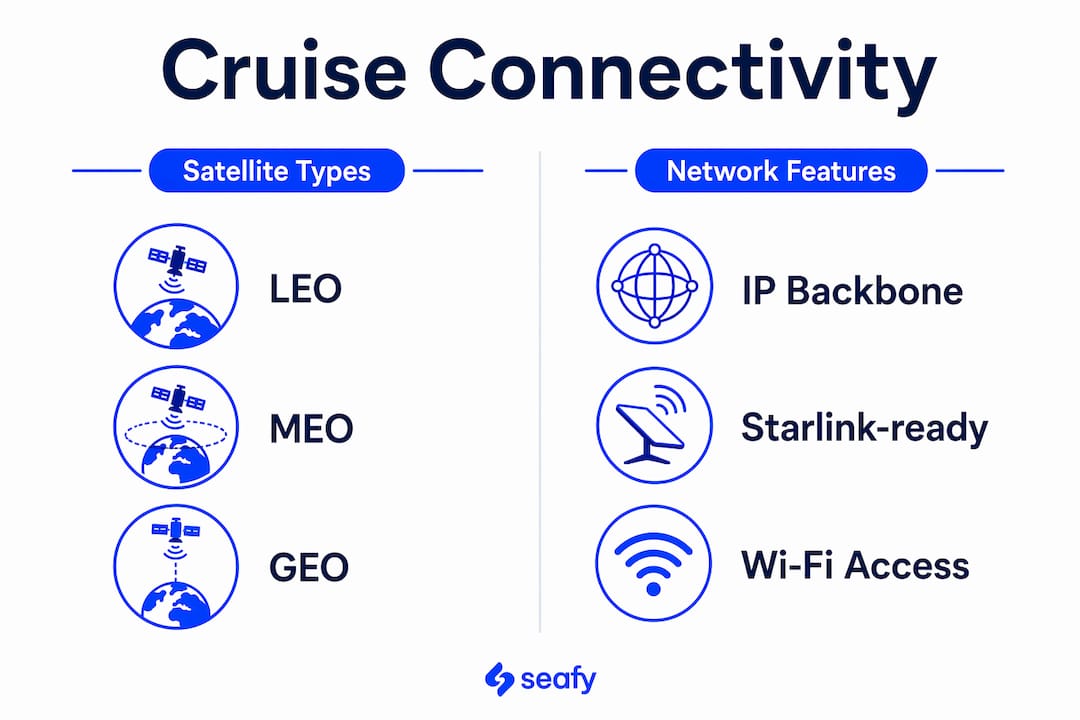
Newbuild ships commissioned in 2025 and 2026 typically launch Starlink-ready from the keel up, targeting 10 Gbps symmetrical throughput and latency below 99 ms. Older ships retrofitted with LEO hardware often fall short of that benchmark because the internal network was not built to match.
Pro Tip: Before booking, check whether your ship is a recent newbuild or an older vessel with retrofitted hardware. Ship age and network upgrade status predict your Wi-Fi experience more accurately than marketing claims.
How does connectivity enhance the passenger experience?
Connectivity turns a cruise ship into a responsive, personalized environment. The impact of technology on cruising is visible in every touchpoint, from wearable devices that unlock your cabin door to AI-managed crowd flow that reduces wait times at restaurants.
Here is how connectivity directly improves your time onboard:
- Self-service automation. Up to 85% of passenger questions and administrative tasks are handled digitally, so you spend less time at the guest services desk and more time enjoying the ship.
- Wearable tech and IoT. Devices linked to the ship’s network enable touchless room entry, real-time food and beverage delivery, and location-based service alerts.
- Streaming and video calls. Low-latency, high-speed Wi-Fi makes video conferencing and HD streaming reliable, not just possible.
- Social sharing. Passengers can post photos and videos in real time, keeping friends and family connected to the voyage as it happens.
- Pre-voyage digital engagement. 50% of onboard revenue is prebooked digitally before passengers embark. That means connectivity shapes the guest experience before the ship even leaves port.
Seafy supports this connected experience by giving passengers a straightforward way to purchase and activate Wi-Fi packages through the seafy.com portal. Whether you want to stream a movie or join a work call, the platform is built to make getting online simple. You can read more about what shapes your connection quality at sea before you sail.
What operational benefits does connectivity provide for cruise lines?
Connectivity is not only a passenger amenity. It is the infrastructure that keeps a ship running safely and efficiently. Cruise lines that treat internet access as core infrastructure, rather than an optional add-on, gain measurable advantages in safety, crew retention, and operational performance.
Key operational benefits include:
- Real-time analytics. Cloud platforms and onboard sensors feed live data to operations teams, enabling faster decisions on fuel use, maintenance scheduling, and crowd management.
- Crew communication. AIDA Cruises implemented OpenRoaming technology across its fleet, giving crew and passengers seamless Wi-Fi that moves with them deck-to-deck without dropped connections or repeated logins. That standard exceeds many land-based networks.
- Safety system integration. Navigation data, weather feeds, and emergency communication systems all depend on low-latency connectivity to function reliably.
- MEO satellite coverage. MEO satellites provide the geographic redundancy needed for operational continuity on global itineraries where LEO coverage alone is inconsistent.
Seafy’s platform supports both passenger and crew needs, providing the kind of stable maritime internet that makes these operational functions possible. The role of Wi-Fi in ship operations goes well beyond leisure browsing.
Pro Tip: If you are traveling as crew or a remote worker, ask whether the ship uses OpenRoaming or a similar technology. It signals a network built for reliability, not just passenger marketing.
How has connectivity changed who cruises and why?
The benefits of connectivity at sea have reshaped the passenger profile. Cruise ships now attract remote workers, digital nomads, and younger travelers who would not have considered a cruise before reliable internet became available onboard.
- Remote work at sea is now viable. Stable video conferencing and cloud access mean professionals can maintain full work schedules during longer itineraries without sacrificing productivity.
- Longer voyages attract new demographics. When you can work from the ship, a two-week Mediterranean crossing becomes a practical option, not just a luxury.
- Younger passengers engage differently. Gen Z and millennial travelers expect to share their experience in real time. High-speed Wi-Fi is not a bonus for them. It is a baseline expectation.
- Digital lifestyles continue uninterrupted. Streaming playlists, staying in group chats, and managing personal finances at sea are now normal behaviors, not exceptions.
Cruise ships have transformed from paper-based, disconnected vacations into data-driven ecosystems powered by cloud computing, IoT, and AI-managed systems. That shift is not a trend. It is a permanent change in what passengers expect and what cruise lines must deliver.
Key Takeaways
Reliable, high-speed connectivity is the foundation of the modern cruise experience, enabling automated services, operational safety, and the digital lifestyles passengers now expect as standard.
| Point | Details |
|---|---|
| Technology gap is structural | Modern hybrid satellite systems deliver 1 Gbps at under 50 ms latency, versus under 5 Mbps on legacy VSAT. |
| Ship age predicts Wi-Fi quality | Newbuilds launched in 2025–2026 are Starlink-ready; retrofitted older ships often underperform despite hardware upgrades. |
| Automation reshapes guest services | Up to 85% of passenger tasks are handled digitally, reducing friction and improving satisfaction. |
| Connectivity drives revenue before boarding | 50% of onboard revenue is prebooked digitally, proving connectivity shapes the guest experience before sailing. |
| Operations depend on connectivity too | Real-time analytics, crew communication, and safety systems all require stable, low-latency internet to function. |
Why connectivity is the unseen cornerstone of cruising
I have spent years watching the cruise industry treat Wi-Fi as a perk, something to advertise in the brochure and then quietly disappoint passengers with once they are at sea. That mindset is fading, but not fast enough.
What strikes me most is that the passengers who complain about bad onboard internet are rarely complaining about speed. They are complaining about broken digital services: the app that will not load, the room key that will not sync, the dinner reservation that failed to process. All of those failures trace back to the same root cause. The ship’s internal network was not built to support the services running on top of it.
The cruise lines getting this right are the ones that treat connectivity as infrastructure first and a passenger amenity second. They sequence their upgrades correctly: internal IP backbone, then access point density, then satellite hardware. The ones that do it backwards spend a lot of money on Starlink and still get one-star Wi-Fi reviews.
My advice to you as a passenger: look at the ship’s build year and ask whether it has had a network retrofit. That single question will tell you more about your internet experience than any marketing page. And if you are sailing on a route served by Seafy, you already have a reliable starting point.
— Raffaele
Seafy keeps you connected from port to port
Reliable internet at sea should not be something you hope for. It should be something you plan for.

Seafy makes onboard connectivity straightforward for cruise and ferry passengers across the Mediterranean. Through the seafy.com portal, you can purchase and activate a Wi-Fi package directly onboard, with no complicated setup. Whether you are streaming, video calling, or catching up on work, Seafy’s platform is built around real passenger needs. Partners include Corsica Ferries, Grimaldi Lines, and GNV, so coverage spans major Mediterranean routes. Check out the satellite internet options at sea to understand what powers your connection before you sail.
FAQ
What is the role of connectivity in modern cruising?
Connectivity delivers the internet access and digital infrastructure that powers automated guest services, onboard entertainment, crew communication, and real-time ship operations. Without it, the modern cruise experience as passengers expect it cannot function.
Why does Wi-Fi quality vary so much between cruise ships?
Wi-Fi quality depends on the ship’s build year, internal network architecture, and satellite technology. Newbuilds launched in 2025–2026 are Starlink-ready with IP backbone networks, while older retrofitted ships often underperform despite newer satellite hardware.
How does connectivity improve safety on cruise ships?
Low-latency connectivity supports real-time navigation data, weather monitoring, and emergency communication systems. MEO satellite networks provide the geographic redundancy needed to keep these systems online across global itineraries.
Can I work remotely from a cruise ship in 2026?
Yes. Modern ships with hybrid satellite architectures deliver stable video conferencing and cloud access, making remote work viable for professionals on longer itineraries. Ship age and network quality remain the key variables to check before booking.
How does Seafy help passengers stay connected at sea?
Seafy provides an easy-to-use portal where passengers on partner ferry and cruise routes can purchase and activate Wi-Fi packages directly onboard, covering use cases from streaming to remote work across Mediterranean routes. ⚡