Tech & Wi-Fi
Role of Satellite Internet at Sea – Enhancing Onboard Life
Role of satellite internet at sea covers technology types, how connectivity works, practical benefits for passengers and crew, costs, and key challenges.
07 February 2026
Role of Satellite Internet at Sea – Enhancing Onboard Life
Losing signal mid-video call or waiting forever for a webpage to load can quickly spoil both your Mediterranean adventure and your remote work productivity. For European cruise and ferry passengers, access to seamless satellite internet at sea is no longer a luxury but a necessity. As satellite networks now stretch effortlessly across open waters, this article reveals how cutting-edge maritime connectivity lets you stream, work, and stay connected from ship to shore—no matter which port your journey takes you next.
Table of Contents
- Satellite Internet At Sea Defined
- Types Of Maritime Satellite Connectivity
- How Shipboard Connectivity Systems Work
- Passenger And Crew Benefits Of Internet
- Practical Costs And Limitations
- Challenges And Alternatives To Sea Connectivity
Key Takeaways
| Point | Details |
|---|---|
| Importance of Satellite Internet | Maritime satellite internet provides crucial connectivity for ships, enhancing communication and bridging isolation while at sea. |
| Types of Connectivity | Various systems like MSS, VSAT, and HTS offer different capabilities, catering to specific maritime needs and applications. |
| Challenges in Adoption | High costs, signal reliability, and regulatory barriers pose significant challenges for implementing maritime satellite internet solutions. |
| Future Directions | Innovations such as LEO satellites and hybrid networks are emerging to improve service quality and address existing limitations in maritime connectivity. |
Satellite Internet at Sea Defined
Satellite internet at sea represents a groundbreaking communication technology that enables continuous, high-speed internet connectivity for maritime travelers and professionals across remote oceanic regions. Unlike traditional terrestrial networks, these advanced satellite systems create a robust digital lifeline for ships traversing vast maritime expanses. Comprehensive satellite internet networks operate through an intricate array of orbital satellites designed to provide seamless broadband communication worldwide.
The core mechanism of maritime satellite internet involves specialized satellites positioned in strategic orbital planes, transmitting and receiving signals between ships and ground stations. These systems utilize multiple frequency bands and employ two primary satellite configurations:
- Geostationary Satellites: Fixed above a specific geographic point, providing consistent coverage
- Non-Geostationary Satellites: Moving across different orbital paths, enabling more dynamic connectivity
- Low Earth Orbit (LEO) Systems: Offering lower latency and faster data transmission
Maritime satellite internet serves multiple critical functions beyond basic web browsing. Advanced communication systems enable crew members to maintain contact with families, access operational data, stream entertainment, and support essential professional communications. These networks have transformed onboard experiences, bridging isolation and providing digital connectivity in previously unreachable maritime environments.
The technology involves sophisticated signal processing, where satellite transponders receive signals from ship-based terminals, relay information through complex orbital networks, and retransmit data across global distances. Modern systems can achieve download speeds ranging from 2-50 Mbps, depending on satellite technology, vessel location, and atmospheric conditions.
Satellite internet at sea is not just a connectivity solution - it’s a digital lifeline connecting maritime professionals and travelers with the global communication ecosystem.
Pro tip: When selecting a maritime satellite internet service, prioritize providers offering consistent coverage, multiple frequency bands, and flexible data packages tailored to your specific maritime communication needs.
Types of Maritime Satellite Connectivity
Maritime satellite connectivity encompasses several sophisticated communication technologies designed to provide internet and communication services across oceanic environments. Maritime satellite services are categorized into distinct types based on frequency bands, orbital configurations, and transmission capabilities, each serving unique maritime communication requirements.
The primary types of maritime satellite connectivity include:
-
Mobile Satellite Services (MSS):
- Operate primarily in L-band frequencies
- Specialize in voice communications and low-rate data transmission
- Ideal for emergency communications and basic maritime operations
-
Very Small Aperture Terminal (VSAT) Services:
- Utilize Ku-band frequencies
- Provide traditional maritime broadband connectivity
- Support higher data rates compared to MSS
-
High Throughput Satellite (HTS) Systems:
- Leverage advanced Ka-band frequencies
- Offer increased bandwidth and lower latency
- Enable high-speed internet and multimedia streaming
Satellite systems are further distinguished by their orbital configurations, each presenting unique advantages for maritime communication. Geostationary (GEO) satellites remain fixed above a specific geographic point, providing consistent coverage. Medium Earth Orbit (MEO) and Low Earth Orbit (LEO) satellite constellations offer dynamic connectivity with reduced signal latency, making them increasingly attractive for maritime internet services.
Maritime satellite connectivity is not just about internet access - it’s about creating a lifeline of communication for vessels traversing the world’s most isolated regions.
Modern maritime satellite networks integrate multiple frequency bands and orbital systems to ensure robust, reliable communication. Advanced hybrid systems combine different satellite technologies, enabling seamless switching between networks to maintain continuous connectivity across varying maritime environments.
Here’s a comparison of major types of maritime satellite internet systems and their ideal uses:
| System Type | Typical Speed Range | Latency Level | Best Use Case |
|---|---|---|---|
| MSS (L-band) | Up to 0.6 Mbps | High | Emergency calls, basic messaging |
| VSAT (Ku-band) | 2–10 Mbps | Moderate | Crew internet, business use |
| HTS (Ka-band) | 10–50 Mbps | Lower | Streaming, high-bandwidth tasks |
| LEO Constellations | 50+ Mbps | Very Low | Real-time apps, video conferencing |
Pro tip: When evaluating maritime satellite connectivity options, consider the specific communication needs of your vessel, comparing bandwidth, latency, and coverage across different satellite service types.
How Shipboard Connectivity Systems Work
Shipboard connectivity systems represent complex technological ecosystems designed to provide seamless internet and communication services across maritime environments. These advanced networks integrate multiple satellite technologies, creating robust communication infrastructures that support everything from operational management to crew welfare.
The core components of modern shipboard connectivity systems include:
-
Satellite Network Integration:
- Combines multiple satellite networks
- Includes Geostationary (GEO) and Low Earth Orbit (LEO) constellations
- Enables continuous and redundant communication channels
-
Hardware Components:
- Specialized stabilized maritime antennas
- Advanced network routing equipment
- Cybersecurity protection systems
-
Connectivity Management:
- Real-time network switching capabilities
- Automatic signal optimization
- Backup communication protocols
Maritime satellite technologies leverage sophisticated signal processing techniques to maintain consistent internet connectivity. The onboard systems use advanced antenna technologies that can track and maintain satellite links while vessels are in constant motion, compensating for ship movements and environmental challenges.
Shipboard connectivity is more than internet access - it’s a lifeline connecting vessels to global communication networks, enabling safety, efficiency, and human connection.
Cybersecurity plays a critical role in these systems, with multilayered protection mechanisms designed to secure data transmission and prevent unauthorized access. Modern shipboard networks implement encryption protocols, firewall technologies, and continuous monitoring to ensure the integrity and safety of communication channels.
Pro tip: When selecting a maritime connectivity solution, prioritize systems offering multiple satellite network integrations and robust cybersecurity features to ensure reliable and secure communication.
Passenger and Crew Benefits of Internet
Maritime internet access has revolutionized the onboard experience for both passengers and crew members, transforming isolated maritime journeys into connected, engaging environments. Modern satellite internet systems provide far more than simple communication - they deliver comprehensive digital experiences that address psychological, professional, and personal needs of individuals spending extended periods at sea.
The key benefits of onboard internet connectivity include:
-
Personal Connection Benefits:
- Instant communication with family and friends
- Video calls across continents
- Social media and messaging platform access
- Reduction of psychological isolation
-
Professional Development Opportunities:
- Remote work capabilities
- Online training and certification courses
- Professional networking
- Real-time information exchange
-
Entertainment and Learning:
- Streaming music and video services
- Educational content access
- Digital library resources
- Interactive online platforms
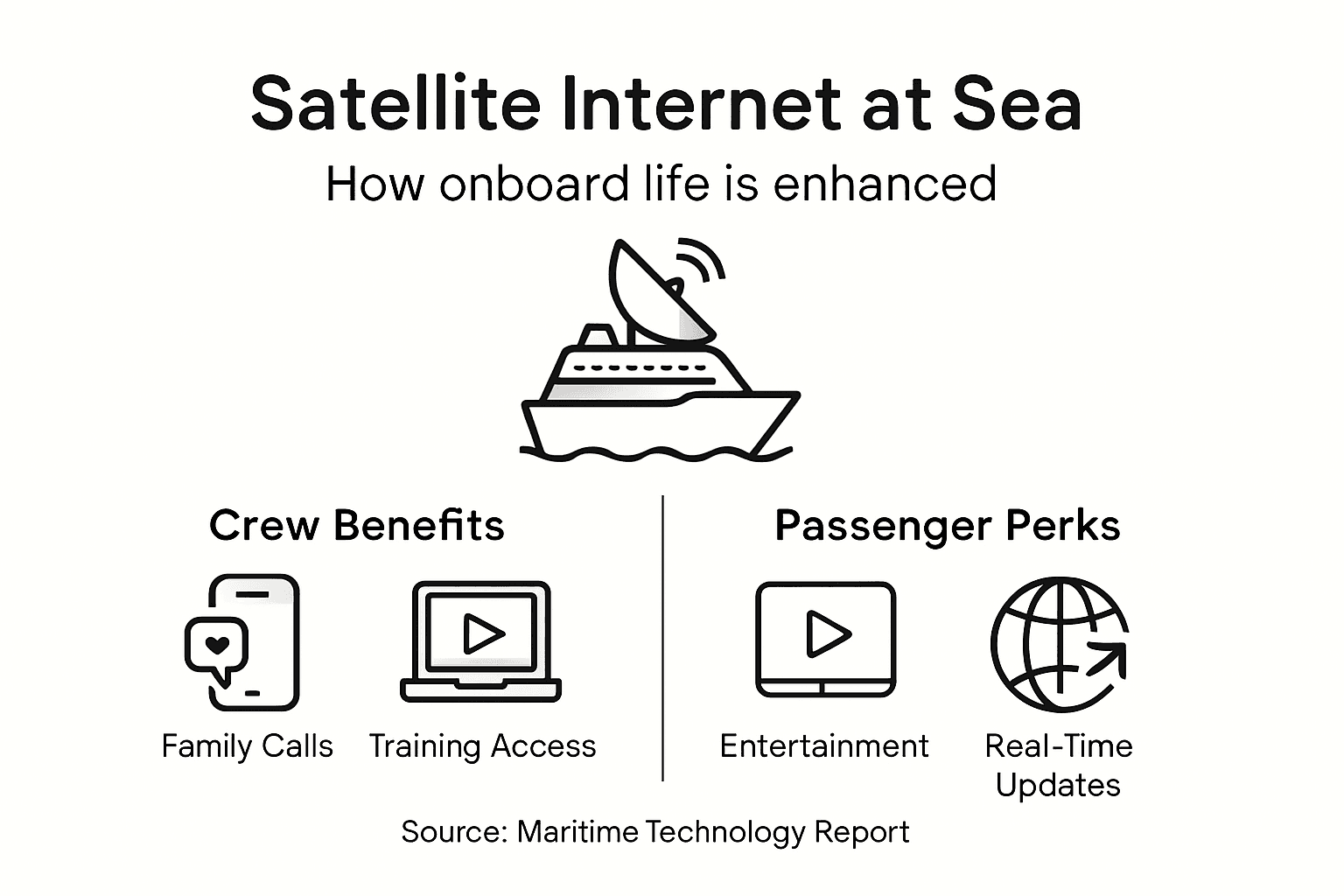
For crew members specifically, internet connectivity represents a critical tool for mental health and professional growth. The ability to maintain social connections, pursue ongoing education, and stay informed about global developments significantly improves job satisfaction and personal well-being.
Onboard internet is no longer a luxury - it’s an essential service that supports human connection, professional development, and personal happiness.
Passengers benefit equally from robust internet services, transforming maritime travel from a potentially monotonous experience into an opportunity for continuous engagement, learning, and entertainment. Travelers can now work remotely, stream their favorite content, maintain family connections, and explore digital resources while enjoying their maritime journey.

Pro tip: Select maritime internet packages that offer flexible data plans and multiple device support to maximize your connectivity experience during sea travel.
Practical Costs and Limitations
Maritime satellite internet systems present complex economic and technical challenges that impact their widespread adoption and functionality. The infrastructure required for seamless maritime connectivity involves substantial investments in specialized equipment, ongoing service maintenance, and sophisticated technological solutions that significantly influence operational expenses.
The primary cost and limitation factors include:
-
Equipment Expenses:
- Specialized stabilized satellite dishes
- Advanced marine-grade network hardware
- Complex signal processing equipment
- Robust cybersecurity infrastructure
-
Service Limitations:
- Bandwidth restrictions
- Higher per-gigabyte data costs
- Inconsistent signal reliability
- Weather-dependent performance
-
Technical Performance Constraints:
- Higher signal latency compared to terrestrial networks
- Potential connection interruptions
- Limited bandwidth in remote oceanic regions
- Signal interference from environmental factors
Satellite internet providers encounter significant regulatory and technical obstacles in delivering consistent maritime connectivity. The complex licensing environments, expensive deployment costs, and technical challenges of maintaining stable signals across vast oceanic distances create substantial barriers to seamless internet access.
Maritime satellite internet represents a delicate balance between technological innovation and practical limitations, requiring continuous investment and technological refinement.
Navigating these limitations requires understanding the nuanced trade-offs between connectivity quality, cost, and technical feasibility. While modern satellite technologies continue to improve, maritime internet remains a sophisticated and evolving technological ecosystem with inherent challenges that demand ongoing innovation and strategic investment.
Pro tip: Compare multiple satellite service providers, focusing on their maritime-specific packages and understanding the detailed performance metrics before committing to a long-term connectivity solution.
Challenges and Alternatives to Sea Connectivity
Maritime connectivity solutions face complex challenges that demand innovative approaches to overcome technological and infrastructural limitations. The maritime communication landscape requires a multifaceted strategy addressing technical, regulatory, and economic barriers to ensure reliable internet access across diverse oceanic environments.
Key challenges and emerging alternatives include:
-
Technical Connectivity Challenges:
- Geographic coverage gaps
- High signal latency
- Inconsistent service quality
- Expensive infrastructure deployment
-
Alternative Connectivity Solutions:
- Hybrid satellite-terrestrial networks
- Cellular network integration
- Airborne communication platforms
- Edge computing technologies
-
Emerging Technological Approaches:
- Low Earth Orbit (LEO) satellite networks
- Advanced network management systems
- Mobile signal repeater technologies
- Adaptive bandwidth allocation
Seafarer connectivity challenges extend beyond technical limitations, encompassing cybersecurity risks and complex regulatory environments. Innovative solutions focus on creating adaptive, resilient communication ecosystems that can dynamically respond to changing maritime connectivity requirements.
Maritime connectivity is not just about technology - it’s about bridging human experiences across vast, isolated oceanic distances.
The future of sea connectivity relies on integrated, flexible approaches that combine multiple communication technologies. By leveraging hybrid networks, advanced signal processing, and intelligent routing mechanisms, maritime communication systems can progressively overcome current limitations and deliver more reliable, cost-effective internet access.
The following table highlights the main challenges of maritime internet and how emerging alternatives address them:
| Main Challenge | Impact at Sea | Alternative Approach | Resulting Benefit |
|---|---|---|---|
| Coverage gaps | Service blackouts | Hybrid satellite-terrestrial | Nearly global uptime |
| High latency | Slow data transfer | LEO satellites | Faster connections |
| High costs | Budget constraints | Edge computing, new providers | Better affordability |
| Cyber risks | Data theft potential | Advanced encryption systems | Improved vessel security |
Pro tip: Evaluate maritime connectivity solutions by assessing their multi-network capabilities, signal redundancy features, and adaptive technological frameworks.
Experience Reliable Satellite Internet at Sea with Seafy
The article highlights the challenges and importance of seamless satellite internet connectivity for passengers and crew on maritime journeys. The struggle with coverage gaps, high latency, and inconsistent connections can impact onboard life, making it difficult to stay connected with family, work remotely, or enjoy entertainment. Seafaring professionals and travelers deserve a stable, high-speed internet solution that truly enhances their experience while navigating remote oceanic routes.
Seafy understands these pain points and offers a powerful digital platform focused on providing reliable onboard Wi-Fi, primarily across ferry and cruise lines in the Mediterranean. By partnering with leading ferry operators and integrating advanced satellite technologies like Starlink, Seafy solves common issues such as signal instability and data limitations. This means uninterrupted communication, streaming, and work capabilities for everyone onboard. Learn more about how maritime satellite internet transforms journeys by visiting the Seafy homepage.
Ready to elevate your connectivity at sea and enjoy the benefits of real-time communication, entertainment, and professional work? Explore Seafy’s easy-to-use Wi-Fi packages and onboard services today at Seafy. Stay connected, wherever the sea takes you.
Frequently Asked Questions
What is satellite internet at sea?
Satellite internet at sea is a communication technology that provides high-speed internet connectivity for maritime travelers and professionals, enabling them to maintain communication while traversing remote oceanic regions.
How do maritime satellite connectivity systems work?
Maritime satellite connectivity systems use an array of satellites that transmit signals between ships and ground stations. This involves specialized hardware, such as stabilized antennas and routing equipment, to maintain a connection while the vessel is in motion.
What types of maritime satellite internet services are available?
There are several types of maritime satellite internet services, including Mobile Satellite Services (MSS), Very Small Aperture Terminal (VSAT) services, and High Throughput Satellite (HTS) systems, each offering different capabilities, bandwidths, and latency levels.
What are the benefits of having satellite internet on board?
Satellite internet enhances onboard life by allowing crew members and passengers to connect with family and friends, access entertainment and educational content, and support remote work capabilities, ultimately improving mental well-being and job satisfaction.