Tech & Wi-Fi
Internet Speeds at Sea – What Impacts Your Connection
Internet speeds at sea explained: how maritime Wi-Fi works, factors impacting speed, satellite technology, and real-world tips for cruise travelers.
17 January 2026
Internet Speeds at Sea – What Impacts Your Connection
Staying connected while sailing the beautiful waters of the Mediterranean brings its own set of challenges for cruise ship passengers and remote workers. Unlike stable land connections, maritime networks must adapt to constant vessel motion, shifting satellite positions, and unpredictable weather. While internet speeds at sea are often much lower and more unstable than those found on land, advancements in satellite technology are making reliable connectivity more accessible. This guide breaks down the core factors impacting high-speed internet onboard, so you can plan work or entertainment with confidence during your voyage.
Table of Contents
- Defining Internet Speeds At Sea Today
- Types Of Maritime Connectivity Solutions
- How Satellite Internet Functions Onboard
- Factors That Affect Online Speeds At Sea
- Comparing Maritime And Land-Based Internet
Key Takeaways
| Point | Details |
|---|---|
| Maritime Internet Performance | Internet speeds at sea are typically lower than land-based connections, with bandwidth ranging from 2-20 Mbps and latency between 500-700 milliseconds. |
| Connectivity Solutions | Various maritime connectivity solutions exist, including Shore-based WiFi, Cellular Data Networks, Marine WiFi Systems, and Satellite Internet, each with its own advantages and limitations. |
| Technology Complexity | Onboard satellite internet uses advanced tracking and signal technology to maintain connectivity, continuously adapting to vessel movement and environmental challenges. |
| Expectation Management | Users should download critical content before departure to manage potential connectivity issues while at sea. |
Defining Internet Speeds at Sea Today
Internet speeds at sea represent a complex technological challenge distinct from traditional terrestrial connectivity. Maritime networks operate under unique constraints that dramatically impact connection quality and performance. Unlike stable land-based internet, seafaring connections must contend with constant environmental variables like vessel movement, satellite positioning, and signal interference.
Current maritime internet technologies primarily rely on satellite connectivity, which has evolved significantly in recent years. Maritime network performance research indicates that broadband services at sea consistently demonstrate lower bandwidth and more unstable connections compared to land-based networks. These limitations stem from several technical challenges, including dynamic link quality, limited transmission capacity, and the inherent complexity of maintaining consistent satellite communication while in motion.
The fundamental characteristics of maritime internet speeds can be broken down into key technical dimensions:
- Bandwidth Capacity: Typically ranges from 2-20 Mbps
- Latency: Usually between 500-700 milliseconds
- Signal Stability: Highly variable depending on satellite coverage
- Connection Technology: Primarily satellite-based with emerging hybrid systems
Understanding these technical parameters helps travelers and maritime professionals set realistic expectations about internet performance while at sea. Satellite internet technologies continue to advance, promising more reliable and faster connections in the coming years.
Pro Tip: When planning internet-dependent work or entertainment at sea, always download critical files and content before departure to minimize reliance on potentially unstable maritime connections.
Types of Maritime Connectivity Solutions
Maritime connectivity has evolved dramatically, offering multiple technological solutions to address the complex communication challenges faced at sea. Maritime communication technologies have developed sophisticated approaches that enable vessels to maintain reliable internet connections across diverse environments and geographic locations.
The primary maritime connectivity solutions can be categorized into four distinct types:
- Shore-based WiFi: Functional within coastal regions, providing high-speed internet when close to land
- Cellular Data Networks: Leveraging mobile networks for connectivity near coastal areas
- Marine WiFi Systems: Specialized onboard wireless networks designed for maritime environments
- Satellite Internet: Comprehensive coverage for open ocean regions using advanced satellite technologies
Satellite internet remains the most robust solution for extended maritime journeys, particularly for vessels traveling significant distances from coastlines. Marine satellite internet options vary significantly based on satellite orbit type, coverage area, and transmission capabilities. Modern maritime communication systems increasingly integrate multiple connectivity methods, creating hybrid networks that optimize internet performance across different geographic zones.
Each connectivity solution presents unique advantages and limitations. Shore-based and cellular networks offer higher bandwidth but limited range, while satellite systems provide extensive coverage at the cost of higher latency and potentially lower data transmission speeds. Advanced maritime communication technologies are continuously improving, with emerging 5G and software-defined networking technologies promising more reliable and faster connections in the future.
Here’s a summary of internet connectivity methods and their practical use for maritime travelers:
| Connectivity Method | Typical Usage Scenario | Coverage Area | Main Limitation |
|---|---|---|---|
| Shore-based WiFi | Docked or coastal zones | Near harbors | Short range only |
| Cellular Data Networks | Near land and coast | Coastal regions | Fades far from shore |
| Marine WiFi Systems | Onboard ship networks | On the vessel | Limited by ship hardware |
| Satellite Internet | Open ocean travel | Global coverage | Higher latency, cost |
Pro Tip: When selecting a maritime internet solution, carefully assess your specific travel routes, expected bandwidth requirements, and budget to choose the most appropriate connectivity strategy.
How Satellite Internet Functions Onboard
Satellite internet onboard represents a sophisticated technological solution that enables continuous connectivity for maritime vessels traversing vast oceanic distances. Satellite internet architecture involves complex communication systems that maintain reliable internet access through specialized marine equipment and advanced tracking technologies.
The core components of onboard satellite internet include:
- Satellite Antenna: Specialized marine-grade dish designed to maintain signal stability
- Marine Modem: Ruggedized communication device adapted for maritime environments
- Signal Tracking System: Advanced positioning technology that continuously adjusts to satellite movements
- Transmission Equipment: Hardware enabling data transmission between vessel and satellite network
Marine satellite internet systems operate through three primary satellite orbit types: Geostationary (GEO), Medium Earth Orbit (MEO), and Low Earth Orbit (LEO). Each orbit type presents distinct performance characteristics, with LEO satellites offering lower latency and higher data transmission speeds compared to traditional geostationary satellites. The onboard system continuously tracks and switches between satellite networks to maintain optimal connectivity, compensating for the vessel’s constant motion and changing geographic positions.
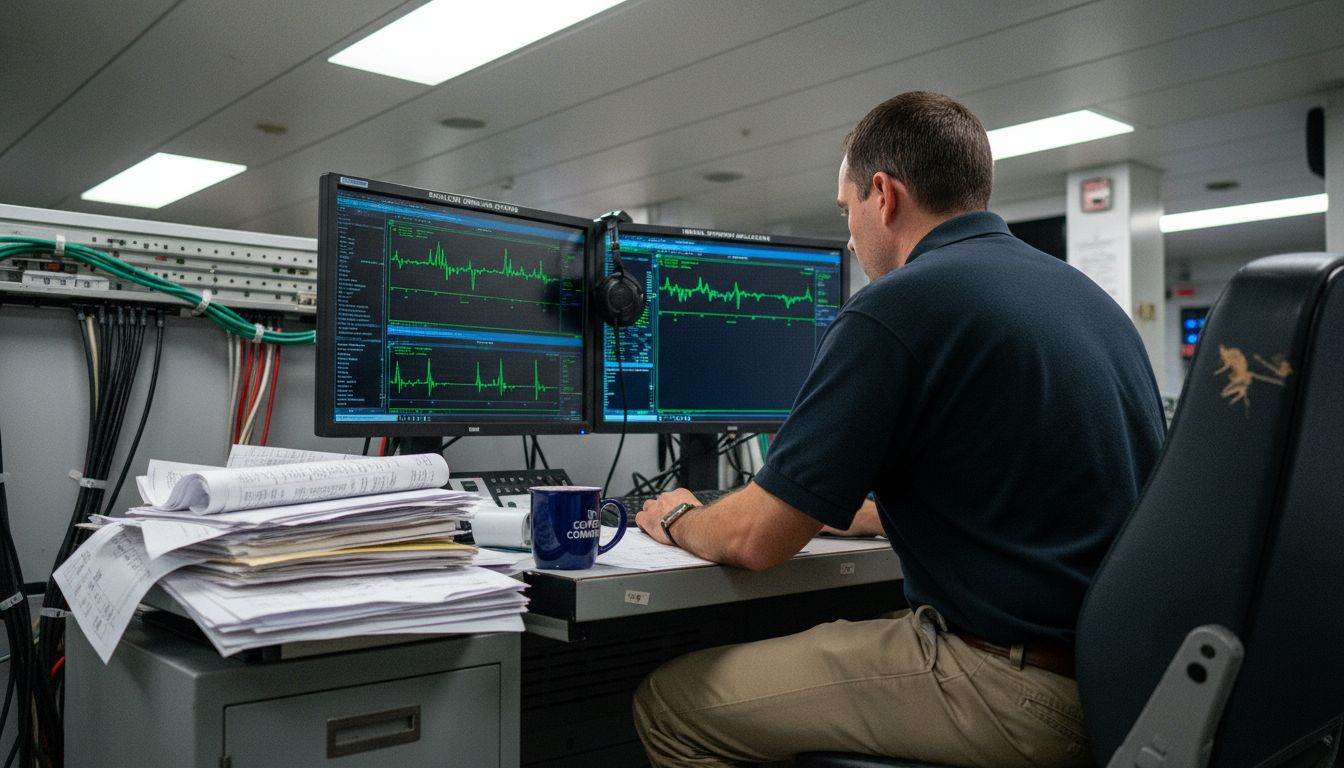
The technical complexity of maritime satellite internet involves continuous signal acquisition, tracking, and handoff processes. Specialized marine antennas automatically adjust their positioning to maintain a consistent connection, overcoming challenges like vessel movement, atmospheric interference, and geographic obstacles. Service providers have developed sophisticated algorithms that optimize signal strength and data transmission, ensuring travelers and maritime professionals can access reliable internet even thousands of miles from coastal regions.
Pro Tip: Invest in marine-grade satellite internet equipment with multiple network compatibility to ensure the most reliable connectivity across different maritime environments.
Factors That Affect Online Speeds at Sea
Online connectivity at sea represents a complex technological challenge with multiple interdependent variables impacting internet performance. Maritime networking dynamics reveal a sophisticated interaction between technological infrastructure and environmental conditions that dramatically influence internet speeds.
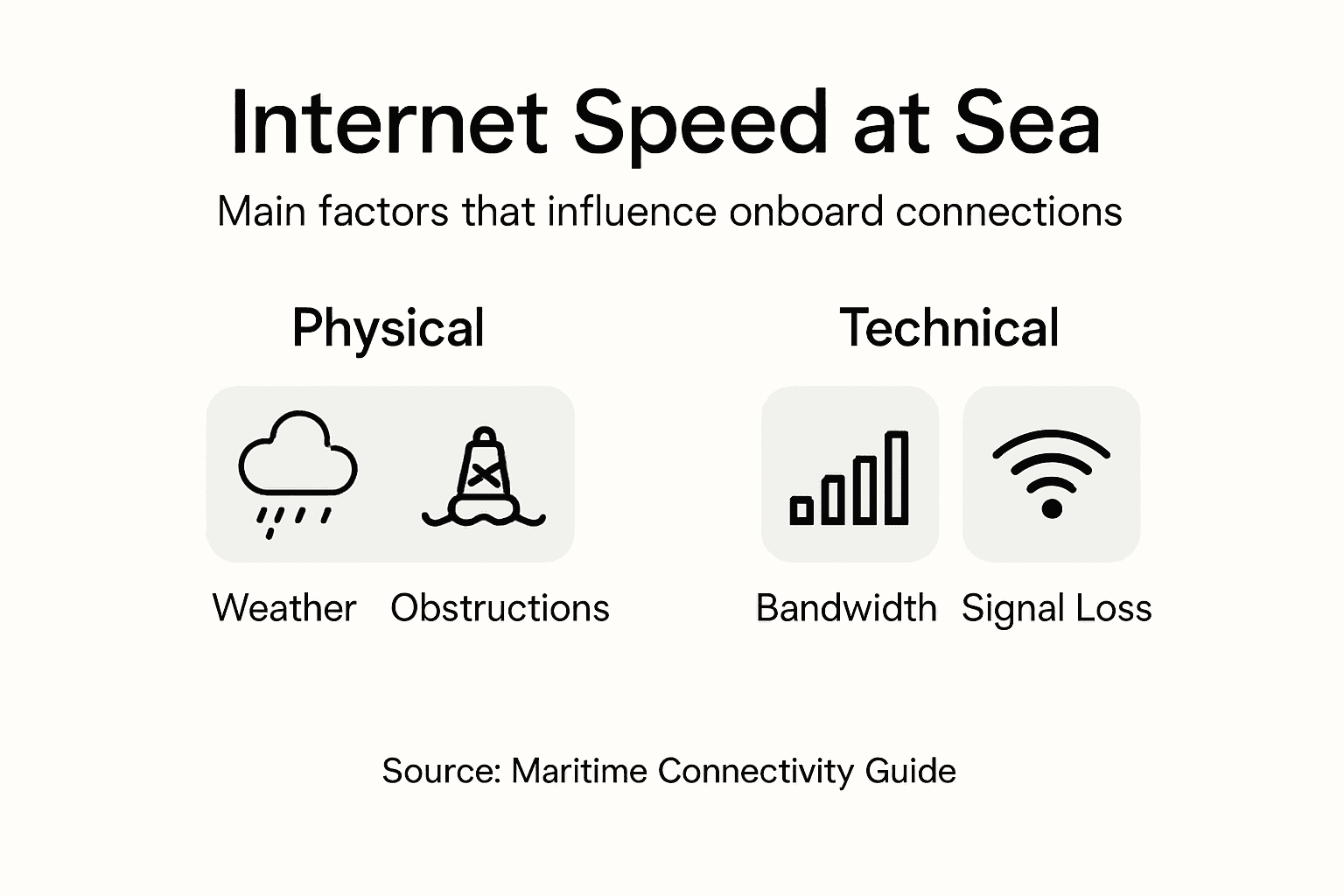
The primary factors affecting maritime internet performance include:
- Vessel Movement: Constant ship motion disrupts signal stability
- Weather Conditions: Sea waves and atmospheric interference degrade signal quality
- Satellite Positioning: Orbital dynamics impact connection reliability
- Distance from Shore: Proximity to cellular towers affects network strength
- Antenna Technology: Marine-grade equipment determines signal acquisition capabilities
Wireless signal propagation in maritime environments presents unique challenges that terrestrial networks never encounter. Sea waves create physical obstacles that interrupt signal transmission, while the vessel’s continuous movement requires sophisticated tracking systems to maintain consistent connectivity. Satellite internet must compensate for these dynamic conditions by continuously adjusting antenna positioning and switching between available network resources.
Technical complexities further compound internet speed challenges. Bandwidth limitations, network topology changes, and signal degradation caused by physical obstructions create a challenging environment for maintaining stable internet connections. Advanced maritime communication systems employ sophisticated algorithms and multiple redundant communication channels to mitigate these performance limitations, ensuring travelers can maintain some level of connectivity even in challenging maritime conditions.
Pro Tip: Choose maritime internet packages that offer multiple network compatibility and adaptive signal technologies to maximize your chances of maintaining consistent connectivity while traveling at sea.
Comparing Maritime and Land-Based Internet
Maritime internet connectivity fundamentally differs from traditional land-based networks, presenting a unique set of technological challenges and performance limitations. Internet connectivity assessment reveals significant disparities between terrestrial and maritime communication infrastructures.
Key differences between maritime and land-based internet include:
- Signal Transmission: Satellite vs. fiber-optic technologies
- Bandwidth Capacity: Significantly reduced maritime performance
- Latency: Maritime connections experience 3-5 times higher delay
- Signal Stability: Highly variable maritime connectivity
- Coverage Range: Limited offshore versus widespread terrestrial networks
Marine internet performance demonstrates substantial technical constraints compared to land-based systems. While terrestrial networks leverage extensive fiber-optic infrastructure and cellular towers, maritime connections predominantly rely on satellite technologies with inherent limitations. Open ocean environments require complex signal tracking, multiple redundant communication channels, and adaptive technologies to maintain even basic internet connectivity.
This comparison highlights the key technical differences between maritime and land internet:
| Characteristic | Maritime Internet | Land-Based Internet |
|---|---|---|
| Signal Type | Satellite-based | Fiber-optic/cellular |
| Typical Latency | 500-700 ms | 20-50 ms |
| Bandwidth Range | 2-20 Mbps | 50-1000+ Mbps |
| Connectivity Range | Limited offshore | Nationwide/global |
The technological gap between maritime and land-based internet extends beyond simple speed measurements. Maritime networks must continuously compensate for environmental challenges like vessel movement, atmospheric interference, and satellite positioning. Terrestrial networks, by contrast, operate in stable, controlled environments with consistent infrastructure, allowing for more predictable and higher-quality internet experiences. These fundamental differences mean maritime internet users must adjust expectations and develop strategies for managing limited connectivity.
Pro Tip: Download critical documents, entertainment content, and communication resources before departing to mitigate potential maritime internet limitations.
Experience Stable and High-Speed Internet Onboard Your Maritime Journey
The article highlights the common challenges of internet speeds at sea such as high latency, signal instability, and bandwidth limitations caused by satellite connections and vessel movement. If you need reliable internet for work or entertainment during your ferry or cruise trip, these pain points can be frustrating and limit your ability to stay connected in real time. Seafy understands these specific obstacles in maritime connectivity and offers a digital platform built to overcome them. By partnering with major ferry lines like Corsica Ferries, Grimaldi Lines, and GNV, Seafy delivers seamless Wi-Fi access optimized for the unique conditions of maritime travel. Whether your goal is to stream content, communicate smoothly, or work remotely, Seafy integrates advanced satellite technology such as Starlink to reduce the impacts of distance and environmental factors.
Take control of your online experience at sea with Seafy’s easy-to-use portal where you can purchase and activate tailored Wi-Fi packages designed to meet your bandwidth needs. Do not let slow or unstable connections hold you back during your Mediterranean or other coastal journeys. Discover more about how Seafy enhances maritime connectivity by visiting Seafy and start enjoying dependable internet onboard today. Set sail with confidence knowing your connection will keep up with you no matter how far you travel.
Frequently Asked Questions
What are the typical internet speeds available at sea?
Internet speeds at sea typically range from 2 to 20 Mbps, but are usually lower than those on land due to the reliance on satellite connectivity.
How does vessel movement affect internet connectivity at sea?
Vessel movement creates challenges for maintaining a stable signal, leading to disruptions in connectivity and impacting overall internet speed.
What factors influence the latency of maritime internet connections?
Latency in maritime internet connections usually ranges between 500-700 milliseconds, influenced by satellite positioning, weather conditions, and the distance from shore.
How do satellite internet solutions differ from shore-based or cellular networks?
Satellite internet offers extensive coverage for open ocean travel but tends to have higher latency and lower bandwidth compared to high-speed shore-based WiFi and cellular networks that provide better performance closer to land.