Tech & Wi-Fi
How digital hubs transform Wi-Fi on ferries 🌐
Discover the role of digital hubs on ferries and how they enhance onboard Wi-Fi, ensuring seamless connectivity for your journey!
13 May 2026
How digital hubs transform Wi-Fi on ferries 🌐
TL;DR:
- Modern digital hubs on ferries serve as centralized systems managing Wi-Fi, entertainment, and operational functions, transforming onboard connectivity experiences. They enable seamless roaming, secure network segmentation, and a unified portal, significantly improving reliability and safety for passengers. The quality of these hubs determines the true user experience more than speed alone, making them essential for reliable internet at sea.
You board a ferry, find a seat by the window, open your laptop, and then the frustration begins. The Wi-Fi portal won’t load. You finally connect, but you lose the signal the moment you walk to the café. Sound familiar? Most passengers blame slow speeds, but the real culprit is almost always a poorly designed onboard connectivity system. The good news is that modern digital hubs are quietly changing all of this, and understanding how they work will help you get far more out of your time at sea, whether you’re there to relax, stream, or stay on top of work.
Table of Contents
- What is a digital hub on ferries?
- How digital hubs deliver seamless Wi-Fi experiences
- Digital hubs, network safety, and cyber risk at sea
- What digital hubs mean for passengers: Real-world scenarios
- The overlooked reality: It’s the experience, not just the connection
- Get reliable Wi-Fi on your next sea journey
- Frequently asked questions
Key Takeaways
| Point | Details |
|---|---|
| Digital hubs explained | A digital hub on ferries manages all guest internet, entertainment, and onboard portal services. |
| Seamless Wi-Fi access | Modern digital hubs allow you to stay connected as you move across the ship with minimal interruptions. |
| Cybersecurity at sea | Digital hubs segment guest and operational networks to minimize security risks onboard. |
| Real trip benefits | Passengers enjoy smoother video calls, streaming, and access to ship info by relying on digital hubs. |
What is a digital hub on ferries?
Think of a digital hub as the central nervous system of a ferry’s entire connectivity setup. It’s not just a router bolted to the ceiling. It’s a unified platform that manages passenger Wi-Fi, crew communications, onboard entertainment, guest information portals, booking systems, and even some operational functions, all from one place.
Here’s what a well-built digital hub typically covers on a modern ferry:
- Guest Wi-Fi access across all passenger zones, including cabins, lounges, and deck areas
- Onboard entertainment portals, where you can stream movies, browse travel info, or check port schedules
- Onboard chat and messaging, so you can stay in touch with travel companions without burning mobile data
- Booking and service systems, letting you order food or upgrade your cabin without hunting down staff
- Crew and operational communications, running on a separate, secure network layer
As onboard Wi-Fi has evolved into an “operations + guest digital services” layer, it’s no longer just a modem. It integrates portals, entertainment, and communications into one coherent system. That shift changes everything about what “good Wi-Fi at sea” actually looks like.
Understanding this matters because it reframes the question you should be asking. It’s not “how fast is the Wi-Fi?” It’s “how well is the whole digital experience designed?” You can read more about boosting travel and work with ferry Wi-Fi to see why this distinction has real-world consequences for passengers.
How digital hubs deliver seamless Wi-Fi experiences
Now that we know what digital hubs are, let’s dig into how they actually make the passenger internet experience better, or worse.
The single biggest frustration for travelers isn’t slow speeds. It’s having to log in again every time you move to a different part of the ship. A digital hub solves this through a concept called identity federation and roaming, which simply means the system recognizes you as the same authenticated user no matter which access point you’re connected to. Digital hubs implement identity and roaming methods, reducing friction for passengers by eliminating repeated logins and providing stable, secure Wi-Fi across the ship.
Here’s a quick comparison so you can see the difference clearly:
| Feature | Without a modern digital hub | With a modern digital hub |
|---|---|---|
| Login experience | Re-enter credentials at every zone | Single sign-on across the entire ship |
| Video call stability | Frequent drops when moving | Smooth handoff between access points |
| Entertainment access | Separate apps or portals required | One unified onboard portal |
| Cyber safety | Shared network for all users | Segmented networks per user type |
| Streaming quality | Inconsistent, buffering common | Prioritized bandwidth allocation |
Here’s what actually happens when you connect to a well-designed ferry Wi-Fi network, step by step:
- You connect to the ship’s network from any device and are directed to a simple login portal.
- The digital hub authenticates your ticket or purchase and assigns you to the correct service tier.
- As you move around the ship, your session transfers automatically to the nearest access point.
- The hub manages bandwidth allocation, so one heavy user doesn’t throttle everyone else.
- At docking, your session closes cleanly, and data is handled according to privacy policy.
This kind of seamless experience directly affects Wi-Fi’s impact on your journey, especially for passengers who need reliable connections for video calls or real-time messaging. And if you want to understand how satellite technology layers into this, high-speed ferry Wi-Fi explains how Starlink and other systems feed into these hubs.
Pro Tip: Before booking a ferry, check whether the operator uses an OpenRoaming-certified or similarly advanced digital hub. This one detail predicts your Wi-Fi experience more accurately than the advertised speed alone.
Digital hubs, network safety, and cyber risk at sea
Seamless Wi-Fi is only one side of the story. Safety and privacy matter just as much, and this is where most passengers are completely in the dark.
When you connect to a public network on a ferry, the biggest risk isn’t an outside hacker. It’s actually the design of the network itself. On poorly configured ships, passenger Wi-Fi, crew communications, and even navigation or engine management systems can share the same network infrastructure. That’s a serious vulnerability.
Digital hubs help mitigate cyber risk by segmenting passenger, business, and operational networks into separate, isolated layers. Think of it like separate plumbing pipes in a building. Even if one gets contaminated, the others stay clean.
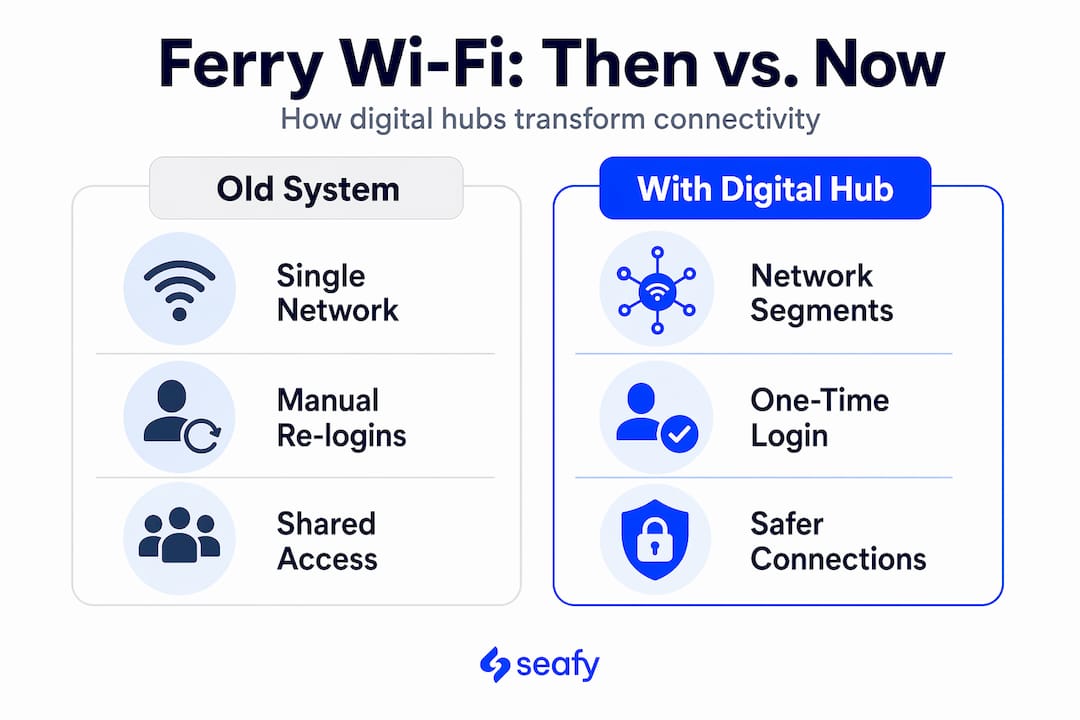
Here’s how segmented versus unsegmented networks compare for your safety as a passenger:
| Risk Factor | Unsegmented network | Segmented digital hub |
|---|---|---|
| Risk of data exposure | High: all traffic on one path | Low: passenger traffic fully isolated |
| Threat to ship operations | Possible: shared access points | None: operational network is air-gapped |
| Vulnerability to malware | Spreads easily across users | Contained within user segment |
| Safe for online banking | Not recommended | Significantly safer |
The key safety practices that robust digital hubs enforce onboard include:
- Network segmentation separating passengers, crew, and operations
- Encrypted authentication, so your login credentials are never sent in plain text
- Bandwidth throttling to prevent any single user from conducting abnormal traffic volumes
- Real-time monitoring to detect unusual patterns that may signal an attack
If you ever run into connectivity issues and want to rule out configuration problems versus signal problems, the Wi-Fi troubleshooting guide for ferries walks you through the most common causes and fixes.
What digital hubs mean for passengers: Real-world scenarios
So what does all this technical detail actually mean for your next journey? Let’s put it in concrete terms.
Scenario 1: The digital nomad. You’ve booked a 20-hour overnight crossing and have a video call at 9 AM. With a proper digital hub, your call connects cleanly, your session doesn’t drop when you move from your cabin to the lounge, and the hub’s bandwidth management keeps your stream stable even if the ferry is full. Without it, you’re rebooting, re-logging in, and apologizing to your client for the buffering.

Scenario 2: The family crossing. Two kids want to stream cartoons on the TV in the cabin while their parents use the onboard portal to pre-book a shore excursion. A digital hub handles both simultaneously, allocating bandwidth intelligently and keeping the family’s data separate from other passengers.
Scenario 3: The solo traveler. You just want to check the port arrival time, message a friend, and see if the onboard restaurant is still open. The digital hub’s guest information portal has all of this in one clean interface, no extra apps, no separate logins.
Passenger experience depends not just on bandwidth, but on how expertly digital hubs manage access and minimize friction, which is the real key for reliable video calls, messaging, and streaming. Here’s how a typical journey unfolds when your ferry has a solid digital hub:
- Board the ferry and connect to the onboard Wi-Fi network automatically.
- Open the portal, log in once with your booking reference or purchased package.
- Access all onboard services, entertainment, and internet from a single dashboard.
- Move freely around the ship without losing your connection or being asked to log in again.
- Arrive at your destination with your session having been fully managed in the background.
Curious about the different ways ferries structure their onboard connectivity? Exploring the types of onboard Wi-Fi solutions gives you a fuller picture of what to expect and how to compare options. And if you want to understand the portal experience in more detail, the ferry Wi-Fi portal guide is a great starting point.
Pro Tip: Ask your ferry operator directly whether their onboard system offers a unified passenger portal and single sign-on. These two features alone are the fastest way to predict whether your experience will be smooth or frustrating.
The overlooked reality: It’s the experience, not just the connection
Here’s something that most travel guides won’t tell you. Bandwidth numbers are almost meaningless on their own.
We’ve seen passengers with access to genuinely fast satellite connections still spend half their crossing frustrated because the underlying hub architecture was poorly designed. Dropped sessions, repeated logins, entertainment apps that don’t load, these problems have nothing to do with how many megabits per second the ship’s antenna receives. They’re entirely about how the digital hub manages, routes, and maintains your session.
The industry conversation is slowly shifting toward this realization, but most passengers and even many booking sites still advertise or judge Wi-Fi by peak speed alone. That’s like judging a restaurant by how hot the kitchen runs rather than what ends up on your plate.
Understanding why high-speed internet matters is important, but the smarter question to ask before any voyage is: what platform is powering the onboard connectivity? Is it a legacy patchwork of routers, or a modern digital hub with OpenRoaming, proper segmentation, and a unified guest portal? That answer will define your experience far more than any speed figure will.
When you’re evaluating ferry Wi-Fi options next time, skip the speed test comparison. Ask about the platform.
Get reliable Wi-Fi on your next sea journey
Ready to put your new knowledge to use and guarantee a better onboard internet experience? Now that you understand what separates a frustrating connection from a truly seamless one, it’s time to choose a ferry experience that’s built on the right foundation. ⚡

At Seafy, we work directly with major ferry lines like Corsica Ferries, Grimaldi Lines, and GNV to bring passengers reliable, hub-powered Wi-Fi that covers everything from casual browsing to remote work video calls. Our platform is designed around the passenger experience, so you get one easy login, stable connectivity across the ship, and packages tailored to how you actually use the internet at sea. Explore your options and activate your Wi-Fi at sea with Seafy before your next departure, because a smooth crossing starts with a connection you can trust. 🌐
Frequently asked questions
Can I use Wi-Fi seamlessly throughout the ferry with only one login?
Yes, digital hubs with identity and roaming technologies allow you to stay connected without repeated logins as you move around the ship.
How do digital hubs impact onboard entertainment options?
They unify streaming, info portals, and onboard chat, letting you access entertainment and services in one place. As part of the digital hub, onboard Wi-Fi integrates entertainment and communication services seamlessly.
Is Wi-Fi on ferries secure for online banking and work?
Ferry digital hubs segment passenger and operational networks, significantly reducing cyber risks for activities like online banking and remote work.
Does a digital hub improve Wi-Fi speed or just convenience?
A digital hub primarily improves stability and access convenience, but it also indirectly boosts your effective speed by reducing interruptions. Passenger experience depends on how digital hubs manage access and minimize friction, not just raw bandwidth.