Tech & Wi-Fi
Why High-Speed Internet Matters on Ferries
Discover why high-speed internet for ferries is crucial—covering passenger needs, technical solutions, real onboarding benefits, and practical challenges.
02 February 2026
Why High-Speed Internet Matters on Ferries
Smooth video calls and endless streaming feel out of reach once your Mediterranean ferry slips past the shoreline, but today’s travelers expect to stay connected wherever they roam. Finding reliable high-speed internet at sea matters more than ever, especially for those balancing work deadlines with island escapes. Modern ferry internet now draws on advanced satellite technologies, promising connections fast enough for both productivity and relaxation as you sail between iconic Greek isles or Italian ports.
Table of Contents
- Defining High-Speed Internet for Ferries
- Essential Needs of Passengers and Crew
- How Maritime Wi-Fi Connectivity Works
- Key Technologies: Satellite and Starlink Integration
- Challenges and Solutions at Sea
- Comparing Onboard Internet to Alternatives
Key Takeaways
| Point | Details |
|---|---|
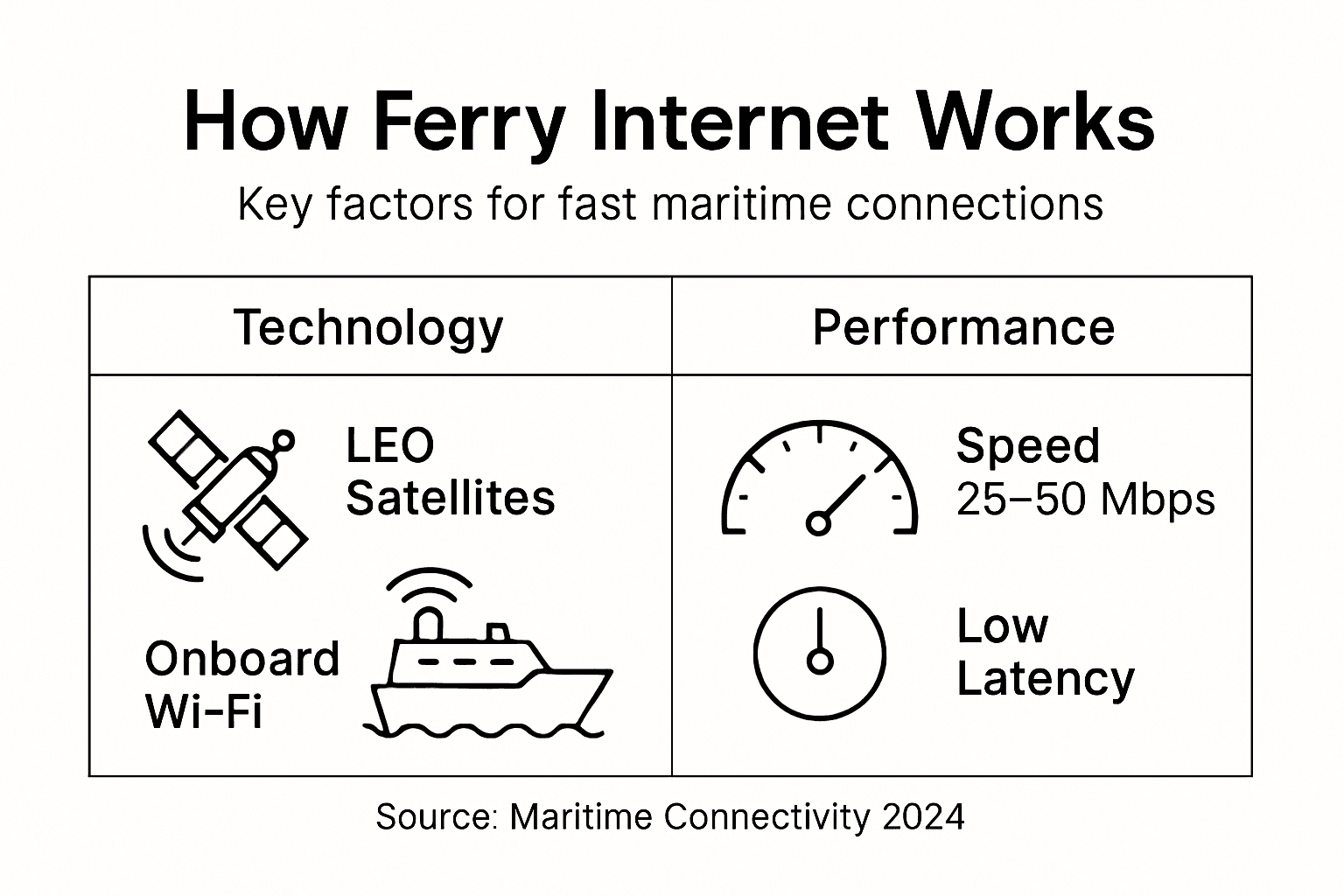
| High-Speed Internet Requirements | Effective maritime internet requires speeds of 25-50 Mbps download, with low latency under 150 ms, ensuring consistent connectivity for multiple users. |
| Technology of Connectivity | Low Earth Orbit (LEO) satellites, like Starlink, provide faster, more reliable internet compared to traditional geostationary satellites by operating closer to Earth. |
| Passenger and Crew Needs | Connectivity now supports essential functions such as professional communication, safety protocols, and personal entertainment, which are vital for modern travel experiences. |
| Challenges in Maritime Communication | Unique maritime conditions create obstacles for connectivity; hybrid communication architectures can help overcome these challenges and enhance user experience at sea. |
Defining High-Speed Internet for Ferries
High-speed internet on maritime vessels isn’t just a luxury—it’s a critical connectivity lifeline that transforms how travelers and professionals experience sea travel. High-speed maritime connectivity fundamentally depends on advanced satellite technologies that deliver reliable, low-latency internet access across remote maritime environments.
In the maritime context, high-speed internet represents a specific technical benchmark that goes beyond typical land-based connectivity standards. These requirements include:
- Minimum download speeds of 25-50 Mbps
- Upload speeds around 10-25 Mbps
- Latency under 150 milliseconds
- Consistent connectivity across open water regions
- Ability to support multiple simultaneous users
The primary technological enabler for these demanding specifications is low Earth orbit (LEO) satellite networks like Starlink. Unlike traditional geostationary satellites that orbit far from Earth, LEO satellites position themselves much closer to the planet’s surface. This proximity dramatically reduces signal transmission time, enabling near-instantaneous internet experiences that feel remarkably similar to high-quality land-based connections.
Connection Quality Factors influencing maritime internet performance include satellite technology, signal strength, vessel location, and onboard networking infrastructure. Professional-grade maritime internet solutions must account for constant environmental variables like wave interference, geographic positioning, and signal obstacles.
Pro tip: When selecting ferry internet services, always verify the specific bandwidth guarantees and check whether the provider uses advanced LEO satellite technologies for optimal performance.
Essential Needs of Passengers and Crew
Ferry passengers and crew have increasingly complex connectivity requirements that extend far beyond simple internet access. Maritime communication networks now serve multiple critical functions, transforming how people work, communicate, and experience maritime travel.
The essential connectivity needs for passengers and crew can be categorized into several key areas:
- Professional Communication
- Personal Entertainment
- Safety and Emergency Coordination
- Remote Work Capabilities
- Real-time Location Tracking
- Personal and Professional Data Management
Professional Connectivity is particularly crucial for crew members who require stable, high-bandwidth internet to manage operational communications, access critical maritime documentation, and maintain contact with shoreside management. Modern ferry crews rely on robust internet connections to:
- Submit real-time navigation reports
- Communicate with maritime authorities
- Access weather and route information
- Manage crew scheduling and logistics
For passengers, internet connectivity has become a fundamental expectation. Travelers now demand seamless internet experiences that mirror their land-based expectations, enabling activities like:
- Video conferencing for remote work
- Streaming entertainment content
- Social media sharing
- Navigation and travel information access
- Continuous communication with family and colleagues
Safety Considerations are paramount in maritime environments. Passenger safety protocols increasingly depend on reliable communication networks that support emergency coordination, real-time tracking, and instant information dissemination.
Pro tip: Always verify the internet package’s specific bandwidth and coverage details before your maritime journey to ensure your connectivity needs will be fully met.
How Maritime Wi-Fi Connectivity Works
Maritime Wi-Fi connectivity represents a complex technological ecosystem that bridges multiple communication technologies to ensure seamless internet access at sea. Maritime communication networks integrate sophisticated systems that overcome the unique challenges of offshore internet delivery.
The core infrastructure of maritime connectivity involves several key technological components:
- Satellite Communication Systems
- Cellular Network Extensions
- Floating Base Stations
- Multi-hop Wireless Networks
- Advanced Signal Repeater Technologies
Satellite Communication forms the primary backbone of maritime internet connectivity. Modern maritime networks leverage a combination of technologies to create robust, reliable internet experiences. These systems typically involve:
- Low Earth Orbit (LEO) Satellite Networks
- Geostationary Satellite Systems
- Advanced Signal Processing Technologies
- Specialized Maritime Communication Protocols
Signal Transmission Technologies are crucial in overcoming maritime connectivity challenges. Unlike terrestrial networks, maritime communications must contend with constant environmental variables like wave interference, vessel movement, and extreme distances from traditional network infrastructure.

The technical complexity involves creating multi-hop wireless networks that can extend connectivity ranges, allowing seamless communication between ships, shore-based stations, and global internet backbones. This involves sophisticated routing algorithms and signal amplification technologies that can maintain stable connections in challenging maritime environments.
Pro tip: Always check your ferry’s specific communication infrastructure to understand the potential internet performance and bandwidth limitations before your journey.
Key Technologies: Satellite and Starlink Integration
The maritime internet connectivity landscape is being revolutionized by advanced satellite technologies, with Starlink’s LEO satellite constellation leading the technological transformation.
Starlink’s breakthrough technologies include several critical components:
- Phased Array Antennas
- Inter-Satellite Laser Links
- Advanced Deployment Strategies
- Low Earth Orbit Positioning
- Real-Time Signal Processing
Low Earth Orbit (LEO) Satellites represent a fundamental shift in satellite communication technology. Unlike traditional geostationary satellites that orbit approximately 22,236 miles above Earth, LEO satellites operate much closer—typically between 310 and 1,200 miles from the planet’s surface. This proximity enables several significant advantages:
- Dramatically reduced signal latency
- Higher bandwidth capabilities
- More consistent connection quality
- Faster data transmission speeds
The technical sophistication of Starlink’s system involves complex signal transmission technologies. User terminals employ custom-designed phased array antennas that can dynamically connect with thousands of satellites worldwide, ensuring seamless internet coverage even in challenging maritime environments.
These technologies are particularly transformative for maritime connectivity, addressing long-standing challenges of internet access at sea. The ability to maintain stable, high-speed connections across vast oceanic distances represents a quantum leap in communication infrastructure for ferries, cruise ships, and maritime vessels.
Here is a summary contrasting LEO satellites and traditional geostationary satellites for maritime connectivity:
| Attribute | LEO Satellites (e.g., Starlink) | Geostationary Satellites |
|---|---|---|
| Orbit Distance | 310–1,200 miles from Earth | About 22,236 miles above Earth |
| Latency | Below 150 ms | 500 ms or higher |
| Bandwidth | High capacity, scalable | Moderate, fixed |
| Coverage Adaptability | Flexible, global coverage | Best near equator, limited poles |
| Practical Impact | Near real-time experiences | Noticeable delay, less ideal for live video |
Pro tip: When traveling, verify your vessel’s specific satellite communication setup to understand the potential internet performance and bandwidth expectations.
Challenges and Solutions at Sea
Maritime communication networks encounter unique obstacles that demand sophisticated technological solutions. Maritime communication challenges stem from the inherently complex and dynamic nature of oceanic environments.
The primary connectivity challenges include:
- Extensive open water coverage areas
- Signal degradation from weather conditions
- Extreme environmental variability
- Limited terrestrial infrastructure
- High signal latency with traditional technologies
Signal Transmission Obstacles represent the most critical technical hurdles for maritime internet connectivity. Ocean environments create multiple interference points that can dramatically impact communication quality:
- Wave interference patterns
- Atmospheric moisture disruptions
- Vessel movement dynamics
- Electromagnetic signal scattering
- Distance from terrestrial networks
Technological solutions involve multi-layered communication strategies that integrate diverse network types. Modern maritime communication architectures now combine:
- Satellite networks (LEO and traditional)
- Cellular network extensions
- Aerial communication relays
- Advanced signal processing algorithms
- Multi-hop connectivity protocols
The emerging technological landscape prioritizes resilience and adaptability. By deploying sophisticated hybrid communication systems, maritime networks can now provide more consistent, high-speed internet experiences across previously challenging oceanic regions.
Pro tip: Always investigate your vessel’s specific communication infrastructure to understand potential connectivity limitations and backup communication strategies.
Comparing Onboard Internet to Alternatives
Ferry internet connectivity has evolved dramatically, with multiple options emerging to address the complex challenges of maritime communication. Ship internet alternatives reveal a sophisticated landscape of technological solutions beyond traditional satellite connections.
The primary internet connectivity alternatives for maritime environments include:
- Prepaid satellite messaging systems
- Hybrid cellular-satellite networks
- Port-based connectivity solutions
- Onboard entertainment server networks
- Local cellular data extensions
Satellite Connectivity remains the foundational technology, but modern approaches have significantly enhanced traditional models. Key alternative strategies involve:
- Integrating multiple communication technologies
- Leveraging coastal cellular networks
- Implementing hybrid communication architectures
- Developing localized onboard network solutions
- Utilizing advanced signal processing techniques
The most compelling alternatives balance three critical factors: coverage, cost, and performance. Hybrid solutions near coastal regions offer particularly innovative approaches, combining satellite technologies with terrestrial cellular networks to provide more reliable and cost-effective internet experiences.
Maritime internet solutions must dynamically adapt to changing technological landscapes and user requirements.
Remote ocean regions still predominantly rely on satellite technologies, with emerging solutions like Starlink promising more consistent and high-speed connectivity across previously challenging maritime environments.
The following table compares major alternatives for ferry internet connectivity:
| Solution Type | Typical Usage Zone | Main Strength | Limitation |
|---|---|---|---|
| LEO Satellite Internet | Open ocean | High speed, low latency | Costlier, power required |
| Hybrid Cellular-Satellite | Coastal waters | Lower cost near shore | Drops when offshore |
| Port-Based Wi-Fi | In port | Fastest, low latency | Only works when docked |
| Prepaid Messaging Terminals | Remote regions | Reliable essential messaging | Not for web browsing |
Pro tip: Research your specific ferry’s communication infrastructure before traveling to set realistic expectations about internet performance and available connectivity options.
Experience Reliable High-Speed Internet Onboard Your Ferry
Navigating the challenges of maritime connectivity requires more than just access to the internet. As highlighted in the article “Why High-Speed Internet Matters on Ferries,” overcoming issues like signal latency, inconsistent coverage, and environmental interference is essential for passengers and crew who depend on stable connections for work, safety, and entertainment. Seafy understands these pain points and leverages advanced satellite technologies including Starlink integration to provide seamless, high-speed Wi-Fi that keeps you connected across Mediterranean ferry routes and beyond.
Don’t let connectivity challenges impact your travel experience. With Seafy’s onboard internet services, you gain reliable access to the internet through an easy-to-use portal designed specifically for maritime environments. Whether you need to stay productive with remote work, stream your favorite shows, or keep in touch with loved ones, Seafy’s platform offers the stability and speed that meet the modern traveler’s high expectations. Start your journey with confidence by securing your Wi-Fi package today at Seafy.com and enjoy connectivity that makes every moment at sea worthwhile.
Frequently Asked Questions
What are the typical download and upload speeds for high-speed internet on ferries?
High-speed internet on ferries typically requires download speeds of 25-50 Mbps and upload speeds of 10-25 Mbps to ensure a smooth online experience.
How does satellite technology improve internet connectivity on ferries?
Satellite technology, particularly Low Earth Orbit (LEO) satellites like Starlink, improves connectivity by reducing latency to below 150 milliseconds and providing more reliable, higher bandwidth internet than traditional geostationary satellites.
What factors affect maritime internet performance on ferries?
Factors influencing maritime internet performance include satellite technology, signal strength, vessel location, onboard networking infrastructure, and environmental challenges like wave interference and weather conditions.
Why is reliable internet important for ferry crews and passengers?
Reliable internet facilitates professional communication, personal entertainment, safety coordination, and remote work capabilities for crews and passengers, enhancing the overall maritime travel experience.