Tech & Wi-Fi
Types of Onboard Communications: Ferry and Cruise Guide
Discover the types of onboard communications available for ferries and cruises. Enhance your sea experience with the right connectivity options!
22 May 2026
Types of Onboard Communications: Ferry and Cruise Guide
TL;DR:
- Onboard maritime communication systems include satellite internet, radio, and safety devices, forming a layered infrastructure. These systems balance safety, operational needs, and passenger connectivity, with priorities differing based on trip length and purpose. Proper integration and management of these technologies enhance safety, satisfaction, and remote work capabilities at sea.
Whether you’re a remote worker, a streaming-obsessed traveler, or a crew member on a Mediterranean ferry, the types of onboard communications available will directly shape your experience at sea. Connectivity at sea works very differently from on land, and the options range from satellite internet and marine radio to onboard Wi-Fi networks and infotainment systems. Knowing what each method does, and which one fits your needs, saves you frustration before you even board.
Table of Contents
- Key takeaways
- The types of onboard communications you need to know
- 1. Satellite internet (VSAT)
- 2. VHF radio
- 3. MF/HF radio
- 4. EPIRB and SART systems
- 5. Inmarsat and Iridium satellite terminals
- 6. Onboard infotainment systems
- 7. Shipboard Wi-Fi networks (LAN and wireless distribution)
- 8. Public address and internal intercom systems
- Comparing communication types at sea
- Choosing the right communication setup for your trip
- My take on where onboard communications are really heading
- Stay connected at sea with Seafy
- FAQ
Key takeaways
| Point | Details |
|---|---|
| Multiple systems work together | Ships use satellite internet, VHF radio, Wi-Fi networks, and infotainment systems as layers, not replacements. |
| Safety comms are legally required | GMDSS-compliant equipment is mandatory on commercial vessels over 300 GT on international voyages. |
| Bandwidth is a real constraint | Satellite costs run $500 to $2,000 per Mbps/month, which is why ships cache content and use adaptive streaming. |
| Passenger needs vary by trip type | Short ferry hops need basic connectivity; long cruises need full work and entertainment solutions. |
| Platform choice matters | Services like Seafy simplify Wi-Fi activation onboard with flexible packages for passengers and crew. |
The types of onboard communications you need to know
Every vessel operating at sea relies on multiple communication systems running in parallel. No single technology handles everything from safety alerts to passenger streaming. Understanding what each system does helps you choose the right option and set realistic expectations.
Here is a framework to evaluate any onboard communication method:
- Connectivity speed and reliability: Can it support video calls, streaming, or just basic browsing?
- Coverage area: Does it work in open ocean, coastal zones, or only near ports?
- Cost: Some systems are free for safety use; passenger internet packages vary widely in price.
- Ease of use: Activation should be straightforward, especially for travelers unfamiliar with maritime tech.
- Regulatory compliance: Safety systems like GMDSS are not optional. They are legally mandated.
- Integration: The best setups combine internet, entertainment, and safety tools without competing for bandwidth.
Pro Tip: Before booking, check whether the ferry or cruise line partners with a reliable connectivity platform. Activating your Wi-Fi package before you board, through a service like Seafy, means you are connected from the moment you step onboard.
1. Satellite internet (VSAT)
Satellite internet is the backbone of connectivity at sea. VSAT (Very Small Aperture Terminal) systems beam internet from geostationary satellites to an antenna mounted on the ship, then distribute it across the vessel via onboard networks.
The main challenge is cost. Satellite bandwidth costs can reach $2,000 per Mbps per month, which explains why ships carefully manage data usage and cap speeds during peak hours. Newer low-earth orbit systems like Starlink have started to address this, offering lower latency and more competitive pricing.
Pros: Works in open ocean far from any coast. Supports internet, VoIP, and streaming when bandwidth allows. Cons: Expensive per megabit. Latency from geostationary satellites can affect real-time applications like video calls.
2. VHF radio
VHF (Very High Frequency) radio is the standard voice communication tool between ships, ports, and coast guards. It operates on dedicated marine channels and is a core component of the GMDSS safety framework.
Every commercial vessel uses VHF for operational coordination. Channel 16 is the international distress and calling channel, monitored continuously. Portable VHF radios are also kept near survival craft for emergency use.
Pros: Immediate, reliable, no data cost. Works independently of internet infrastructure. Cons: Short range (roughly 20 to 40 nautical miles). Not suitable for passenger internet or entertainment.
3. MF/HF radio
Medium Frequency and High Frequency radio systems extend communication range far beyond VHF limits. Ships use MF/HF for long-distance voice and data transmissions, particularly on ocean crossings where coastal VHF coverage is out of reach.
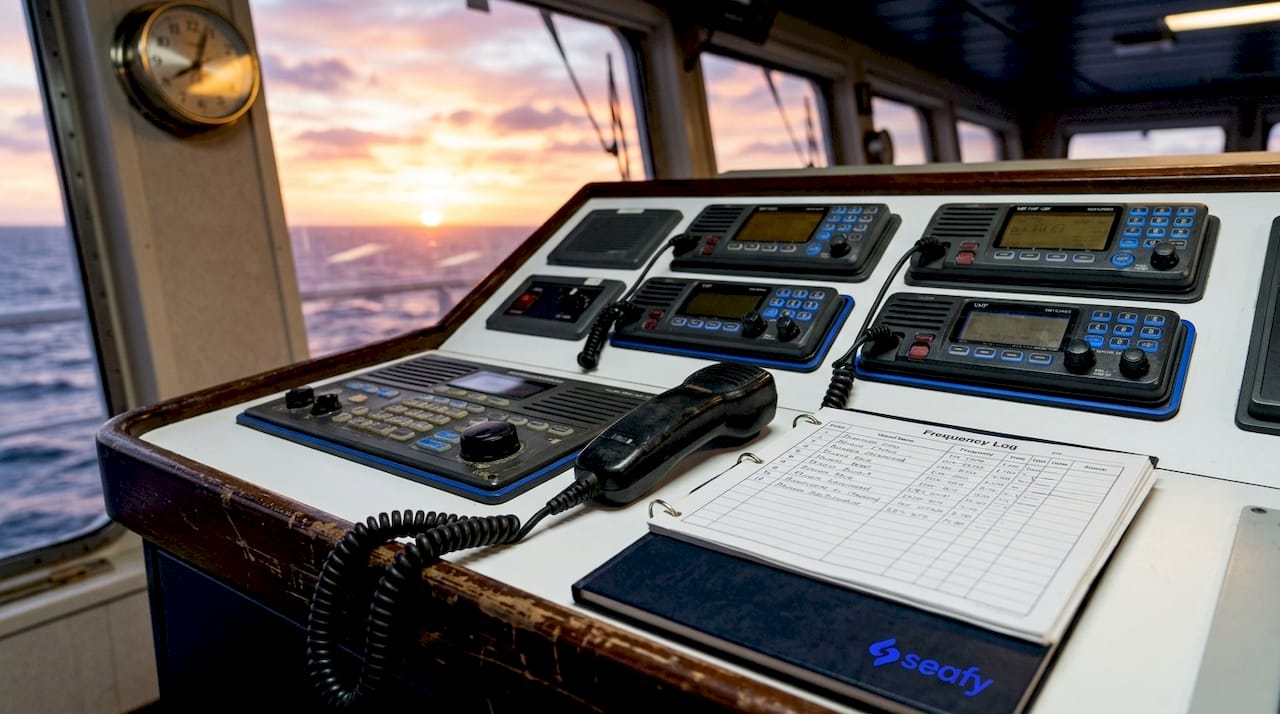
Under GMDSS regulations, commercial vessels on international voyages must carry MF/HF equipment depending on their operational sea area. These systems are strictly for safety and operational communications, not passenger use.
4. EPIRB and SART systems
An EPIRB (Emergency Position-Indicating Radio Beacon) automatically transmits a distress signal when activated, helping search and rescue teams locate a vessel in trouble. A SART (Search and Rescue Transponder) responds to radar signals from rescue aircraft or ships.
Both are critical safety tools with specific stowage rules under SOLAS. EPIRBs must be mounted in float-free brackets so they activate automatically if a vessel sinks. These are not communication tools for passengers. They are lifesaving infrastructure that runs silently in the background.
5. Inmarsat and Iridium satellite terminals
Satellite terminal systems like Inmarsat and Iridium provide safety-grade voice and data communications independent of internet service providers. They feed directly into the GMDSS framework and are used for official distress alerting.
Iridium Certus provides pole-to-pole coverage using low-earth orbit satellites, which is critical for vessels operating in polar regions where Inmarsat geostationary coverage does not reach. For passengers on Mediterranean ferries, these systems run silently in the background as part of the ship’s mandatory safety infrastructure.
6. Onboard infotainment systems
Infotainment systems deliver movies, TV channels, and on-demand content to passenger cabins and public screens. They use a hybrid delivery model: content is cached onboard during port calls and supplemented by satellite streaming when bandwidth allows.
Ships can preload up to 50TB of content while docked, dramatically reducing the amount of live satellite data needed at sea. Intelligent adaptive streaming systems can then serve thousands of cabins simultaneously while keeping satellite costs manageable. This is why your cabin TV on a cruise ship often has an impressive content library even in the middle of the ocean.
7. Shipboard Wi-Fi networks (LAN and wireless distribution)
The onboard Wi-Fi network is what most passengers interact with directly. It distributes internet access from the VSAT satellite connection across the vessel using access points, routers, and a local area network (LAN).
The quality depends on both the satellite feed and the onboard infrastructure. A well-distributed Wi-Fi network with good signal coverage throughout cabins, lounges, and decks makes a real difference. You can read more about how maritime Wi-Fi works and why it behaves differently from your home connection.
8. Public address and internal intercom systems
SOLAS requires that shipboard emergency communication systems include two-way voice communication between the bridge, muster stations, and key locations throughout the vessel. Public address systems complement this by broadcasting announcements to all passengers simultaneously.
These systems are not glamorous, but they are life-critical. During an emergency drill or actual incident, they are how the crew coordinates evacuation and keeps passengers informed. Ships also use these for routine announcements, port arrival updates, and service information.
Comparing communication types at sea
Here is a side-by-side look at the main onboard communication methods based on what matters most to passengers, crew, and operators:
| Communication type | Primary use | Coverage | Passenger access | Safety role |
|---|---|---|---|---|
| VSAT satellite internet | Passenger internet, work | Ocean-wide | Yes, via Wi-Fi packages | Indirect |
| VHF radio | Ship-to-ship/port voice | Coastal, short range | No | Core GMDSS |
| MF/HF radio | Long-range voice and data | Ocean-wide | No | Core GMDSS |
| EPIRB / SART | Emergency location | Global | No | Critical |
| Inmarsat / Iridium | Safety data and distress | Global (Iridium: polar) | No | Core GMDSS |
| Infotainment system | Streaming, TV, movies | Onboard only | Yes | None |
| Shipboard Wi-Fi LAN | Passenger internet access | Onboard only | Yes | Indirect |
| Public address system | Announcements, emergency | Onboard only | Receive only | Core SOLAS |
For passengers, the three relevant types are VSAT-powered Wi-Fi, the infotainment system, and the public address system. Everything else runs in the background as operational and safety infrastructure. For operators and crew, all eight layers matter.
Choosing the right communication setup for your trip
Your ideal communication setup depends on your trip type, your purpose, and your route.
- Short Mediterranean ferry crossing (2 to 8 hours): Basic Wi-Fi for messaging and light browsing is enough. Look for packages you can activate quickly through a portal like seafy.com.
- Overnight or multi-day ferry voyage: You will want reliable internet for streaming or calls. Check whether the ferry line partners with a managed connectivity service.
- Long cruise voyage: Full infotainment, strong Wi-Fi, and crew communication tools all matter. Starlink-enhanced services offer the best experience currently available.
- Remote work onboard: You need dedicated bandwidth, low latency for video calls, and a stable connection. Not all packages are equal. Look for services that explicitly support work use.
Pro Tip: Coverage maps matter more than speed claims. Check real-time satellite coverage details for your specific route before purchasing any onboard internet package.
My take on where onboard communications are really heading
I’ve spent years watching maritime connectivity evolve, and the shift happening right now is the most significant yet. When I started, passengers on Mediterranean ferries considered any working Wi-Fi a bonus. Today, they expect a usable connection for video calls, not just email.
What I find genuinely interesting is that the biggest gains are not coming from faster satellites alone. They come from smarter integration. A vessel that caches entertainment content in port, uses Starlink for live internet, and routes crew communications on separate bandwidth channels delivers a dramatically better experience than one relying on a single pipe for everything.
The cost barrier is real. Operators on tight margins still hesitate to invest in premium connectivity. But the data is clear: passenger satisfaction is directly tied to internet quality. Crew welfare also improves measurably when seafarers can video call their families during off-hours.
What I tell operators and travelers alike: stop thinking about communication types as separate decisions. They are a layered system, and the best outcomes come from platforms that manage those layers together. That is exactly what services like Seafy are built to do.
— Raffaele
Stay connected at sea with Seafy
Planning a ferry crossing with Corsica Ferries, Grimaldi Lines, or GNV? Seafy makes it easy to purchase and activate your onboard Wi-Fi package before or during your voyage, with no technical setup required.

Whether you are streaming movies, joining a work call, or just staying in touch with family, Seafy’s portal gives you flexible packages designed for the realities of maritime connectivity. Coverage spans major Mediterranean routes, and the platform integrates with technologies like Starlink for a stable, high-speed experience at sea. Crew members also benefit from dedicated connectivity options that support morale and communication throughout long voyages. Head to seafy.com to explore available packages for your next crossing. ⚡
FAQ
What are the main types of onboard communications?
The main types are satellite internet (VSAT), VHF and MF/HF radio, EPIRB and SART emergency systems, Inmarsat and Iridium terminals, onboard Wi-Fi networks, infotainment systems, and public address systems. Each serves a different purpose, from passenger internet access to mandatory safety communications.
How do ships communicate in an emergency?
Ships use GMDSS-compliant systems including VHF DSC radio, satellite terminals, EPIRB, and SART. These systems are required by SOLAS and integrate multiple technologies to send distress alerts and coordinate rescue responses across all sea areas.
Can I use Wi-Fi for work on a ferry or cruise ship?
Yes, but the experience depends on the connectivity service onboard. Look for ferries and cruise ships that partner with managed connectivity platforms, which offer packages designed for remote work with adequate speed and stability for video calls and file transfers.
Why is satellite internet expensive at sea?
Satellite bandwidth for maritime use traditionally costs between $500 and $2,000 per Mbps per month due to the infrastructure required for ocean-wide coverage. Newer low-earth orbit systems like Starlink are reducing these costs, which is improving the affordability and quality of passenger Wi-Fi.
What is GMDSS and why does it matter for passengers?
GMDSS (Global Maritime Distress and Safety System) is a mandatory international framework requiring commercial vessels to carry specific communication equipment for distress alerting and safety coordination. Passengers do not interact with it directly, but it is the reason emergency communications onboard are reliable and standardized.