Tech & Wi-Fi
What Is Maritime IoT? Applications, Benefits, and Challenges
Discover what maritime IoT is, its real-world applications, benefits, and challenges. Unlock the future of shipping technology today!
11 June 2026
What Is Maritime IoT? Applications, Benefits, and Challenges
TL;DR:
- Maritime IoT uses interconnected sensors and communication networks to monitor vessel and cargo conditions in real time.
- It has proven capable of supporting large-scale deployments over extensive ranges, enhancing safety and operational efficiency.
- Adopting hybrid connectivity solutions and integrating AI with AR tools offers significant advantages for maritime management and safety.
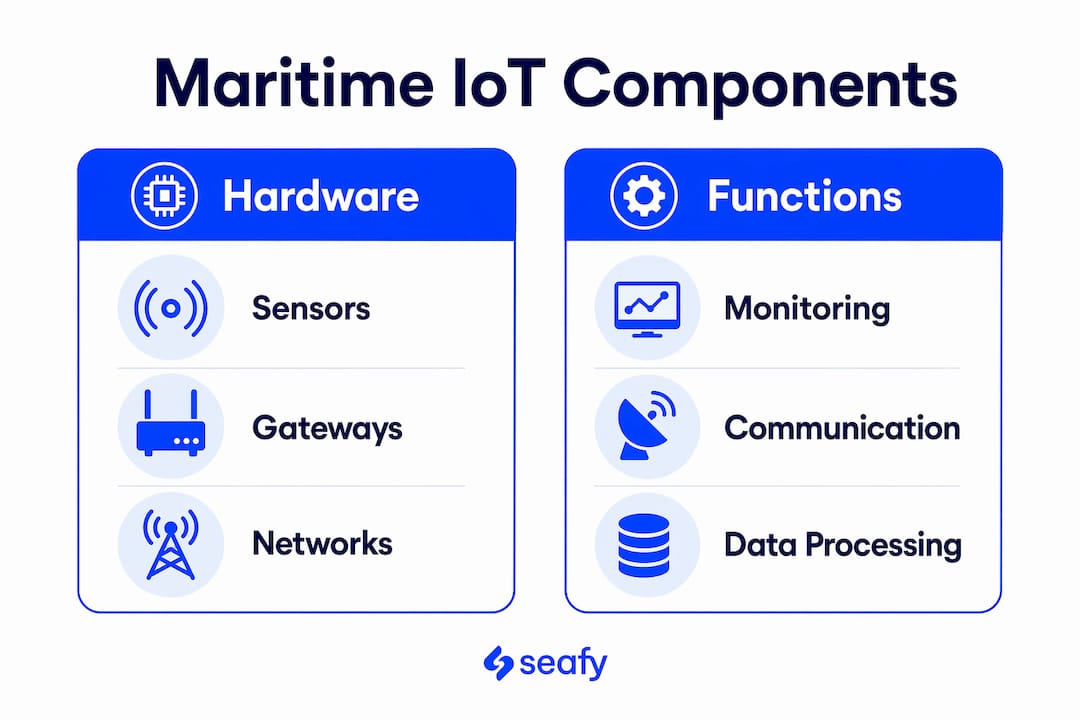
Maritime IoT is defined as a network of interconnected sensors, gateways, and communication systems deployed on vessels, ports, and maritime infrastructure to collect and transmit real-time operational data. The maritime internet of things monitors everything from engine vibration to container temperature, covering assets that carry roughly 90% of global trade. In 2025, South Korea’s ETRI completed the world’s first real-world verification of a Maritime IoT communication network, achieving a 35 km range while connecting 30 devices simultaneously. That milestone confirmed what the industry already suspected: Maritime IoT is no longer experimental. It is the operational backbone of modern shipping.
What is Maritime IoT and how does it work?
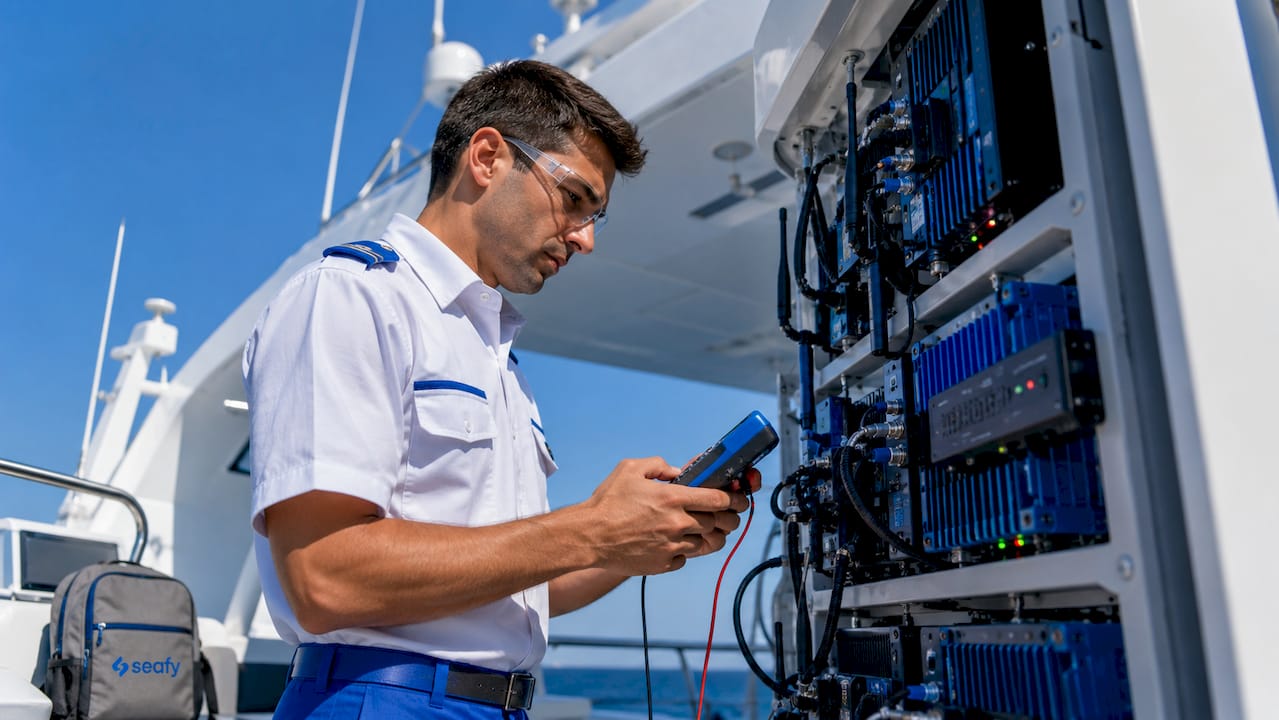
Maritime IoT, also called MIoT, operates through three core layers: sensors on the vessel, gateways that aggregate data, and network servers that process and route information to shore-based platforms. Sensors track parameters like engine vibration, GPS location, battery levels, cargo humidity, and fuel consumption. Gateways collect those signals and push them over whichever network is available, whether satellite, cellular, or a private 5G link.
What separates MIoT from standard terrestrial IoT is its protocol design. Standalone MIoT networks use low-power protocols that prioritize safety-service message delivery over high-bandwidth transmissions typical of LTE-M. This keeps device costs low and battery life long, which matters enormously when sensors are bolted to a hull in the middle of the Atlantic.
The ETRI trial demonstrated that a single MIoT network can support up to 1,000 devices, transmitting GPS location and battery data every three minutes across a 35 km radius. That scale makes fleet-wide monitoring practical without requiring a cellular tower on every buoy.
Core infrastructure components
| Component | Role in Maritime IoT |
|---|---|
| Onboard sensors | Measure engine health, cargo conditions, emissions, and location |
| LoRaWAN gateways | Aggregate low-power sensor data and relay it to network servers |
| Satellite links | Provide ocean coverage where cellular signals cannot reach |
| Network servers | Process, store, and forward data to shore-based management platforms |
| C-Mesh relay nodes | Extend LoRaWAN coverage by 20% offshore for vessels beyond terrestrial range |
Hybrid connectivity is the standard approach for serious deployments. Vessels switch between satellite, cellular, and private 5G depending on proximity to shore, with failover logic built into the gateway firmware. This keeps data flowing even when one network drops out.
What are the benefits and applications of Maritime IoT?
The benefits of Maritime IoT fall into four practical categories: maintenance, cargo integrity, safety, and environmental compliance. Each one translates directly into cost savings or regulatory advantage.
-
Predictive maintenance. Real-time machinery health monitoring reduces unplanned downtime by flagging anomalies before they become failures. A vibration sensor on a propeller shaft can detect bearing wear weeks before a breakdown, saving a drydock visit that could cost hundreds of thousands of dollars.
-
Cargo condition monitoring. Temperature and humidity sensors inside refrigerated containers alert operators the moment conditions drift outside acceptable ranges. This protects pharmaceutical shipments, fresh produce, and any cargo with strict environmental requirements.
-
Safety tracking. IoT tags on life jackets and small rescue boats provide real-time location data during emergencies. Crew overboard scenarios, which are among the most time-critical maritime emergencies, benefit directly from this layer of situational awareness.
-
Emissions and regulatory compliance. IoT sensors monitor exhaust gas composition continuously, giving fleet managers the data they need to meet International Maritime Organization targets without relying on manual spot checks.
-
Fleet and logistics management. Port operators use IoT data to predict vessel arrival times with greater accuracy, reducing berth waiting times and improving cargo throughput across the entire supply chain.
Pro Tip: If you manage a fleet, start with engine monitoring and fuel consumption sensors before expanding to cargo tracking. The ROI on predictive maintenance is measurable within the first operating season, which makes it the easiest internal business case to build.
The impact of Maritime IoT on shipping extends beyond individual vessels. Port authorities, logistics companies, and insurers all benefit from the data streams that MIoT generates, creating a shared intelligence layer across the entire supply chain.
What are the main challenges in Maritime IoT connectivity?
Maritime environments are among the harshest on earth for electronic hardware. Salt air corrodes connectors, wave motion stresses cable joints, and temperature swings from tropical ports to Arctic routes push components to their limits. Environmental challenges remain the single biggest hurdle in Maritime IoT deployments, and hardware selection is as important as network design.
Connectivity presents a separate set of problems:
- Ocean coverage gaps. Cellular networks disappear within 20 to 50 km of shore. Vessels on transoceanic routes depend entirely on satellite links, which carry higher latency and cost per megabyte than terrestrial networks.
- Bandwidth constraints. Low-power IoT protocols are efficient but limited. High-frequency sensor polling across hundreds of devices can saturate a narrow satellite channel.
- Network switching. Moving between satellite, LTE, and private 5G without dropping data requires gateway firmware that handles handoffs automatically. Poorly configured systems lose data packets during transitions.
Connectivity solutions compared
| Approach | Best use case | Limitation |
|---|---|---|
| Satellite (LEO/GEO) | Open ocean, transoceanic routes | Higher cost, latency on GEO |
| Cellular (LTE/5G) | Coastal and port operations | Limited to ~50 km from shore |
| LoRaWAN with C-Mesh | Fishing vessels, offshore monitoring | Lower data throughput |
| Private 5G onboard | Large vessels with dense sensor networks | High upfront infrastructure cost |
The C-Mesh relay architecture within LoRaWAN is a practical solution for smaller vessels. By enabling local message delivery independent of onshore network availability, C-Mesh extends coverage offshore and keeps position tracking active even when the vessel is beyond terrestrial range. For maritime professionals exploring connectivity solutions at sea, understanding which network layer handles which data type is the foundation of a reliable MIoT architecture.
How are AR and AI advancing Maritime IoT technology?
The next wave of Maritime IoT technology advances combines artificial intelligence and augmented reality with existing sensor networks to give crews actionable intelligence rather than raw data streams. AI integrated with IoT enables autonomous positioning, trajectory prediction, and intelligent emergency alerts, reducing the cognitive burden on bridge officers during complex maneuvers.
Augmented reality takes this further. AR-IoT systems allow crew members wearing smart glasses to see live equipment status, emissions readings, and maintenance alerts overlaid directly on the physical machinery they are inspecting. A 2025 study across more than 800 vessels found that AR-IoT integration produced 28% faster decision-making compared to traditional dashboard-based monitoring. That speed advantage matters most during fault diagnosis, where every minute of uncertainty translates into operational risk.
AI also handles the pattern recognition that human operators cannot sustain at scale. Analyzing vibration data from dozens of engines simultaneously, identifying the early signature of a bearing failure, and triggering a maintenance work order automatically is exactly the kind of task where machine learning outperforms manual review. The role of internet connectivity in maritime safety is directly tied to how reliably these AI-generated alerts reach the right people in real time.
Pro Tip: When evaluating AR-IoT systems for your vessel, prioritize platforms that work offline and sync data when connectivity is restored. Ocean coverage gaps are real, and a system that freezes without a live connection is a liability, not an asset.
Adoption barriers remain. AR hardware is expensive, crew training takes time, and integrating new AI platforms with legacy vessel management systems requires technical resources that smaller operators may not have in-house. The technology is proven, but the implementation path still demands careful planning.
Key takeaways
Maritime IoT is the foundational technology layer that transforms raw vessel and cargo data into decisions, making predictive maintenance, emissions compliance, and real-time safety tracking operationally practical at scale.
| Point | Details |
|---|---|
| Core definition | Maritime IoT connects sensors, gateways, and networks to monitor vessels and cargo in real time. |
| Proven range | ETRI verified a 35 km MIoT network supporting up to 1,000 devices simultaneously in 2025. |
| Top operational benefit | Predictive maintenance reduces unplanned downtime and supports fuel and emissions optimization. |
| Connectivity strategy | Hybrid satellite, cellular, and LoRaWAN with C-Mesh relay provides reliable ocean coverage. |
| Emerging advantage | AR-IoT integration delivers 28% faster crew decision-making across large vessel fleets. |
Why Maritime IoT deserves more attention than it gets
I have spent years watching the maritime industry treat connectivity as a passenger amenity rather than an operational tool. That framing is changing fast, and the operators who still think of onboard internet as a “nice to have” are going to feel the gap acutely over the next two years.
What strikes me most about the ETRI verification is not the 35 km range. It is the 1,000-device capacity. That number means a single MIoT network can monitor an entire fleet of fishing vessels, not just one ship. The economics of fleet-wide predictive maintenance become compelling at that scale, and the safety implications for crew working in remote waters are significant.
My honest advice to maritime professionals: do not wait for a perfect connectivity solution before starting. Deploy sensors on your highest-cost machinery first, use whatever network is available, and build from there. The data you collect in year one will tell you exactly where to invest in year two. The maritime Wi-Fi infrastructure already on many vessels is a usable starting point for MIoT data transmission, even before dedicated IoT networks are in place.
— Raffaele
Stay connected at sea with Seafy

Reliable internet is the backbone of any Maritime IoT deployment, and that is exactly what Seafy delivers onboard. Seafy provides high-speed Wi-Fi connectivity on ferries and cruise ships across the Mediterranean, partnering with Corsica Ferries, Grimaldi Lines, and GNV to keep passengers and crew connected at all times. Whether you are monitoring operational data, working remotely, or simply staying in touch, you can get internet at sea through Seafy’s easy-to-use onboard portal. Integrating with satellite technologies like Starlink, Seafy gives you the stable, fast connection that modern maritime operations depend on. ⚡
FAQ
What is Maritime IoT in simple terms?
Maritime IoT is a system of connected sensors and communication devices installed on ships, ports, and maritime equipment to collect and share real-time data about vessel operations, cargo conditions, and safety parameters.
How far can Maritime IoT networks communicate?
ETRI’s 2025 real-world trial verified a Maritime IoT network operating at 35 km range while connecting 30 devices simultaneously, with capacity to support up to 1,000 devices on a single network.
What are the main applications of Maritime IoT?
The primary applications include predictive maintenance, cargo condition monitoring, crew safety tracking, emissions compliance, and fleet logistics management across shipping and port operations.
What connectivity does Maritime IoT use at sea?
Maritime IoT deployments use hybrid networks combining satellite links for open-ocean coverage, cellular (LTE/5G) for coastal operations, and low-power LoRaWAN with C-Mesh relay architecture for extended offshore range.
How does AI improve Maritime IoT systems?
AI processes sensor data at scale to enable autonomous positioning, trajectory prediction, and automated maintenance alerts, reducing the manual monitoring burden on crew and improving response times during emergencies.