Tech & Wi-Fi
What Is Seamless Internet Access for Maritime Travel
Discover what is seamless internet access for maritime travel. Learn how it enhances connectivity for passengers and crews at sea!
12 June 2026
What Is Seamless Internet Access for Maritime Travel
TL;DR:
- Seamless internet access at sea automatically routes data across satellite, LTE/5G, and Wi-Fi networks without user intervention. Technologies like Smart Blending enable continuous connectivity by evaluating real-time network performance, ensuring applications like video calls remain uninterrupted. Platforms such as Seafy.com facilitate onboard purchase of high-speed packages, combining multiple network types for reliable service on Mediterranean ferries.
Seamless internet access is defined as the automatic routing of data across multiple network types, including satellite, LTE/5G, and Wi-Fi, without any manual switching or interruption by the user. The industry term for this capability is “converged connectivity,” and it represents a fundamental shift from traditional single-link internet setups. For ferry passengers, digital nomads, and crew members working aboard ships in the Mediterranean, this technology is the difference between a productive workday at sea and a frustrating string of dropped calls. Platforms like Seafy.com are built around this principle, and AT&T’s OneConnect shows that 72% of users now prefer a single subscription that handles all network types automatically.
What is seamless internet access and how does it work at sea?
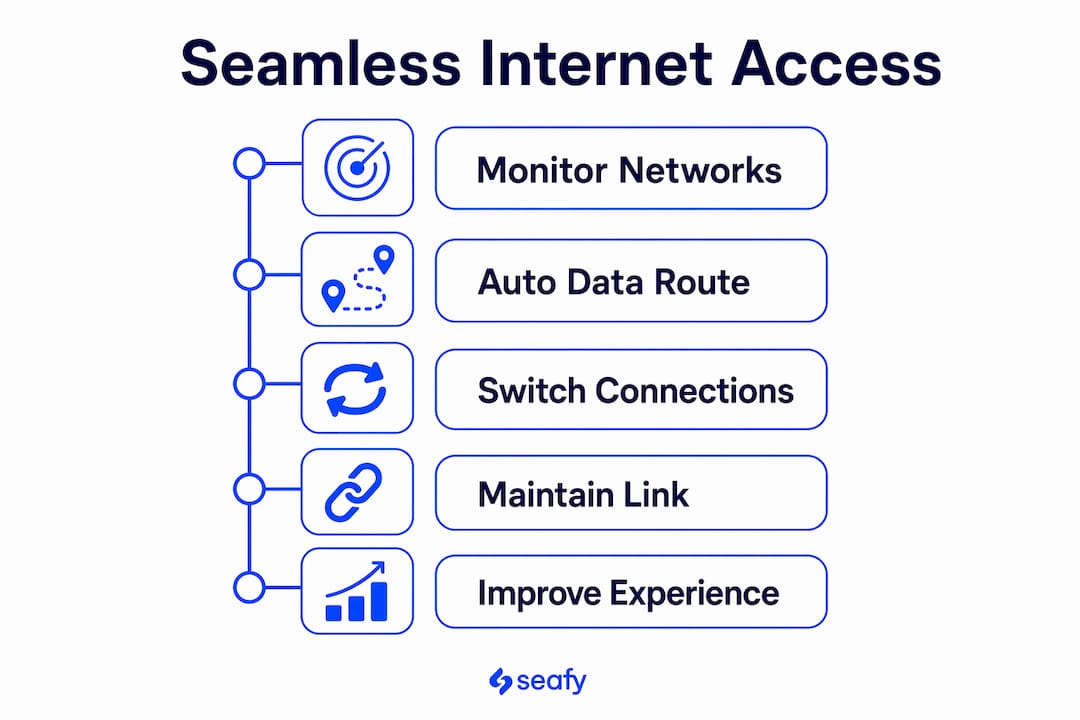
Seamless internet access works by continuously monitoring multiple network connections and routing your data through whichever path performs best at any given moment. This process happens at the packet level, meaning individual chunks of data are distributed across satellite, cellular, and Wi-Fi links simultaneously. The result is that your video call keeps running even when one network degrades or drops entirely.
The core technology behind this is called Smart Blending, which evaluates real-time metrics like latency, jitter, and packet loss to decide how to distribute traffic. Standard failover systems, by contrast, wait for a primary connection to fail before switching, which creates the 10 to 30 second gaps that interrupt calls and crash cloud sessions. Smart Blending eliminates those gaps entirely.
On vessels, this architecture typically combines three network layers:
- LEO/MEO/GEO satellite links for wide-area coverage far from shore
- LTE/5G cellular connections for coastal and port proximity zones
- Onboard Wi-Fi as the final delivery layer to passenger devices
Modular antenna systems, such as Airbus’s HBCplus, let ships switch dynamically among satellite types depending on orbit and signal conditions. LEO satellites deliver latency under 50ms, while older GEO systems exceed 600ms. That gap matters enormously for real-time applications like video conferencing or cloud-based project tools.
Pro Tip: If you’re working remotely on a ferry, schedule your most latency-sensitive tasks, like live video calls or VoIP meetings, for the first and last hours of the crossing when the vessel is closest to shore and LTE/5G signals are strongest.
Benefits of continuous internet access for passengers, crews, and remote workers
Reliable, uninterrupted connectivity at sea delivers concrete advantages that go well beyond simple convenience. For remote workers, the ability to stay inside cloud-based applications like Microsoft 365 and Microsoft Teams without session drops is the defining factor in whether a sea crossing is productive or wasted. Seamless connectivity treats network access as access-agnostic, meaning your applications never know a network switch occurred.
Here are the four most significant benefits for maritime users:
- Zero-interruption video calls. Automatic network transitions happen in milliseconds, so your Teams or Zoom session continues without the freeze or reconnect that standard failover causes.
- Consistent access to cloud tools. Applications like Google Workspace, Slack, and Microsoft 365 require stable, low-latency connections to sync files and deliver notifications in real time.
- Simplified experience with one subscription. Rather than juggling separate satellite and cellular plans, a converged service handles everything under a single login and package, reducing friction for both passengers and crew.
- Crew welfare and morale. For crew members on long voyages, reliable internet access for personal communication is directly tied to job satisfaction and mental health. Consistent connectivity is no longer a perk; it is a welfare standard.
The productivity and morale gains from always-on connectivity are particularly significant for maritime professionals who spend weeks at sea. When the internet works reliably, the ship stops feeling isolated.
How do seamless connectivity solutions compare for maritime use?
Not all onboard internet solutions deliver the same quality of continuous access. The table below compares the key technical dimensions that matter most for passengers and remote workers at sea.
| Feature | GEO satellite only | LEO/MEO satellite | Smart Blending (multi-network) |
|---|---|---|---|
| Latency | 600ms+ | Under 50ms | Under 50ms (adaptive) |
| Network switching | Manual or single failover | Automatic per orbit | Automatic, packet-level |
| Authentication | Manual login required | Varies | Automated via Passpoint/Hotspot 2.0 |
| Coverage at open sea | Strong | Growing rapidly | Combined for maximum uptime |
| Best use case | Basic browsing | Video calls, remote work | All applications, crew welfare |
LEO satellite latency under 50ms represents a fundamental leap from GEO systems, reshaping what is possible for remote work and entertainment onboard. This shift is why platforms integrating Starlink and similar LEO constellations now set the benchmark for maritime Wi-Fi quality.
Seafy.com sits in the Smart Blending category, combining satellite, cellular, and Wi-Fi to deliver high-speed connectivity on Mediterranean ferry routes. Passengers on Corsica Ferries, Grimaldi Lines, and GNV routes can purchase and activate packages directly through the Seafy portal onboard, without needing to configure anything manually.
Pro Tip: Before boarding, check whether your ferry route is covered by Seafy.com. Knowing your connectivity options in advance lets you plan data-heavy tasks, like downloading files or syncing backups, before departure rather than competing for bandwidth mid-crossing.
Practical tips for maintaining your connection while traveling or working at sea
Getting the most from onboard internet requires a few deliberate habits, especially if you depend on it for work. True seamless experience requires both physical network handoff and instant authentication to work together. If either fails, you get a connectivity gap even when signal is present.
Follow these practices to stay reliably connected:
- Register your device on known networks before departure. Hotspot 2.0 and Passpoint protocols allow automatic authentication when your device encounters a recognized network, bypassing captive portals entirely.
- Use a trusted onboard platform. Services like Seafy.com handle authentication and package activation through a single portal, removing the manual login steps that break connectivity during network transitions.
- Monitor your connection quality actively. Apps like Speedtest by Ookla or Cloudflare’s 1.1.1.1 give you real-time latency and packet loss readings, so you know when to delay a video call and when conditions are optimal.
- Plan bandwidth-heavy tasks strategically. Large file uploads, software updates, and video streaming consume the most bandwidth. Schedule these during off-peak hours onboard, typically early morning or late evening.
- Explore remote work at sea resources to understand how maritime professionals structure their workday around connectivity windows.
Cellular backup automatically takes over when a primary link fails, providing near-instant failover without user action. On a ferry, this means your connection stays alive as the vessel moves between satellite coverage zones and coastal LTE ranges.
Key takeaways
Seamless internet access at sea requires multi-network blending, LEO satellite integration, and automated authentication working together to deliver truly uninterrupted connectivity for passengers and remote workers.
| Point | Details |
|---|---|
| Core definition | Seamless access routes data automatically across satellite, LTE/5G, and Wi-Fi without user action. |
| LEO satellite advantage | LEO systems deliver latency under 50ms, enabling real-time video calls and cloud work at sea. |
| Authentication matters | Hotspot 2.0 and Passpoint protocols are required to prevent login gaps during network transitions. |
| Smart Blending vs. failover | Smart Blending eliminates the 10 to 30 second gaps that standard failover systems create. |
| Seafy.com for maritime users | Seafy.com offers onboard purchase and activation of Wi-Fi packages on major Mediterranean ferry routes. |
Why LEO satellites changed everything I thought I knew about maritime connectivity
I spent years advising maritime operators who accepted poor internet as an unavoidable cost of working at sea. The assumption was that satellite latency was simply too high for anything beyond email. GEO systems with 600ms latency made that assumption reasonable. Then LEO constellations arrived, and the entire calculus changed overnight.
What surprised me most was not the speed improvement. It was how much the user experience depended on the authentication layer, not just the signal. I watched passengers on a Mediterranean ferry crossing get a strong satellite signal and still lose their session because the network handoff triggered a captive portal login. The physical connection was there. The seamless experience was not.
The onboard Wi-Fi solutions that actually work in 2026 are the ones that treat authentication as part of the connectivity stack, not an afterthought. Platforms that automate both the network switch and the login process are the ones delivering on the promise of continuous internet access at sea.
My honest view is that the maritime industry is still two to three years away from standardizing this approach across all operators. Until then, choosing a platform that handles both layers, like Seafy.com does for Mediterranean routes, is the most practical decision a remote worker or frequent ferry traveler can make.
— Raffaele
Stay connected at sea with Seafy
If you travel or work on Mediterranean ferries, Seafy.com is built for exactly your situation. Seafy offers high-speed Wi-Fi packages you can purchase and activate directly onboard, with no technical setup required on your end.

Seafy integrates satellite, cellular, and Wi-Fi connectivity to keep you online whether you are streaming, on a video call, or managing files in the cloud. The platform is trusted by major ferry operators including Corsica Ferries, Grimaldi Lines, and GNV, covering some of the busiest Mediterranean routes. For crew members, Seafy also supports welfare connectivity needs throughout long voyages. Visit seafy.com to browse available packages for your next crossing and get online the moment you board. ⚡
FAQ
What is seamless internet access in simple terms?
Seamless internet access is a system that automatically switches your data between satellite, cellular, and Wi-Fi networks to keep you connected without interruption. You never need to manually reconnect or log in again when the network changes.
Why does latency matter for internet access at sea?
Latency determines whether real-time applications like video calls and cloud tools function properly. LEO satellites deliver latency under 50ms, while older GEO systems exceed 600ms, making the difference between a usable video call and a frozen screen.
How does Seafy.com provide seamless connectivity on ferries?
Seafy.com offers onboard Wi-Fi packages that combine satellite, cellular, and Wi-Fi networks, activated directly through its portal. It operates on major Mediterranean ferry lines including Corsica Ferries, Grimaldi Lines, and GNV.
What is Hotspot 2.0 and why does it matter for maritime Wi-Fi?
Hotspot 2.0, also called Passpoint, is a protocol that allows your device to authenticate automatically on known networks without a manual login. Without it, network handoffs at sea often trigger captive portals that break your connection.
Can I work remotely on a ferry with a reliable internet connection?
Yes, provided the vessel uses a multi-network blending system with LEO satellite coverage. Platforms like Seafy.com on Mediterranean routes support cloud applications, video calls, and file transfers for remote workers onboard.