Tech & Wi-Fi
Cruise Ship Connectivity Explained: What Passengers Need to Know
Curious about what is cruise ship connectivity? Discover how modern tech transforms internet access for passengers at sea. Stay connected!
02 June 2026
Cruise Ship Connectivity Explained: What Passengers Need to Know
TL;DR:
- Cruise ship connectivity relies on satellite systems like VSAT and Starlink, distributing internet via onboard Wi-Fi networks. Shared bandwidth limitations, signal conditions, and physical location influence internet speed and reliability at sea. Enhancing user experience involves software solutions like OpenRoaming and onboard messaging apps, making connectivity seamless and more dependable.
Cruise ship connectivity is the internet access system that allows passengers and crew to go online via satellite links and shipboard Wi-Fi networks, even hundreds of miles from the nearest coastline. The industry term for this infrastructure is maritime broadband, and it covers everything from the dish antennas mounted on a ship’s mast to the Wi-Fi access points installed in every cabin corridor. Technologies like VSAT satellites, Starlink, and OpenRoaming have transformed what was once a slow, expensive luxury into a reliable daily service. Understanding how it works helps you get the most out of your time at sea.
What is cruise ship connectivity and how does it work?
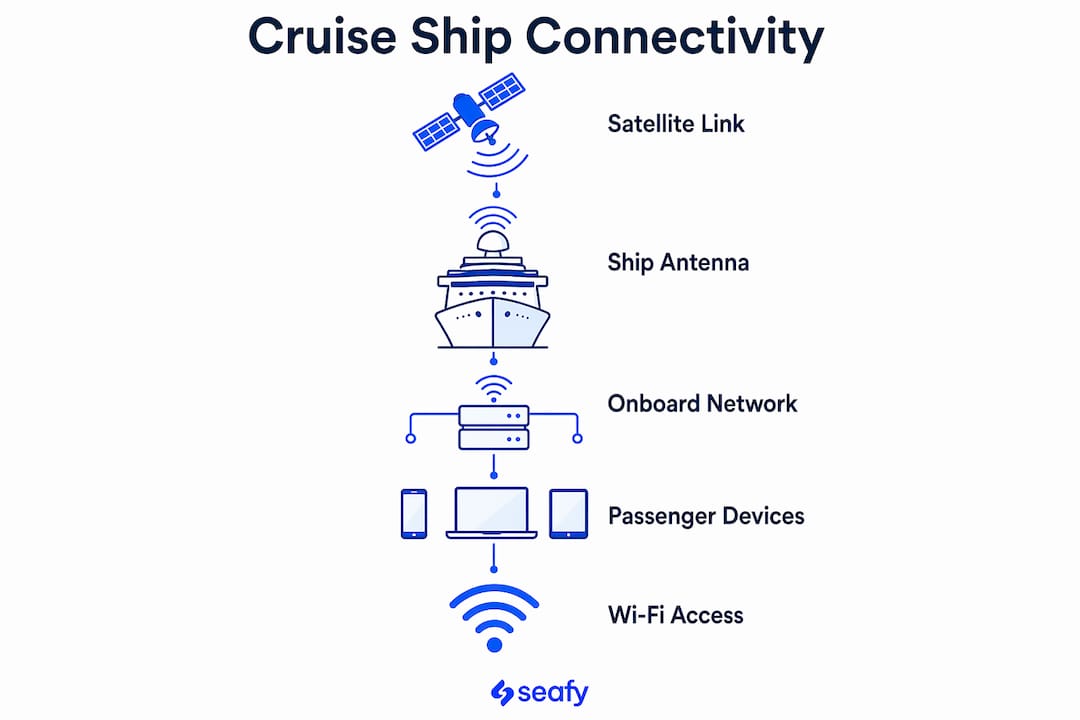
Cruise ship connectivity starts with satellites. Ship antennas link to satellites orbiting above Earth, which beam internet signals down to the vessel. Those signals are then distributed throughout the ship via onboard servers and hundreds of Wi-Fi access points, covering cabins, restaurants, pool decks, and crew quarters.

The two dominant satellite technologies in use today are VSAT (Very Small Aperture Terminal) and Starlink. VSAT uses geostationary satellites positioned roughly 35,000 kilometers above Earth, offering wide coverage but higher latency. Starlink uses low-Earth orbit satellites at around 550 kilometers altitude, delivering significantly lower latency and faster speeds. KT SAT’s partnership with Starlink, for example, enabled speeds up to 180 Mbps on the Korean cruise ship New Cidao Pearl, supporting tablet-based food ordering and real-time passenger services. That figure illustrates how far maritime broadband has come in just a few years.
Onboard, the network architecture resembles a small city more than a hotel. AIDA Cruises operates 12,000 Cisco network devices across its 11 ships, with physically separate data centers and redundant network paths to keep services running 24/7. This level of infrastructure means that even if one satellite link degrades, the ship’s network can reroute traffic automatically.
Here is what the core technical setup looks like on a modern cruise ship:
- Satellite dish antennas mounted on the ship’s superstructure, continuously scanning to lock onto the strongest available satellite signal as the vessel moves
- Onboard servers and routing equipment that manage traffic between the satellite link and the internal network
- Wi-Fi access points distributed throughout passenger and crew areas, typically supporting both 2.4 GHz and 5 GHz bands
- Redundant data centers providing failover capability and hosting onboard entertainment, guest services, and operational systems
Pro Tip: Connect to the 5 GHz Wi-Fi band when available onboard. It handles less congestion than 2.4 GHz and delivers noticeably faster speeds in crowded areas like the pool deck or main dining room.
You can read more about the technology behind nautical Wi-Fi to understand how ships maintain signal continuity while constantly moving.
What factors affect internet speed and reliability at sea?
Connection quality on a cruise ship is not fixed. Several variables interact to determine what speed you actually experience at any given moment.
- Shared bandwidth. Every passenger and crew member on the ship shares the same satellite uplink. Bandwidth contention from simultaneous users causes most daily slowdowns, not signal absence. A ship carrying 3,000 passengers all streaming after dinner creates a very different experience than the same connection at 7 a.m.
- Satellite position and signal path. Geostationary satellites sit far above the equator, meaning ships at higher latitudes face longer signal paths and higher latency. Weather conditions and satellite position both affect signal quality, with heavy rain or storms causing temporary degradation.
- Physical location on the ship. Thick steel bulkheads and interior cabins on lower decks receive weaker Wi-Fi signals than open-deck areas or cabins near access points.
- Time of day. Peak usage typically occurs between 8 p.m. and midnight. Scheduling video calls or large uploads for early morning or late afternoon produces a measurably better experience.
“The shared satellite link is the primary bottleneck. Prioritizing bandwidth usage and scheduling heavy activity off-peak can optimize your experience beyond what any technology upgrade alone can deliver.” — Virgin Voyages
Modern ships address these issues with load-balancing software that distributes traffic across multiple satellite beams and prioritizes latency-sensitive applications like video calls over background downloads. Understanding these dynamics helps you set realistic expectations and plan your connectivity use smartly. For a deeper look at what shapes your connection, Seafy’s guide on internet speeds at sea covers each variable in practical detail.
Modern onboard Wi-Fi solutions improving your experience
The biggest recent shift in cruise ship internet services is not raw speed. It is the reduction of friction. Two technologies stand out in 2026.
OpenRoaming vs. traditional login portals
| Feature | Traditional captive portal | OpenRoaming |
|---|---|---|
| Login required | Yes, every session | No, automatic secure connection |
| Session continuity | Drops when moving between zones | Maintained throughout the ship |
| Security | Variable, often unencrypted | WPA3-level encryption by default |
| Passenger experience | Repeated interruptions | Invisible, always-on connectivity |
AIDA Cruises deployed Wireless Broadband Alliance OpenRoaming across its entire fleet, eliminating the repeated login screens that frustrated passengers moving between decks and public areas. The result is that reducing login friction improves perceived connection quality significantly, even without increasing raw bandwidth. That is a counterintuitive but important insight: the experience of connectivity is as much about software design as satellite hardware.
App-based onboard messaging is the second major development. TUI Cruises rolled out the MXP365 Mein Schiff Chat system, integrated into the ship’s mobile app for private and group messaging without using cellular roaming services. Passengers can coordinate with travel companions across the ship without paying international SMS rates or burning through their Wi-Fi data allowance.
Pro Tip: Download your cruise line’s official app before boarding. Many ships now offer free onboard messaging through the app even on basic Wi-Fi plans, so you can stay in touch with your group without upgrading to a premium package.
Advantages of high-speed Wi-Fi for passengers and crew
Strong cruise ship internet services deliver concrete benefits across every type of traveler. Passengers increasingly expect internet as standard, and cruise lines that deliver on that expectation see measurable improvements in satisfaction scores and repeat bookings.
Here is what reliable connectivity actually enables onboard:
- Video calls and social sharing. Staying in touch with family or posting real-time travel content requires consistent upload speeds, not just download capacity.
- Remote work. Digital nomads and business travelers can attend video conferences, access cloud platforms, and meet deadlines without returning to port. This use case has grown sharply since 2020.
- Entertainment. Streaming music, catching up on series, or accessing cloud-based games all depend on low-latency, high-bandwidth connections.
- Crew welfare and safety. Crew members rely on stable connections to communicate with families at home during long voyages. Safety-critical systems including navigation, weather monitoring, and emergency communications also run on the ship’s network infrastructure.
- Onboard services. Tablet-based ordering, digital menus, and guest service portals all depend on the same network that passengers use for personal browsing.
The practical takeaway is that Wi-Fi on a cruise ship is no longer a convenience add-on. It is infrastructure that shapes the entire onboard experience, from how you order dinner to how the ship navigates safely.
Key takeaways
Cruise ship connectivity relies on satellite technology, onboard network architecture, and smart software design working together to deliver reliable internet access at sea.
| Point | Details |
|---|---|
| Satellite technology is the foundation | VSAT and Starlink beam internet to ship antennas, which distribute it via onboard Wi-Fi access points. |
| Shared bandwidth drives most slowdowns | Peak-hour congestion, not signal absence, causes the majority of speed drops onboard. |
| OpenRoaming removes login friction | Automatic secure connections, as deployed by AIDA Cruises, improve perceived quality without increasing raw bandwidth. |
| App messaging saves data and money | Onboard chat systems like TUI Cruises’ MXP365 let passengers communicate without cellular roaming costs. |
| Connectivity benefits everyone onboard | Passengers, remote workers, and crew all depend on stable internet for entertainment, communication, and safety. |
Why connectivity at sea matters more than most passengers realize
I have spent years watching maritime Wi-Fi evolve from a slow, overpriced novelty into genuine infrastructure. The shift that surprises most people is not the speed improvement. It is how much the experience of connectivity has changed.
When AIDA Cruises deployed OpenRoaming across its fleet, the passenger feedback was not “the internet got faster.” It was “the internet just works now.” That distinction matters. Most complaints about cruise ship Wi-Fi are not about raw megabits. They are about dropped sessions, repeated logins, and the frustration of a connection that feels unreliable even when the signal is technically present.
My honest view is that the cruise industry is still underestimating how much bandwidth demand will grow. Starlink integration is a strong step forward, but ships carrying thousands of passengers will need dynamic spectrum management and smarter traffic prioritization as 4K streaming and real-time cloud applications become the norm. The lines that invest in network intelligence now, not just satellite hardware, will be the ones passengers remember for the right reasons.
For passengers, my practical advice is simple: use off-peak hours for heavy tasks, download your cruise line’s app before boarding, and check whether your ship supports OpenRoaming. Those three steps cost nothing and make a real difference.
— Raffaele
Stay connected at sea with Seafy ⚡
Seafy is a maritime Wi-Fi platform built specifically for passengers and crew traveling on cruise ships and ferries across the Mediterranean and beyond. Partners include Corsica Ferries, Grimaldi Lines, and GNV, covering some of the busiest routes in the region.

Purchasing a Wi-Fi package is straightforward. You connect to the onboard portal, select the plan that fits your needs, and activate it directly through the Seafy platform. No complicated setup, no surprises. Whether you are a vacationer who wants to share photos in real time, a remote worker keeping up with deadlines, or a crew member staying in touch with family, Seafy delivers a reliable, easy-to-use connection at sea. Visit seafy.com to explore available packages for your next voyage.
FAQ
What is cruise ship connectivity?
Cruise ship connectivity is the internet access system onboard a vessel, delivered via satellite links and distributed through shipboard Wi-Fi networks to passengers and crew. It uses technologies like VSAT and Starlink to maintain a connection even in open ocean.
Why is cruise ship Wi-Fi sometimes slow?
The most common cause is shared bandwidth. When thousands of passengers use the same satellite uplink simultaneously, speeds drop. Connecting during off-peak hours, typically early morning, produces noticeably better performance.
How does OpenRoaming improve onboard Wi-Fi?
OpenRoaming enables automatic, secure Wi-Fi connections without repeated logins, maintaining session continuity as you move around the ship. AIDA Cruises deployed this technology across its entire fleet, significantly improving the passenger experience.
Can I work remotely on a cruise ship?
Yes. Modern cruise ships with Starlink or advanced VSAT connections support video conferencing, cloud applications, and file transfers. Scheduling bandwidth-heavy tasks during off-peak hours and choosing a premium data plan gives you the most reliable experience.
What is the difference between VSAT and Starlink on ships?
VSAT uses geostationary satellites at high altitude, offering broad coverage with higher latency. Starlink uses low-Earth orbit satellites, delivering lower latency and faster speeds. Both are in active use on cruise ships today, and some vessels combine both systems for redundancy.