Tech & Wi-Fi
The Role of Digital Entertainment at Sea in 2026
Discover the evolving role of digital entertainment at sea in 2026—how streaming, gaming, and connectivity enhance your cruise experience!
10 June 2026
The Role of Digital Entertainment at Sea in 2026
TL;DR:
- Digital entertainment at sea now encompasses streaming, gaming, and interactive media delivered through advanced onboard networks. Modern ships utilize content pre-caching, hybrid satellite, and 5G systems to ensure reliable, high-speed connectivity for passengers and crew. The quality of digital experiences heavily depends on ship generation, with newer vessels offering significantly better services and AI-driven personalization.
Digital entertainment at sea is defined as the full spectrum of streaming, gaming, interactive media, and connectivity-driven experiences delivered to passengers and crew aboard cruise ships and ferries through onboard technology infrastructure. The role of digital entertainment at sea has shifted from a luxury add-on to a baseline expectation, driven by platforms like Netflix and YouTube now integrated directly into cabin interfaces, and by satellite networks like Starlink delivering 1 Gbps+ connectivity to modern vessels. For travelers and remote workers crossing the Mediterranean on Corsica Ferries, Grimaldi Lines, or GNV routes, what happens onboard digitally shapes the entire voyage.
How do ships deliver digital entertainment despite bandwidth limits?
Maritime connectivity is the single biggest technical constraint shaping what you can watch, stream, or download at sea. Satellite bandwidth on maritime routes has historically been expensive and scarce, and cruise lines typically manage entertainment for 3,000 cabins using 50 to 100 Mbps of total bandwidth. That figure puts the challenge in sharp relief: 3,000 cabins sharing roughly the bandwidth of a mid-size office building.
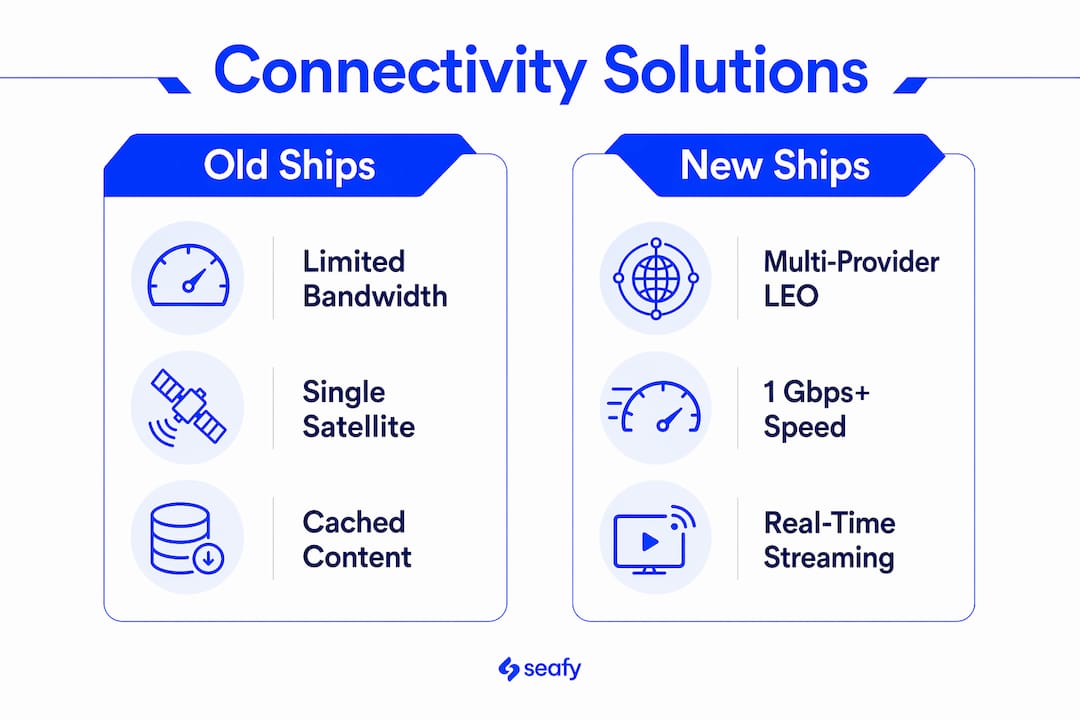
The industry’s answer is a hybrid delivery model. Ships pre-cache up to 50TB of content on local servers while in port, so passengers can stream movies and series on demand without touching live satellite bandwidth. Live channels, sports, and real-time data still travel via satellite, but the load is dramatically reduced. This is why your cabin TV often works flawlessly even when the ship is far from shore.
The next generation of ships goes further. Multi-provider LEO hybrid networks now deliver 1 Gbps or more shipwide, with automatic failover to 5G when vessels approach coastal areas. Starlink-ready systems launched in 2026 add low-latency connectivity that supports video calls, cloud gaming, and real-time analytics alongside passenger streaming.
- Content pre-caching: Up to 50TB stored locally, refreshed in port, covering movies, series, and on-demand libraries.
- Live satellite feeds: Sports, news, and live events delivered via LEO constellations with minimal buffering.
- 5G coastal handoff: Automatic switch to shore-based 5G for high-bandwidth tasks near ports.
- Adaptive streaming: Bitrate adjusts automatically based on available bandwidth to prevent interruptions.
Pro Tip: If you want the best streaming quality on a ferry or cruise ship, download content to your device before boarding. Onboard caching handles most on-demand video, but your own offline library is always the most reliable backup.
What are the latest innovations in immersive onboard entertainment?
Modern cruise ship entertainment has moved well beyond the theater and the casino. New flagship vessels now feature gaming zones exceeding 1,000 square meters, AI-powered interactive shows, and premium dining-theater experiences that blend physical and digital environments. This is not incremental improvement. It represents a fundamental rethinking of what a ship’s interior is for.
AI personalization is the most significant shift in how digital media on ships reaches passengers. Instead of a fixed daily program, systems now build recommendations based on your passenger profile, past viewing habits, and even time of day. The result is closer to what you experience on Netflix at home than what you would have found on a cruise ship five years ago.
“Digital entertainment is no longer isolated but integrated into the ship’s architecture and guest flow.” — Blooloop, 2026
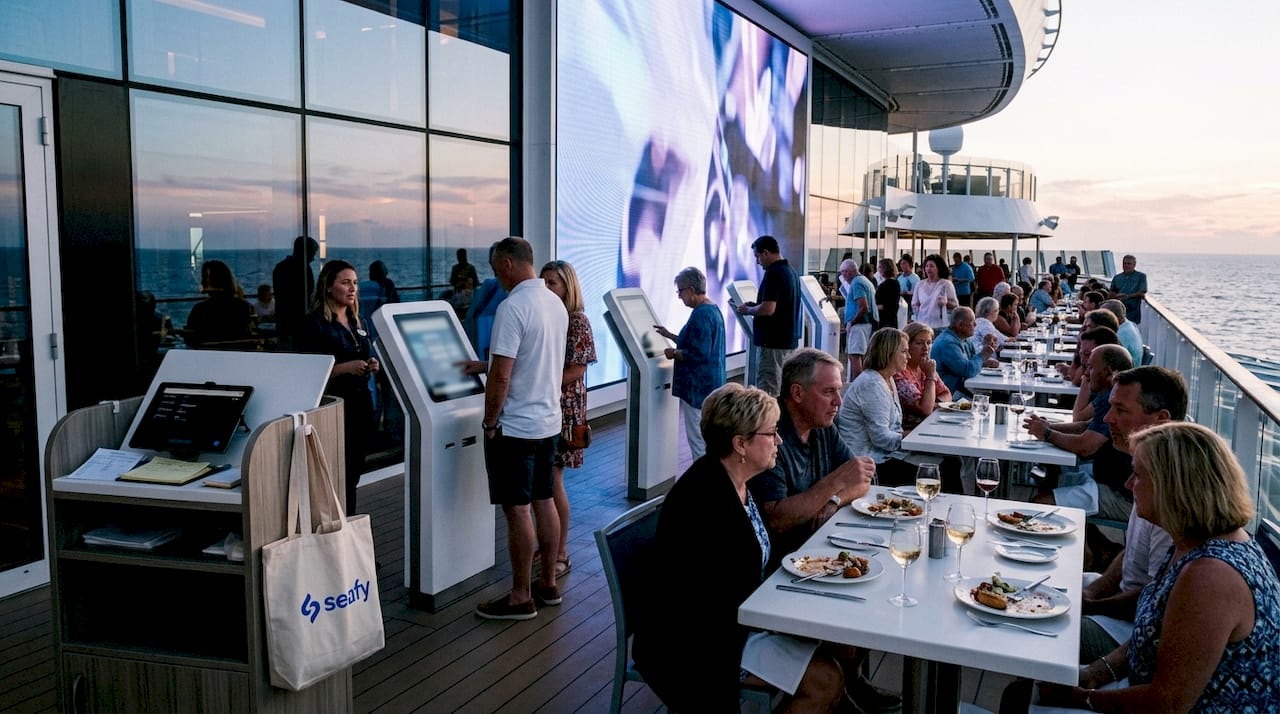
Dynamic ship designs reinforce this integration. Interactive stages and floor-to-ceiling LED screens transform dining areas and public spaces into programmable entertainment environments. A breakfast area becomes a live cooking show stage. An atrium becomes an immersive light installation. The physical and digital layers of the ship are now one system.
Mobile apps tie it all together. Keyless cabin entry, on-demand food service, and entertainment controls are managed from a single app, giving passengers a unified interface for their entire onboard life. For travelers who already manage everything from their phones on land, this feels natural and expected.
How does digital entertainment support remote workers at sea?
Remote workers aboard ships have specific needs that go beyond leisure streaming. You need reliable video conferencing, stable upload speeds for file transfers, and enough bandwidth diversity to handle a full workday without interruption. Hybrid satellite networks delivering 1 Gbps+ make this possible on newer vessels, and the gap between ship and shore connectivity is closing fast.
Here is how the digital experience breaks down for a remote worker on a modern ferry or cruise ship:
- Morning work session: Video calls via Zoom or Microsoft Teams run on the ship’s LEO satellite connection, with 5G handoff near ports for extra stability.
- Midday break: Netflix or YouTube, integrated directly into the cabin interface, provides a genuine downtime reset without needing to switch devices.
- Afternoon productivity: Cloud-based tools like Google Workspace or Notion sync reliably over the ship’s Wi-Fi, supported by automated guest experience tools that monitor and refine connectivity quality in real time.
- Evening entertainment: AI-curated content recommendations surface shows and films matched to your preferences, so downtime actually feels like downtime.
The internet speeds at sea you experience depend heavily on the ship’s generation and satellite infrastructure. Newer 2026 builds provide far superior digital experiences compared to older vessels, so checking your ship’s connectivity specs before booking is worth the effort.
Pro Tip: When working remotely on a ferry, schedule your heaviest bandwidth tasks like large uploads or video calls for early morning. Passenger demand on shared networks peaks mid-morning and after dinner, so off-peak hours give you noticeably better speeds.
How do digital systems balance passenger enjoyment and crew welfare?
The role of technology in cruising extends beyond passenger-facing entertainment. Crew members on long deployments rely on digital access for morale, training, and communication with family. KVH Link content is refreshed monthly and delivered via secure satellite and cellular networks, giving crew access to movies, training videos, and personal connectivity on multiple devices. This matters because crew welfare directly affects service quality and retention.
Operational efficiency is the other side of the equation. Automated media loaders push fresh content to ships without requiring manual crew intervention, which reduces both workload and the risk of unauthorized content. Cloud-based content supply chains also improve consistency across fleets, so passengers on any ship in a line get the same quality library.
| Stakeholder | Digital benefit | Delivery method |
|---|---|---|
| Passengers | On-demand streaming, AI recommendations | Local cache servers plus live satellite |
| Crew | Movies, training, personal connectivity | Secure satellite and cellular refresh |
| Operations | Automated content updates, safety signage | Cloud-based media management systems |
| Fleet management | Consistent quality across all vessels | Centralized automated content pipelines |
Digital signage adds another layer. Safety announcements, port arrival information, and emergency instructions are distributed across the ship via the same onboard network that carries entertainment. This means the role of Wi-Fi in ship operations is simultaneously a passenger experience tool and a critical safety infrastructure.
Key takeaways
Digital entertainment at sea is now a core passenger expectation, delivered through hybrid satellite networks, AI personalization, and automated content systems that serve both travelers and crew.
| Point | Details |
|---|---|
| Bandwidth is managed, not unlimited | Ships use local cache servers holding up to 50TB to reduce live satellite load. |
| AI personalization is the new standard | Passenger profiles drive content recommendations, replacing fixed daily programming. |
| Remote workers need more than leisure | Reliable 1 Gbps+ connectivity supports video calls, cloud tools, and streaming simultaneously. |
| Crew welfare depends on digital access | Monthly content refreshes via secure satellite networks support morale on long deployments. |
| Ship generation determines quality | Newer 2026 vessels deliver significantly better digital experiences than older fleets. |
Why the digital gap between old and new ships matters more than you think
I have spent time looking at how passengers actually experience connectivity across different vessel generations, and the gap is larger than most booking sites let on. A 2019-built ferry and a 2026 newbuild can carry the same route, the same price point, and a completely different digital reality. On the older vessel, streaming stutters, video calls drop, and the entertainment system feels like a hotel TV from a decade ago. On the newer one, you genuinely forget you are at sea.
What surprises me most is how few travelers check this before booking. Ship generation and satellite infrastructure are publicly available details, yet most people focus on cabin size and itinerary. For remote workers especially, this is the wrong priority order. A week of unreliable connectivity costs you far more in productivity and stress than a slightly smaller cabin.
The other thing worth saying plainly: AI-curated entertainment is not a gimmick. When passenger profiles drive content recommendations, the onboard experience genuinely competes with what you have at home. That changes the psychology of a voyage. You stop feeling like you are making a sacrifice by being offline and start feeling like you are in a different kind of living room. Legacy vessels that do not upgrade will lose passengers to ships that have made this shift. It is that direct.
— Raffaele
Stay connected at sea with Seafy
Whether you are streaming your favorite series in your cabin or joining a video call from the Mediterranean, reliable onboard internet makes the difference between a frustrating voyage and a genuinely productive or relaxing one.

Seafy provides high-speed Wi-Fi packages for passengers on Corsica Ferries, Grimaldi Lines, GNV, and other major ferry routes. You can purchase and activate your package directly through the seafy.com portal before or during your voyage. No complicated setup. No guesswork. Just connect and go. If you want to understand what to expect before you board, the Seafy guide on satellite internet at sea breaks down exactly how onboard connectivity works and what affects your experience. ⚡
FAQ
What is digital entertainment at sea?
Digital entertainment at sea refers to streaming, gaming, interactive media, and connectivity-driven experiences delivered to passengers and crew via onboard technology and satellite internet. It includes Netflix and YouTube integration in cabins, AI-powered show recommendations, gaming zones, and mobile app controls.
How does streaming work on a cruise ship or ferry?
Ships use a hybrid model: large content libraries are pre-cached on local servers holding up to 50TB, while live channels and real-time data travel via satellite. This setup allows smooth on-demand streaming even when the vessel is far from shore.
Can remote workers rely on ship internet for video calls?
Modern vessels with multi-provider LEO networks deliver 1 Gbps or more shipwide, making video conferencing via Zoom or Microsoft Teams fully viable. Older ships with limited satellite bandwidth may struggle with high-demand tasks during peak hours.
Does crew get access to digital entertainment too?
Yes. Crew entertainment packages include movies, training content, and personal connectivity refreshed monthly via secure satellite and cellular networks, supporting morale during long deployments at sea.
Does the ship’s age affect digital entertainment quality?
Significantly. Newer 2026 builds provide far superior digital experiences compared to older fleets, with Starlink-ready systems, smart cabin controls, and AI-personalized content that older vessels simply cannot match.