Tech & Wi-Fi
Top maritime Wi-Fi solutions for cruise and ferry travel
Discover top examples of maritime connectivity solutions for cruise and ferry travel, ensuring smooth sailing with reliable onboard Wi-Fi!
03 May 2026
Top maritime Wi-Fi solutions for cruise and ferry travel
TL;DR:
- Onboard maritime Wi-Fi performance depends heavily on advanced roaming technology and satellite infrastructure rather than speed alone.
- Modern systems like OpenRoaming provide seamless connectivity and reduce login frustrations, ensuring a better passenger experience at sea.
Picture yourself on a Mediterranean ferry, halfway between Barcelona and Mallorca, trying to send a quick video call home or finish a work presentation before docking. You pull up the ship’s Wi-Fi, type in your password for the third time that day, and still watch the spinning loading circle mock you. Sound familiar? Onboard Wi-Fi architecture affects your experience far more than just the raw internet speed advertised at the boarding gate. This article cuts through the jargon to walk you through how today’s best maritime connectivity solutions actually perform, what separates a frustrating trip from a smooth one, and how to choose the right option for your needs. 🌐
Table of Contents
- Key criteria for evaluating Wi-Fi at sea
- Satellite internet: Powering ship-wide connectivity
- Roaming authentication: Seamless logins across your voyage
- Comparing top passenger Wi-Fi solutions
- Why most onboard Wi-Fi struggles—and what truly matters for passengers
- Get connected with Seafy: Wi-Fi made for sea travelers
- Frequently asked questions
Key Takeaways
| Point | Details |
|---|---|
| Modern Wi-Fi matters | A smooth shipboard internet experience requires advanced roaming and modern authentication, not just high bandwidth. |
| Satellite powers most connections | Satellite systems like Starlink enable connectivity at sea but shared bandwidth means speeds can fluctuate during busy hours. |
| Authentication impacts experience | Next-gen roaming solutions eliminate repeated logins, offering true session stability as you move around the vessel. |
| Choose tech for your needs | Match your ship or Wi-Fi package to your real needs—remote work, streaming, or just messaging—by reviewing both bandwidth and login systems. |
Key criteria for evaluating Wi-Fi at sea
Now that you know why onboard connectivity matters, let’s break down what features really set top-performing maritime Wi-Fi apart.
Not all ship Wi-Fi is built the same. A ferry running older satellite equipment and a basic login system will feel completely different from a modern cruise ship with advanced roaming technology, even if both advertise “high-speed internet.” Knowing what to look for puts you in control.
Here are the key criteria worth checking before or during your voyage:
- Session stability: Can you move from your cabin to the pool deck without losing your connection mid-video?
- Authentication ease: Do you log in once and stay connected, or does the system kick you out every time you switch locations?
- Bandwidth during peak hours: Raw speed means little if 3,000 passengers are all streaming at dinner. Per-user throughput during busy periods is what actually matters.
- Quayside connectivity: Some modern systems treat the dock as a virtual extension of the ship’s network, keeping you online even while in port.
- Coverage in all areas: Outdoor decks and interior cabins both need strong signal, not just the main lounge.
- Support for key apps: Streaming services, video calls, and business tools like VPNs all have different bandwidth requirements.
Maritime Wi-Fi challenges such as session stability, bandwidth contention, and repetitive logins are the three biggest design problems operators must solve. Understanding these helps you ask smarter questions when comparing ships or Wi-Fi packages.
You can also check out captive portal basics and reliable Wi-Fi practices for deeper background on both the technology and the habits that help you stay connected.
Pro Tip: Ask your ferry line or cruise operator whether their network uses modern roaming technology or a traditional captive portal. This single detail will tell you more about your day-to-day experience than any speed number they advertise.
Satellite internet: Powering ship-wide connectivity
With these criteria in mind, let’s look at the backbones powering shipboard Wi-Fi. Today, that’s almost always satellite.
Ships at sea are cut off from the land-based cellular towers and fiber cables that power fast internet on shore. Satellite connections bridge that gap, beaming data from the ship up to orbiting satellites and back down to ground stations. The role of satellite internet in modern maritime travel has grown enormously in recent years, with newer technologies replacing older, slower systems.
Here’s what you need to know about satellite Wi-Fi at sea:
- Shared bandwidth model: Every passenger on the ship shares the total satellite capacity. When everyone is streaming after dinner, individual speeds drop.
- High-throughput satellites (HTS): These newer satellites, including Starlink’s low-earth orbit (LEO) constellation, offer far greater capacity and lower latency than older systems.
- LEO vs. GEO satellites: Traditional geostationary (GEO) satellites sit 35,000 km above Earth and create noticeable lag. Starlink’s LEO network orbits at roughly 550 km, cutting latency dramatically for video calls and gaming.
- Weather impact: Heavy storms can degrade satellite signals, though modern systems are much more resilient than older dishes.
⚡ Speed spotlight: Royal Caribbean’s Star of the Seas uses Starlink to deliver 10Mbps per passenger on average, even though the ship’s total connection reaches 10Gbps. That’s the shared bandwidth reality in action.
This example from Royal Caribbean shows both the promise and the limitation of satellite Wi-Fi. Ten gigabits sounds extraordinary, but divided across thousands of simultaneous users, the per-person experience depends heavily on overall ship load. For context, streaming HD video typically requires about 5Mbps, so 10Mbps per user is workable but leaves little headroom during peak periods.
Understanding how satellite Wi-Fi works at a practical level helps you set realistic expectations and choose the right package for your trip.
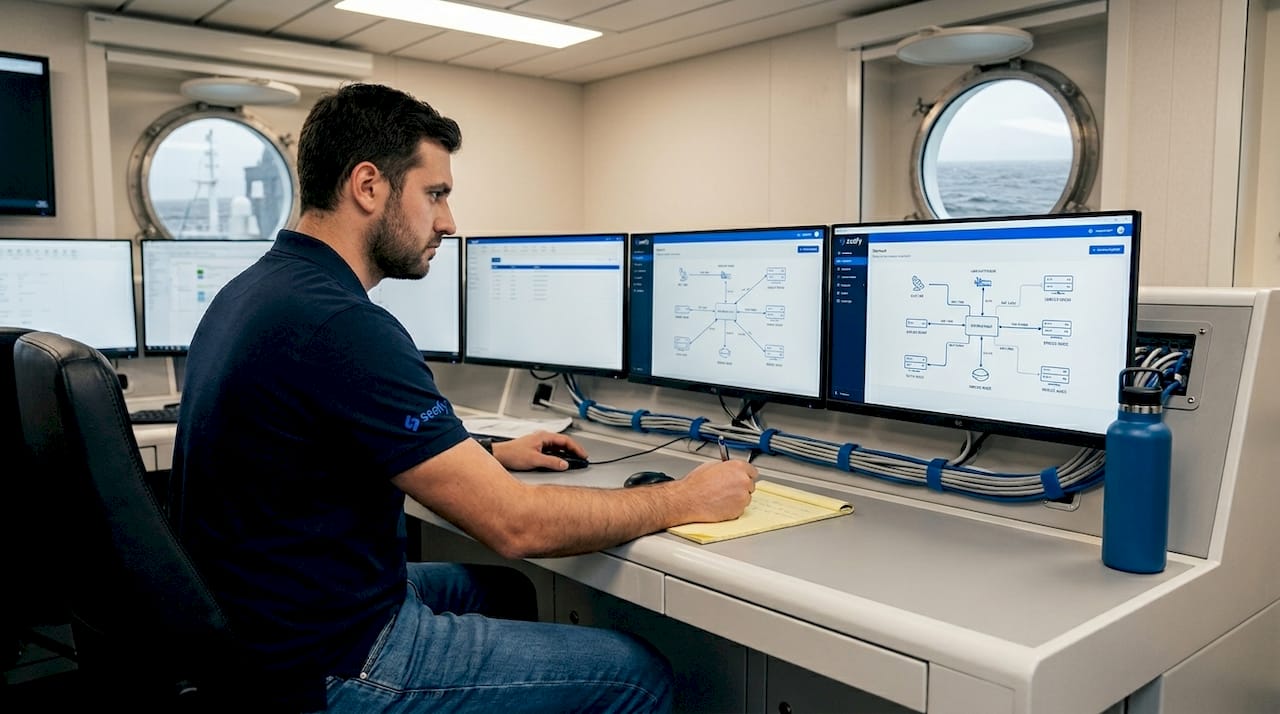
Pro Tip: Large modern cruise ships are increasingly adopting Starlink or Ku-band HTS systems. Smaller Mediterranean ferries may still run older, lower-capacity satellites. Always check what technology the specific vessel uses before purchasing a premium Wi-Fi package.
Roaming authentication: Seamless logins across your voyage
Bandwidth is only part of the equation. True passenger satisfaction comes from how easy it is to connect and stay online, which brings us to authentication systems.
You have probably experienced the frustration of logging into a hotel or airport Wi-Fi network, wandering to a different part of the building, and suddenly losing your connection. The same thing happens on ships, only worse, because a large cruise ship has dozens or even hundreds of individual Wi-Fi access points spread across multiple decks.
Traditional shipboard systems use what is called a captive portal: a login page you must authenticate through each time you switch between access points. Walk from your cabin to the restaurant, and you might need to log in again. This is a top source of passenger complaints, and it has nothing to do with internet speed.
Newer systems solve this through roaming authentication protocols. WBA OpenRoaming is one of the most advanced. It lets your device move seamlessly between access points without triggering a new login prompt, much like how your phone moves between cell towers without dropping your call.
The authentication experience on a ship can genuinely make or break your enjoyment of even a fast connection.
“AIDA Cruises deployed WBA OpenRoaming across 107 access points and recorded zero drops during a 14-day dry dock test, with no repeated logins required as passengers moved around the ship.”
That result is significant. Zero drops across a full ship during a two-week trial means passengers stayed connected whether they were at the pool, in their cabin, or in the dining room. For anyone trying to stay in touch with family or handle a work email, that consistency is invaluable.
| Feature | Captive portal (traditional) | OpenRoaming (modern) |
|---|---|---|
| Login frequency | Every zone change | Once per session |
| Session stability | Drops on deck change | Continuous |
| Onboarding speed | Slow, manual | Instant, automatic |
| Passenger satisfaction | Frequently frustrating | Consistently smooth |
Comparing top passenger Wi-Fi solutions
To make all these features easier to compare, here is how major technologies and setups stack up for real-world passenger needs.
Real-world examples from Royal Caribbean and AIDA Cruises demonstrate that the best onboard experience combines strong satellite infrastructure with smart authentication.
| Solution type | Speed potential | Login friction | Entertainment ready | Remote work ready |
|---|---|---|---|---|
| Satellite + captive portal | Medium | High (repeated logins) | Moderate | Limited |
| Satellite + OpenRoaming | High | Very low (single login) | Excellent | Good |
| Hybrid satellite/cellular + modern login | Highest | Minimal | Excellent | Excellent |
Based on what we know about these technologies, here are practical recommendations for different types of travelers:
- Casual users and vacationers: A standard satellite plan with captive portal will cover social media, messaging, and occasional browsing. Just expect to log in a few times per day.
- Remote workers and digital nomads: Prioritize ships or ferries using OpenRoaming or equivalent, and choose the highest-tier package available. Consistent uptime matters more than peak speed.
- Streaming enthusiasts: Look for vessels with Starlink or HTS satellite plus modern authentication. Buffering during peak hours is still possible, so schedule heavy streaming for off-peak times like early morning.
For a broader overview of what is available in 2026, check out the best onboard Wi-Fi guide and tips specifically for remote work at sea.
Why most onboard Wi-Fi struggles—and what truly matters for passengers
After reviewing all the technical solutions, here is an honest insider take on what actually impacts your experience as a traveler.
The cruise and ferry industry loves to advertise impressive-sounding numbers. “10Gbps total ship bandwidth!” sounds extraordinary until you remember that it is shared among thousands of people. The real question is never about total capacity. It is about what you personally experience at 8 PM when everyone on board is trying to watch something.
In our view, the biggest culprit behind miserable onboard Wi-Fi is not slow satellites. It is repeated logins and unpredictable session drops. These frustrations make even a moderately fast connection feel unusable, especially if you are in the middle of a work call and suddenly get a login page demanding your credentials again.
Seamless internet at sea is not a luxury; it is a basic expectation for modern travelers, and the technology to deliver it already exists.
Our strong advice: before booking, look beyond the advertised speed. Ask or research whether the ship uses OpenRoaming or a similar modern authentication system. A connection that rarely drops and never interrupts you mid-task is worth far more than a theoretical speed boost that only exists at 3 AM with nobody else online.
“Zero drops means more Netflix on deck and fewer headaches when you’re remote working between ports.”
If a ship openly advertises its network architecture, that is a good sign. Operators who invest in seamless authentication are investing in your actual experience, not just a marketing number.
Get connected with Seafy: Wi-Fi made for sea travelers
For your next Mediterranean journey, consider solutions like Seafy, built specifically around the needs of cruise and ferry passengers like you.

Wi-Fi onboard with Seafy is designed to address exactly the pain points we covered: easy login, stable coverage throughout the ship, and speeds that support streaming, video calls, and remote work. Seafy partners with major ferry lines including Corsica Ferries, Grimaldi Lines, and GNV to bring reliable connectivity to popular Mediterranean routes. Whether you are on a short overnight crossing or a longer voyage, you can purchase and activate a package right from your device. If you work while you travel, our remote work advice section is full of practical tips for staying productive at sea. Bon surf! 🌐
Frequently asked questions
What Wi-Fi speeds should I expect on a cruise ship?
Most modern cruise ships offer 10Mbps per passenger on average, though speeds vary depending on the satellite system in use and how many passengers are online at the same time.
Why do I have to log in multiple times to ship Wi-Fi?
Traditional systems use captive portals that reset with each access point, but newer technologies like OpenRoaming keep you authenticated continuously as you move around the ship.
Can I work remotely with ferry or cruise Wi-Fi?
Yes, especially on ships with modern satellite infrastructure and roaming authentication, though shared bandwidth limits mean peak-hour performance can still fluctuate.
What should I look for when choosing a ship for entertainment streaming?
Prioritize vessels advertising high-speed satellite like Starlink combined with modern authentication, since seamless connectivity architecture reduces buffering and interruptions far more than raw speed alone.