Tech & Wi-Fi
How internet connectivity shapes your ferry and cruise experience
Discover the role of internet in passenger experience on ferries and cruises. Learn how modern connectivity transforms your journey at sea!
01 May 2026
How internet connectivity shapes your ferry and cruise experience
TL;DR:
- Satellite and hybrid networks have significantly improved internet connectivity on ships, especially in the Mediterranean.
- Passengers now expect reliable, tiered packages costing $15 to $30 daily, suitable for various online needs.
- Proper planning, off-peak usage, and device management enhance the onboard internet experience despite some inherent limitations.
Think internet at sea is still the sluggish, frustrating experience it was a decade ago? Think again. Satellite technology, especially Starlink, plus hybrid networks combining cellular and satellite signals, has transformed what you can expect when you cross the Mediterranean on a ferry or cruise ship. Tiered packages for basic browsing and premium streaming now cost roughly $15 to $30 per day, giving you real options rather than a one-size-fits-all connection. This guide breaks down exactly what is available, what to expect, and how to get the most from your time online onboard. 🌐
Table of Contents
- Why internet matters for ferry and cruise passengers
- Types of onboard internet: Packages, pricing, and technology explained
- Onboard versus at-home: What passengers can really expect
- Getting the best online experience: Practical tips for travelers
- Why most guides underestimate the new reality of internet at sea ⚡
- Set sail with reliable internet: How Seafy can help
- Frequently asked questions
Key Takeaways
| Point | Details |
|---|---|
| Modern networks lead | Hybrid and satellite technologies now cover most Mediterranean routes, dramatically improving reliability. |
| Tiered options available | Passengers can choose between basic, streaming, or remote work packages to fit their needs and budget. |
| Manage expectations | Shipboard internet still lags behind home speeds but is good enough for most leisure and professional uses. |
| Maximize your connection | Travelers can optimize their online experience by preparing devices, choosing off-peak times, and selecting the right plan. |
Why internet matters for ferry and cruise passengers
Being connected at sea is no longer a luxury. It is a baseline expectation, whether you are a remote worker who cannot fully disconnect, a family trying to stream a movie during a long overnight crossing, or a traveler who simply wants to share photos with friends back home.
Consider what modern Mediterranean passengers actually need from their connection:
- Remote work and video calls: Platforms like Zoom, Microsoft Teams, and Google Meet are now everyday tools, even on vacation.
- Streaming entertainment: Long crossings, sometimes 12 to 24 hours for routes from Genoa to Palermo, make streaming services genuinely valuable.
- Navigation and trip planning: Real-time maps, local restaurant searches, and last-minute hotel bookings all require a working connection.
- Staying in touch: Messaging apps and social media keep you connected to family, especially important for families traveling separately.
- Crew communications: Ship crew members also rely on internet for personal communication during off-hours.
Understanding why onboard Wi-Fi changes your travel experience goes beyond convenience. It directly affects passenger satisfaction, loyalty to a ferry line, and even the overall mood of a trip.
“Connectivity is now as expected as a hot meal onboard. Passengers who cannot get online often rate the entire trip lower, regardless of other service quality.” — Industry passenger feedback analysis
Good news: Wi-Fi on ferry travel has advanced rapidly, and hybrid networks now cover 80 to 90% of itineraries with a reliable return on investment under two years for operators. That means ferry and cruise companies have strong financial reasons to keep investing in better connectivity for you.
Now that you know why internet is such a hot topic for travelers, let’s break down the latest options available onboard.
Types of onboard internet: Packages, pricing, and technology explained
Most ships in 2026 offer a tiered internet package system, similar to what you see from mobile carriers. You pick what suits your needs and budget. Here is a clear breakdown:
| Package tier | Best for | Typical daily cost | Key features |
|---|---|---|---|
| Basic / Social | Messaging, light browsing | $15 | WhatsApp, email, social media |
| Standard | General browsing, video calls | $20 | Faster speeds, HD calls |
| Premium / Streaming | Netflix, remote work | $25 to $30 | High bandwidth, lower latency |
Royal Caribbean’s Surf+Stream package, for example, sits around $20 per day and allows streaming on one device. Tiered packages for basic browsing through premium remote work are now the industry norm across almost all major lines.
The technology behind these packages matters too. Traditional geostationary (GEO) satellites sit roughly 36,000 kilometers above Earth, which creates noticeable signal delay. Starlink uses low-Earth orbit (LEO) satellites, orbiting at around 550 kilometers, dramatically cutting that delay and boosting speeds. Many ferries, including those operated by Corsica Ferries, Grimaldi Lines, and GNV, are integrating these newer systems. The result is high-speed internet on ferries that genuinely competes with mid-range home broadband for most everyday tasks.
Hybrid models layer satellite coverage with cellular boosters near coastlines, which is a significant advantage in the Mediterranean. When your ship is close to the Italian or French coast, cellular signals can kick in and improve your experience noticeably. Learn more about onboard cruise Wi-Fi hotspots and how these access points distribute signal across decks.
Understanding the options is one thing, but what is it actually like to be connected at sea? Let’s compare the real onboard experience to land-based internet.
Onboard versus at-home: What passengers can really expect
Here is an honest picture of the differences you will notice:
| Factor | Home internet | Ship internet (2026) |
|---|---|---|
| Average download speed | 100 to 500 Mbps | 10 to 80 Mbps |
| Latency | 5 to 20 ms | 30 to 80 ms (LEO) |
| Consistency | Very stable | Variable by conditions |
| Weather impact | Minimal | Moderate |
| Congestion risk | Low | Higher during peak hours |
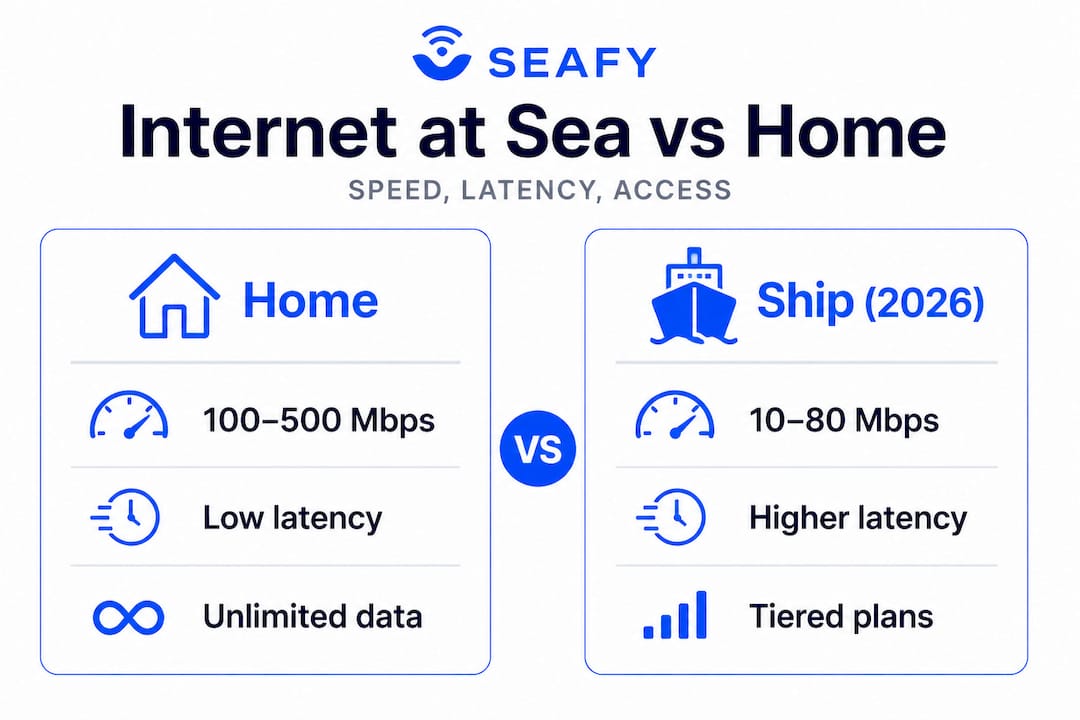
Shipboard internet has improved dramatically thanks to the Starlink revolution, but it still lags behind home broadband in congestion, weather sensitivity, and latency. This is not a failure of the technology. It is simply the physics of moving satellites, distance from land, and thousands of passengers sharing a finite connection.
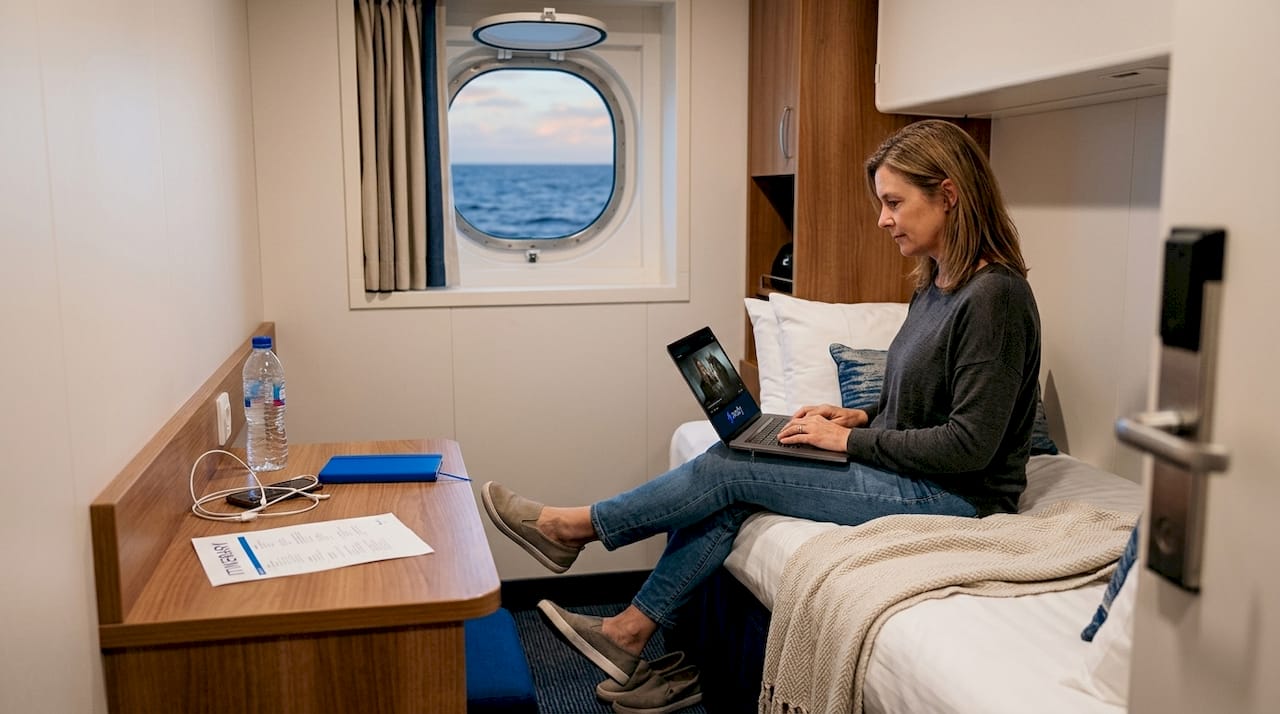
What this means practically: video calls work well, streaming is reliable at off-peak hours, and basic browsing is smooth. However, online gaming with fast reaction times and large file downloads during peak hours can frustrate you if expectations are not calibrated.
The Mediterranean is actually one of the best regions in the world for maritime internet. Coastal geography keeps ships near cellular towers more often, and the density of ferry operators investing in hybrid infrastructure is high. Think of the internet’s impact at sea as genuinely close to home quality for 80% of your use cases, with the remaining 20% requiring some patience or smart timing.
Pro Tip: Connect during off-peak hours such as early morning or late evening when most passengers are asleep. Speeds during these windows are frequently two to three times faster than midday peak periods.
Once you know what is possible and what is not, it is time to get practical. Here is how to make the most of your online time onboard.
Getting the best online experience: Practical tips for travelers
Being prepared makes a real difference. Follow these steps before and during your trip:
- Choose the right package upfront. If you are just messaging family, the basic tier saves you money. If you have work calls or want to stream, invest in the premium tier from the start rather than upgrading midtrip.
- Update everything before you board. App updates, operating system patches, and cloud syncs consume massive bandwidth. Do all of this on home Wi-Fi before departure.
- Download content offline. Netflix, Spotify, and YouTube all offer offline downloads. Queue up movies, playlists, and podcasts before you board.
- Disable background apps. Cloud backup services, streaming preloads, and automatic updates running silently will eat your data allowance. Turn them off or set them to manual.
- Turn off your VPN. VPNs add latency and can sometimes block access to the ship’s portal entirely. Unless you genuinely need one for work security, disable it onboard.
- Use Wi-Fi calling apps instead of native cellular. WhatsApp calls and FaceTime use far less data than traditional video call software.
- Log off when you are not using it. Many packages are time-based rather than data-based, so active management matters.
Preparation and smart off-peak habits are key, and hybrid networks make the Mediterranean the ideal region to put these strategies into practice. For more detail, explore these onboard internet tips and ferry internet best practices that cover everything from device settings to data management.
Pro Tip: If you are traveling with a group, one person can purchase a higher-tier package and use a mobile hotspot to share the connection across a few devices, reducing the cost per person significantly.
With these tips, you are ready to get online at sea. But what does the future hold, and what do most articles miss? Here is our perspective.
Why most guides underestimate the new reality of internet at sea ⚡
Many travel articles about cruise and ferry internet are still written from a 2018 or 2020 mindset, when satellite internet was genuinely painful. That picture is outdated.
We believe the real story is this: the gap between home internet and ship internet has shrunk to a level most passengers will not even notice for everyday tasks. Video calls, streaming at HD quality, remote work sessions, and social media browsing are all genuinely comfortable experiences on modern Mediterranean routes, provided you choose the right package and use off-peak hours.
Hybrid networks now cover 80 to 90% of itineraries with a return on investment that makes operator upgrades financially sensible. That economic reality means investment in better onboard connectivity will continue accelerating, not slowing down. The operators partnering with platforms like Seafy and integrating Starlink are not doing this as a side project. It is a core part of their competitive strategy.
The Mediterranean, with its dense coastal routes, high ferry traffic, and proximity to cellular infrastructure, is at the absolute front of this shift. Travelers on routes between Italy, France, Spain, Sardinia, Corsica, and Sicily can expect consistently strong service that would have seemed impossible just five years ago. And onboard entertainment powered by Wi-Fi is raising the bar for the entire passenger experience.
Our advice: stop assuming the worst and start planning for what is actually available. Read the current package details, prepare your devices, and treat your onboard connection as a capable tool rather than a last resort.
Set sail with reliable internet: How Seafy can help
Whether you are crossing the Mediterranean for business or pleasure, having a dependable connection changes everything about your journey. Seafy was built specifically to make that connection effortless for ferry and cruise passengers.

With Seafy, you can browse, select, and activate a Wi-Fi package that fits your exact needs, from a quick social media check to full remote work sessions. Seafy partners with major ferry lines including Corsica Ferries, Grimaldi Lines, and GNV to deliver a seamless, portal-based experience backed by the latest satellite technology. Ready to plan your connected crossing? Visit Wi-Fi on board with Seafy to explore available packages and get onboard with confidence. 🌐
Frequently asked questions
Is internet access on ferries and cruises reliable for remote work?
Modern hybrid and satellite networks now provide reliable internet for remote work on most Mediterranean routes, though performance can vary by ship and itinerary. Hybrid systems cover 80 to 90% of routes, making consistent remote work connectivity a realistic expectation.
How much does typical onboard internet cost?
Most ships offer packages from $15 to $30 per day, with pricing depending on speed, data allowance, and the number of devices you want to connect.
What is the main limitation of shipboard internet compared to at home?
Despite vast improvements, maritime internet still lags home broadband in latency and consistency, mainly due to satellite signal travel times and the number of passengers sharing the network simultaneously.
How can I get the most from my onboard internet package?
Choose off-peak times such as early morning, turn off nonessential background apps, and disable your VPN to reduce latency and keep your connection running smoothly throughout your crossing.