Tech & Wi-Fi
How Wi-Fi Shapes the Passenger Experience at Sea
Discover how modern maritime Wi-Fi with Starlink and OpenRoaming transforms cruise and ferry travel for leisure, communication, and remote work at sea.
24 April 2026
How Wi-Fi Shapes the Passenger Experience at Sea
TL;DR:
- Passengers now expect reliable, high-speed Wi-Fi at sea similar to home connections.
- Modern maritime internet uses satellite, 5G, and onboard routing for seamless coverage.
- Industry improvements include widespread Wi-Fi 6 and OpenRoaming for automatic, secure access.
How Wi-Fi shapes the passenger experience at sea
Forget everything you think you know about internet at sea. The days of painfully slow, overpriced, and barely functional shipboard Wi-Fi are fading fast. Today, cruise and ferry passengers expect the same connectivity they enjoy at home, and the industry is racing to deliver exactly that. Whether you’re streaming your favorite series between ports, joining a video call from the upper deck, or simply keeping in touch with family, the quality of your onboard connection now shapes how you remember the entire trip.
Table of Contents
- Why Wi-Fi matters for cruise and ferry passengers
- How shipboard Wi-Fi works: From satellite to smartphone
- What reliable Wi-Fi enables: Real-life benefits for travelers
- Current limitations and the push for seamless access
- The future of passenger connectivity: What makes a real difference?
- Stay connected on your next voyage with Seafy
- Frequently asked questions
Key Takeaways
| Point | Details |
|---|---|
| Demand is rising | Most cruise and ferry passengers expect reliable Wi-Fi for work and leisure at sea. |
| Technology drives change | Hybrid satellite, 5G, and OpenRoaming platforms deliver faster, seamless onboard internet. |
| Not all Wi-Fi is equal | Some ships still use old equipment—check your provider for the best experience. |
| Future is seamless | Universal, frictionless Wi-Fi access is becoming an expected part of maritime travel. |
Why Wi-Fi matters for cruise and ferry passengers
Connectivity at sea is no longer a bonus feature tucked into a premium cabin package. It has become central to how passengers experience modern travel. Think about how you use the internet on any given day at home: you check messages, watch videos, browse social media, manage work emails, and maybe join a video call. You expect the same on board, and rightfully so.
The digital needs of today’s passengers span a wide spectrum:
- Leisure travelers want to stream movies, share vacation photos instantly, and browse travel guides for upcoming ports.
- Remote workers and digital nomads need stable enough connections for cloud applications, video conferencing, and file transfers.
- Families want to stay in touch with relatives at home and keep children entertained during long crossings.
- Couples and solo travelers want to post real-time content to social media without waiting until they return to land.
The numbers back this up. Over 60% of cruise passengers use iPhones for Wi-Fi access on board, reflecting just how smartphone-dependent modern travel has become. This isn’t a niche group of tech enthusiasts. This is the majority of passengers sailing today.
Understanding Wi-Fi’s impact on ship operations reveals something important: connectivity affects not just passenger satisfaction but also crew productivity, safety communication, and the overall efficiency of maritime operations. And when it comes to passenger feedback, reliable internet consistently ranks among the top factors influencing satisfaction scores and repeat bookings.
“A strong onboard Wi-Fi connection is no longer a perk. For most passengers, it’s a baseline expectation that shapes their entire travel experience.”
Research consistently shows that Wi-Fi and ferry satisfaction are directly linked. Passengers who enjoy smooth connectivity are far more likely to rate their journey positively and recommend the operator to others.
Pro Tip: Before you board, check your ferry or cruise operator’s Wi-Fi package options online. Many providers, including those partnering with Seafy, let you pre-purchase plans at a better rate than buying on board.
How shipboard Wi-Fi works: From satellite to smartphone
The sheer demand from passengers has pushed operators to completely rethink the technical infrastructure powering your internet connection at sea. The result is a hybrid system that blends satellite technology, 5G cellular networks, and smart onboard routing to deliver stable, wide-reaching coverage.
At the core of modern maritime connectivity is low Earth orbit (LEO) satellite technology. Starlink, operated by SpaceX, has become a leading player here. Unlike older geostationary satellites that sit roughly 35,000 kilometers above Earth, LEO satellites orbit much closer at around 550 kilometers. This dramatically reduces signal delay, or latency, making activities like video calls and gaming actually usable at sea.

These satellite systems combine with 5G and cellular coverage near coastlines. When a ship is close to port, it can tap into terrestrial networks for even faster speeds. Further offshore, the satellite link takes over seamlessly. Passengers rarely notice the transition.
Onboard, a captive portal system lets you choose a Wi-Fi package that fits your needs:
| Package tier | Best for | Typical features |
|---|---|---|
| Basic / messaging | Light users | Email, chat, social media |
| Standard | Casual browsers | Web browsing, light streaming |
| Premium | Workers and streamers | HD video, video calls, cloud apps |
One major development making life easier is OpenRoaming technology, a Wi-Fi standard that lets your device connect securely to recognized networks automatically, without you having to re-enter passwords on every new ship or network. This is a meaningful upgrade over the old experience of hunting for network names and typing in codes every time you changed locations.
For a deeper look at how all of this comes together, the guide on high-speed ferry Wi-Fi explains the full picture. And if you want to compare options before you travel, the breakdown of onboard Wi-Fi types is well worth reading.
Pro Tip: When choosing a Wi-Fi package on board, pick based on your actual usage. If you only need messaging and light browsing, you don’t need to pay for the premium streaming tier. But if you plan to work remotely during the crossing, invest in the highest plan available.
What reliable Wi-Fi enables: Real-life benefits for travelers
Knowing how the technology works is one thing. What actually matters is what you can do with it. Strong onboard Wi-Fi transforms the maritime travel experience in very practical ways.
Here are the most meaningful benefits passengers enjoy with modern, high-speed connectivity:
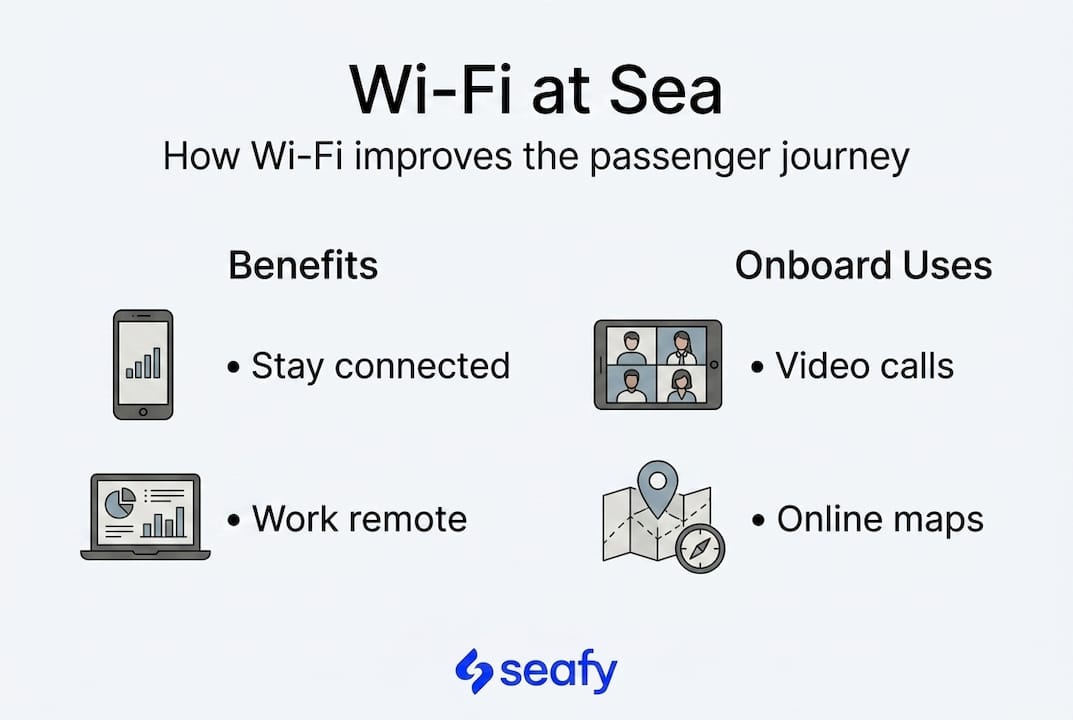
- Video calls with family and colleagues. With download speeds reaching up to 135 Mbps on premium plans like those on Holland America’s Zuiderdam using Starlink, video calls run smoothly without frustrating freezes or audio dropouts.
- Streaming entertainment during long crossings. HD video streaming is fully feasible. No more downloading content before you board or relying on the ship’s curated TV channels.
- Real-time social sharing. You can upload photos and short videos from the deck the moment you take them. Friends and family back home can follow your journey live.
- Remote work without disruption. Cloud-based tools, email clients, and project management platforms all run reliably. For digital nomads, a ferry crossing is no longer downtime. It’s productive work time.
- Accessing travel information on the go. You can look up port guides, restaurant recommendations, local transportation options, and weather forecasts as you approach your destination.
Those speed figures from Holland America Zuiderdam are worth highlighting: 52 to 135 Mbps download, 1 to 1.23 Mbps upload, and 68 to 102 milliseconds ping on the premium Starlink plan. For context, most home broadband connections deliver 50 to 100 Mbps. Premium maritime packages are reaching home-equivalent speeds.
The importance of high-speed ferry internet goes beyond convenience. For professionals who rely on stable connections, it’s the difference between productive travel and a completely lost workday. And as our piece on ferry Wi-Fi for work shows, operators who invest in reliable connectivity see real business returns in passenger loyalty and premium package uptake.
Current limitations and the push for seamless access
Progress is real, but it’s not uniform across the industry. If you’ve experienced frustratingly slow Wi-Fi on a ferry or cruise ship recently, you’re not alone, and there’s a clear technical reason for it.
The core issue is legacy hardware. 12.6% of cruise ship access points still run on Wi-Fi 4 technology, a standard from the early 2010s that simply cannot handle the volume and variety of traffic modern passengers generate. Wi-Fi 4 was designed for a world where fewer devices connected and data demands were much lighter.
| Technology | Standard | Max theoretical speed | Passenger experience |
|---|---|---|---|
| Wi-Fi 4 (legacy) | 802.11n | ~150 Mbps shared | Slow, congested, inconsistent |
| Wi-Fi 6 (current) | 802.11ax | ~9.6 Gbps theoretical | Fast, low-latency, multi-device |
| OpenRoaming | WBA standard | Varies by hardware | Seamless, secure, no re-login |
Beyond hardware, the rollout of upgrades is inconsistent. A ship refitted last year may offer excellent Wi-Fi, while another vessel in the same fleet running older access points delivers a noticeably worse experience.
However, the industry is moving fast. AIDA Cruises deployed OpenRoaming across 11 ships, delivering seamless and secure Wi-Fi to 1.5 million passengers per year without requiring repeated logins. That kind of deployment signals where the whole industry is heading.
Key improvements passengers can expect across the broader fleet over the next few years:
- Full replacement of Wi-Fi 4 access points with Wi-Fi 6 hardware
- Wider Starlink LEO coverage across more routes and vessel types
- Standardized OpenRoaming authentication across cruise and ferry brands
- Transparent, flat-rate pricing to replace confusing tiered data caps
If you run into issues during your crossing, the guide on troubleshooting Wi-Fi onboard covers the most common fixes. And if you’re comparing your options before booking, the overview of Wi-Fi solutions for ferry travelers is a practical starting point.
The future of passenger connectivity: What makes a real difference?
The industry conversation has long centered on headline speeds and coverage maps. But we think that framing misses what passengers actually care about. Speed matters, yes. But what really transforms the experience is invisibility. Wi-Fi that just works, automatically and securely, without portals, passwords, or package confusion.
The most meaningful shift coming isn’t a faster satellite or a new antenna design. It’s universal roaming, automated logins, and transparent pricing that treats connectivity like utilities, not premium add-ons. That’s what how onboard Wi-Fi changes travel ultimately looks like in practice.
Passengers shouldn’t need to think about their connection any more than they think about the ship’s engine. When Wi-Fi becomes truly seamless at sea, the entire concept of being “offline while traveling” disappears. That’s the future we believe in, and it’s closer than most people realize.
Stay connected on your next voyage with Seafy
Ready to experience reliable, high-speed internet on your next ferry or cruise journey? Planning your connectivity in advance makes a real difference. You avoid the stress of slow boarding-day queues and often save money on packages compared to buying last minute.

Seafy partners with leading ferry lines including Corsica Ferries, Grimaldi Lines, and GNV to bring you easy, stable, and affordable onboard Wi-Fi across Mediterranean routes and beyond. Browse available packages, activate your connection before you sail, and travel with the confidence that you’ll stay connected throughout your entire voyage. 🌐⚡
Frequently asked questions
How fast is cruise and ferry Wi-Fi today?
Premium plans on ships like the Holland America Zuiderdam reach download speeds up to 135 Mbps with upload speeds over 1 Mbps, making them comparable to home broadband connections.
Why do some ships still have slow or unreliable Wi-Fi?
Around 12.6% of cruise ship access points still run on outdated Wi-Fi 4 hardware, which cannot handle modern passenger data demands, resulting in congestion and inconsistent speeds.
Is it easy to connect to Wi-Fi on board?
Modern ships using OpenRoaming technology allow passengers to connect securely and automatically without repeated logins, making the process as simple as connecting at home.
Can I use streaming services and video calls with onboard Wi-Fi?
Yes, on modern ships with premium Wi-Fi plans powered by Starlink LEO satellites, both HD streaming and video calls are fully supported with stable performance for most passengers.