Tech & Wi-Fi
Why crew internet access matters: Welfare, work, and security
Discover the vital role of internet for crew at sea. Learn how it enhances welfare, boosts morale, and ensures security onboard.
30 April 2026
Why crew internet access matters: Welfare, work, and security
TL;DR:
- Internet at sea is now a recognized welfare right and essential for crew mental health and safety. Advances in satellite technology are improving connectivity, with systems like LEO and hybrid solutions offering better performance. Crew should understand security risks, practice good cybersecurity habits, and manage usage habits to optimize onboard internet experience.
Internet at sea is no longer a bonus for crew members who want to scroll social media after a long shift. It has become a recognized welfare right and, in many operations, a practical operational tool. MGN 707 guidance now formally frames internet access as part of crew welfare under the Maritime Labour Convention (MLC) 2006. This article breaks down what that means for you: the technology available, your rights and responsibilities, security risks to watch for, and how to get the most from whatever connection you have onboard. 🌐
Table of Contents
- How the internet became essential for crew: Welfare and beyond
- Current technologies: How crew experience connectivity at sea
- Crew privacy, fair use, and security: What every crew member should know
- Practical tips to get the most from internet access onboard
- Why ‘more access’ isn’t always better: Lessons from real-world crew connectivity
- Connect your crew with reliable onboard internet
- Frequently asked questions
Key Takeaways
| Point | Details |
|---|---|
| Internet is crew welfare | Reliable internet is now considered an essential welfare right for seafarers, not a luxury. |
| Choose the right technology | LEO, VSAT, or hybrid setups offer different performance; match your system to your crew’s routes and needs. |
| Security and privacy matter | Protect yourself by using trusted Wi-Fi, strong passwords, and avoiding unknown networks onboard. |
| Fair access, not unlimited | Regulations require practical internet for communication and welfare, but not endless bandwidth for all uses. |
| Smart usage keeps you connected | Simple habits help you get more from limited bandwidth and stay safely online at sea. |
How the internet became essential for crew: Welfare and beyond
For a long time, internet access at sea was treated like a vending machine in the break room. Nice to have, but no one was going to fight over it. That view has shifted dramatically. Regulators, shipowners, and welfare organizations now agree that staying connected is central to crew mental health, safety, and dignity at work.
The importance of internet at sea becomes clear when you think about what isolation does over weeks or months away from family. Loneliness is one of the top drivers of seafarer burnout and mental health issues. Access to reliable communication changes that.
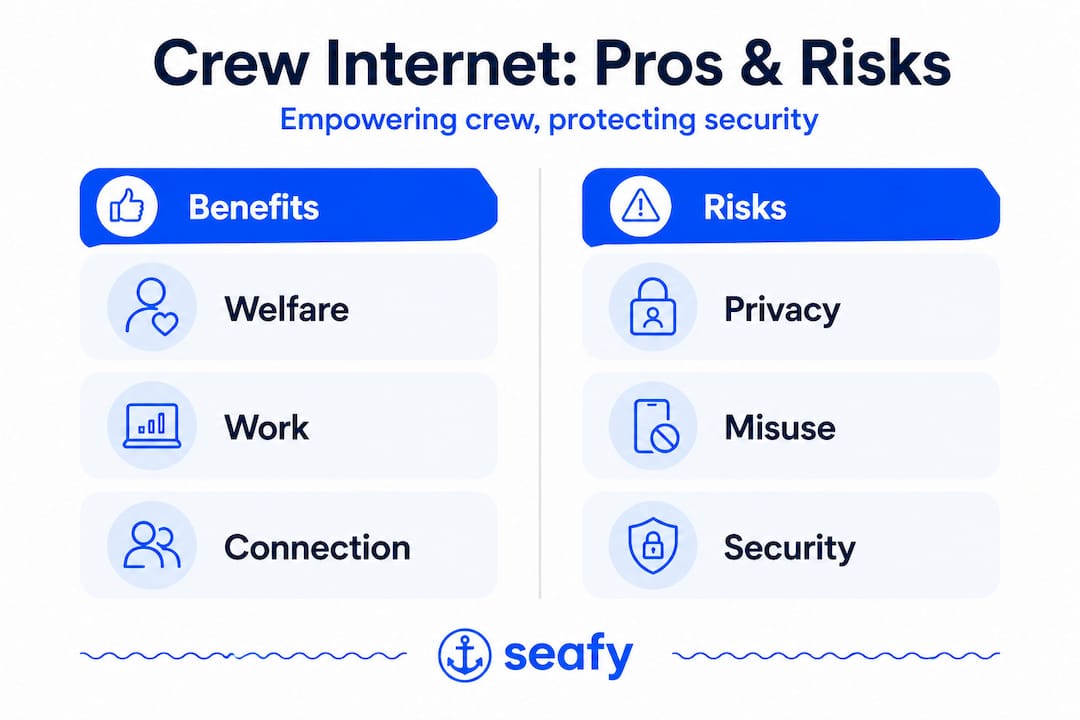
Under updated MLC guidance, seafarers must be provided with social connectivity, meaning ship-to-shore internet services for social communication and social engagement. This is not a vague recommendation. It is a welfare standard that flag states and shipowners must take seriously.
Here is what “social connectivity” actually covers for crew in practice:
- Messaging and video calls: Staying in touch with family and friends, especially for crew on long rotations
- Email access: Personal and professional correspondence that keeps life running smoothly ashore
- Online banking: Checking accounts, paying bills, sending remittances home
- Social media and news: Staying informed and engaged with the world outside the ship
- Basic web browsing: Booking travel, checking health information, accessing educational resources
The role of internet in safety goes beyond welfare too. Crew increasingly rely on onboard connectivity to access updated operational manuals, navigate regulatory changes, and communicate with shore-based support teams during incidents. Internet is not just for morale. It is woven into how modern vessels operate safely.
“Internet access is not a privilege extended to crew. It is part of a recognized framework for crew wellbeing, fair treatment, and operational readiness at sea.” — Aligned with MLC 2006 welfare standards
Importantly, guidance is clear that any charges for internet access should be reasonable and not used as a profit center by shipowners. Crew should not be paying premium rates just to send a message home.
Current technologies: How crew experience connectivity at sea
Understanding your welfare rights is one thing. Understanding what is actually delivering (or failing to deliver) your connection is another. The technology landscape has changed fast, and what you experience day-to-day depends a lot on which system your vessel uses.
Here is a straightforward comparison of the main options available to maritime operators today:
| Technology | Latency | Bandwidth | Coverage | Best for |
|---|---|---|---|---|
| LEO satellite (e.g., Starlink) | Low (20-60ms) | High | Growing globally | Near-coastal, ferries, fast feedback |
| VSAT (GEO satellite) | High (600ms+) | Medium to high | Global | Deep ocean, consistent coverage |
| Hybrid LEO + VSAT | Low when LEO active | Flexible | Broad | Mixed routes, reliability focus |
| 4G/5G cellular | Very low | Very high | Near-shore only | Port areas, coastal routes |
LEO satellite systems like Starlink have transformed expectations. A benchmark study using large measurement volumes reports low latency and relatively high upload performance for Starlink in coastal maritime conditions. In practical terms, this means crew on ferry routes, coastal tankers, and short-sea vessels can realistically make video calls, upload files, and stream content without the frustrating lag that plagued older VSAT systems.
VSAT (Very Small Aperture Terminal) technology communicates with geostationary satellites about 36,000 kilometers above Earth. It works everywhere, but the round-trip signal time creates noticeable lag. Video calls can feel stilted. Gaming is mostly impractical. But for checking email or browsing news, it still gets the job done on deep-ocean routes where LEO coverage thins out.
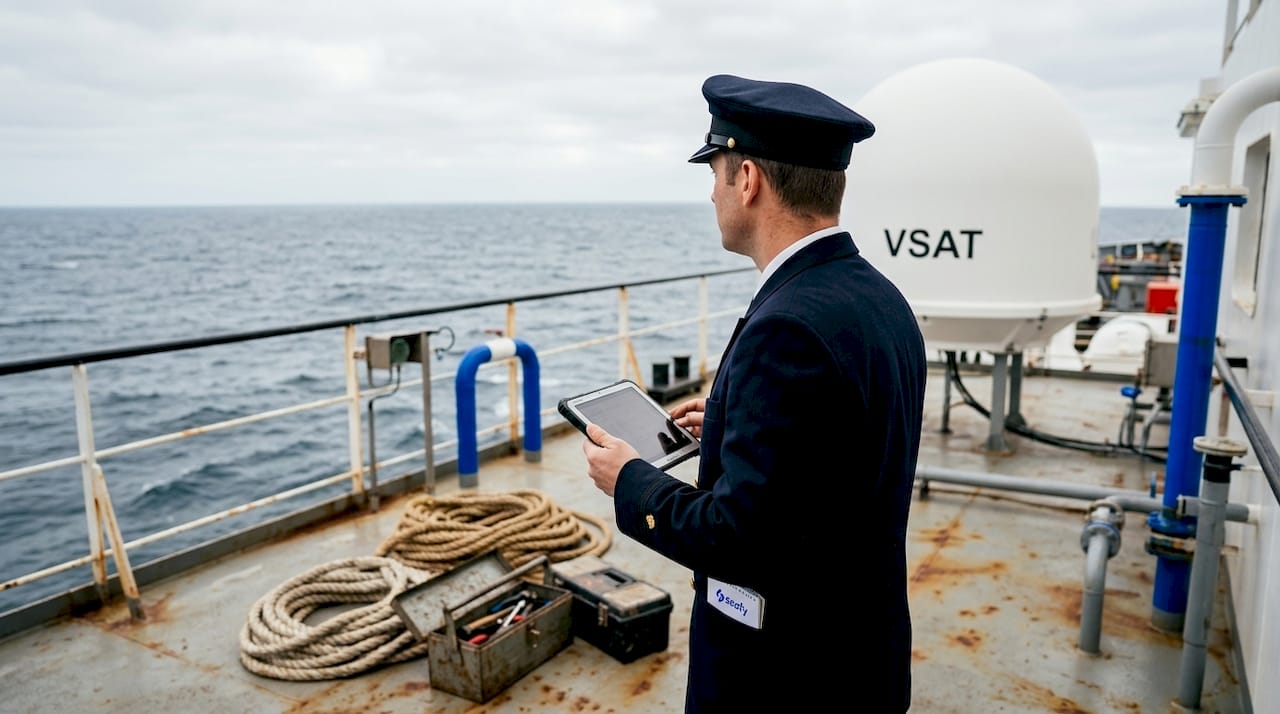
Hybrid systems are becoming the smart default for many ship connectivity options. They switch intelligently between LEO and VSAT depending on coverage and load, giving crew the best of both worlds without requiring any manual switching.
Exploring onboard Wi-Fi solutions and understanding how satellite internet at sea works will help you set realistic expectations and make smarter use of whatever system is available.
Pro Tip: If your vessel runs primarily near-shore Mediterranean routes, LEO satellite service will almost always give you a noticeably better experience than VSAT alone. Ask your IT officer which system is active before assuming poor performance is inevitable.
Crew privacy, fair use, and security: What every crew member should know
Better connectivity also means more risk. This is the part most guides skip over, and it is the part that could genuinely hurt you.
Crew internet provisioning must handle edge cases around privacy, bandwidth sharing, and cybersecurity risk from onboard Wi-Fi devices and user behavior. In plain language: shared networks on ships create real vulnerabilities that you need to take personally.
The most pressing threats for crew include:
- Rogue Wi-Fi networks: Fake access points set up to capture your login credentials and personal data
- Phishing attacks: Emails or messages designed to trick you into revealing passwords or financial information
- Weak passwords: Using simple or reused passwords across accounts makes you an easy target
- Unsecured apps: Apps that transmit data without encryption can expose your activity on shared networks
A 2025 MDPI study simulating maritime Wi-Fi vulnerabilities shows that counterfeit or rogue Wi-Fi networks can lure crew devices automatically, especially if your device is set to auto-connect to saved networks. This is not a theoretical risk. It is a documented attack pattern that works on ships.
“Always treat onboard Wi-Fi as a shared, semi-public network. Protect yourself the same way you would at an airport or hotel.” ⚡
On the privacy side, crews should understand that onboard networks are typically centrally managed. Your usage may be visible to network administrators in broad terms. This is normal and legal, but you should be aware that true anonymity on a ship network is not guaranteed.
For secure maritime internet access, the guidance is consistent: verify network names before connecting, use strong and unique passwords for every account, and enable two-factor authentication wherever possible. The way internet impacts every journey is evolving fast, and so are the risks that come with it.
Pro Tip: Disable auto-connect on your phone and tablet. Manually selecting your network every time is a small habit that significantly reduces your risk of connecting to a rogue access point.
Practical tips to get the most from internet access onboard
Now that you understand the risks and your rights, here is how to actually stretch your access and keep it working for you throughout your rotation.
MLC-aligned guidance recommends sufficient bandwidth to enable messaging and calls, emails, basic social media, web browsing, and internet banking as the baseline for crew connectivity. Use that as your benchmark for what you should expect.
- Prioritize low-bandwidth tasks during busy hours. Send texts and emails when the network is under heavy load. Save video calls for quieter periods like early morning or late evenings.
- Avoid large downloads during peak shift changes. Streaming movies or downloading apps at the same time as 50 other crew members will frustrate everyone, including you.
- Check your device’s saved network list regularly. Remove networks you do not recognize. This simple step reduces your exposure to rogue access points significantly.
- Use encrypted messaging apps like Signal or WhatsApp for personal conversations. End-to-end encryption means your messages stay private even on a shared network.
- Know the difference between a real outage and a policy restriction. Internet may be limited or paused for security drills, port authority requirements, or weather-related technical issues. This is normal.
- Bookmark troubleshooting resources for your onboard Wi-Fi system before you lose connection. Having a guide available offline saves frustration during outages.
Reviewing best practices for ferry internet is a smart way to build habits that work across different vessels and systems you may encounter during your career.
Quick stat: Crew who actively manage their device settings and usage habits typically report a noticeably better day-to-day experience from the same connection compared to those who do not. Bandwidth is shared. How you use it matters.
Pro Tip: Bookmark your ship’s Wi-Fi support page or your provider’s troubleshooting guide during your first day onboard. When connectivity drops, the last thing you want to do is search for help without a connection.
Why ‘more access’ isn’t always better: Lessons from real-world crew connectivity
Here is a perspective that does not get much airtime: the loudest demand in crew connectivity conversations is almost always “give us more bandwidth.” More gigabytes. Faster speeds. No restrictions. It sounds reasonable. But in practice, chasing unlimited access often misses what actually improves crew life at sea.
The methodology that tends to work, according to research on maritime Wi-Fi vulnerabilities, is to architect crew connectivity as a managed, welfare-aware system with bandwidth targets, fair-charge rules, and privacy-by-design principles, integrated with cybersecurity controls and user training. In other words, smart and fair beats unlimited every time.
Unlimited bandwidth on a vessel with 30 crew members and a single satellite link often means chaos. One person streaming 4K video degrades the connection for everyone else trying to call home. Managed systems that prioritize communication traffic and apply reasonable fair-use policies deliver a better collective experience, even if individual access feels constrained.
There is also an important regulatory nuance worth understanding. MLC guidance frames internet provision as social connectivity with “so far as reasonably practicable” provisions. The standard is meaningful access, not unlimited data. Demanding the latter often distracts from getting the former right.
What actually improves crew well-being is reliable, predictable, fair access combined with training on how to use it safely. That is the combination that reduces isolation, supports mental health, and keeps the vessel secure. It is worth reading more about how internet and remote crew work are evolving together, because the future of crew connectivity is less about raw speed and more about smart design.
Connect your crew with reliable onboard internet
Keeping crew connected should not feel complicated. Whether you are managing connectivity for your vessel or looking for better personal access during your rotation, the right solution makes a real difference to daily life at sea.

Seafy works with leading ferry lines across the Mediterranean including Corsica Ferries, Grimaldi Lines, and GNV to deliver stable, crew-friendly Wi-Fi powered by satellite technology including Starlink. Our platform makes it easy to access and manage Wi-Fi at sea with Seafy through a straightforward portal, with fair pricing and options designed around real crew needs. Want to explore what is available for your route? Check out our guide to the best Wi-Fi solutions for ships to find the right fit. Good connectivity at sea is not a dream. It is already here. 🌐
Frequently asked questions
Is internet access now required for all maritime crew?
Yes. Updated MLC guidelines require ships to provide crew with practical internet access as part of social connectivity welfare standards, meaning it is a recognized right, not a discretionary perk.
Does crew internet have to be unlimited?
No. Ships must provide sufficient daily access for communication and basic needs, but MLC guidance frames this as “so far as reasonably practicable,” which explicitly acknowledges technical and security limits.
What’s the safest way for crew to use onboard Wi-Fi?
Use only trusted, verified networks and avoid auto-connecting to saved networks. Research shows that crew trained to recognize rogue networks and use strong authentication are significantly less exposed to onboard cybersecurity threats.
Why is my connection sometimes unavailable while at sea?
Connectivity may be paused for security drills, port authority requirements, or technical satellite coverage gaps. MLC guidance acknowledges there are cases when access is legitimately absent or restricted for operational or security reasons.