Tech & Wi-Fi
High-speed maritime internet: your complete guide
Discover what high-speed maritime internet is and how it transforms connectivity at sea. Ensure seamless, fast browsing for your next voyage!
25 April 2026
High-speed maritime internet: your complete guide
TL;DR:
- Modern maritime internet offers high-speed connectivity comparable to land broadband for streaming and remote work.
- Satellites like Starlink (LEO) and hybrid systems provide lower latency and faster speeds at sea.
- Travelers should research vessel technology and plan usage during off-peak hours for better experience.
Forget everything you think you know about ship Wi-Fi. The days of waiting five minutes for an email to load while crossing the Mediterranean are largely behind us. Thanks to next-generation satellite technology and smarter onboard network designs, seamless internet at sea is no longer a luxury reserved for the wealthy or a feature buried in the fine print. This guide breaks down what high-speed maritime internet actually is, how it works, what you can realistically do with it, and how to choose the best option for your next voyage. 🌐
Table of Contents
- What makes maritime internet “high-speed”?
- How does high-speed maritime internet work?
- What can you actually do with high-speed internet on a ship?
- Choosing the right maritime internet option for your journey
- A fresh take: What most travelers get wrong about internet at sea
- Explore high-speed maritime internet solutions with Seafy
- Frequently asked questions
Key Takeaways
| Point | Details |
|---|---|
| True high-speed benchmarks | Modern maritime internet can deliver 50-135 Mbps, even far from shore. |
| Best tech is hybrid | Combining Starlink/LEO with VSAT offers the best performance on Mediterranean routes. |
| More than just browsing | These connections enable remote work, streaming, and vital ship operations. |
| Choose smartly | Check a ship’s internet setup before you book for the best onboard experience. |
What makes maritime internet “high-speed”?
With the stage set, let’s clarify what “high-speed” really means at sea. On land, most people think of high-speed internet as anything above 25 Mbps download. At sea, the definition has evolved significantly, and the gap between land and ocean is narrowing fast.
Download speed refers to how quickly data travels from the internet to your device. Upload speed is the reverse. Latency (sometimes called ping) measures the time, in milliseconds, it takes for a signal to travel from your device to a server and back. Lower latency means snappier browsing, smoother video calls, and less frustration.
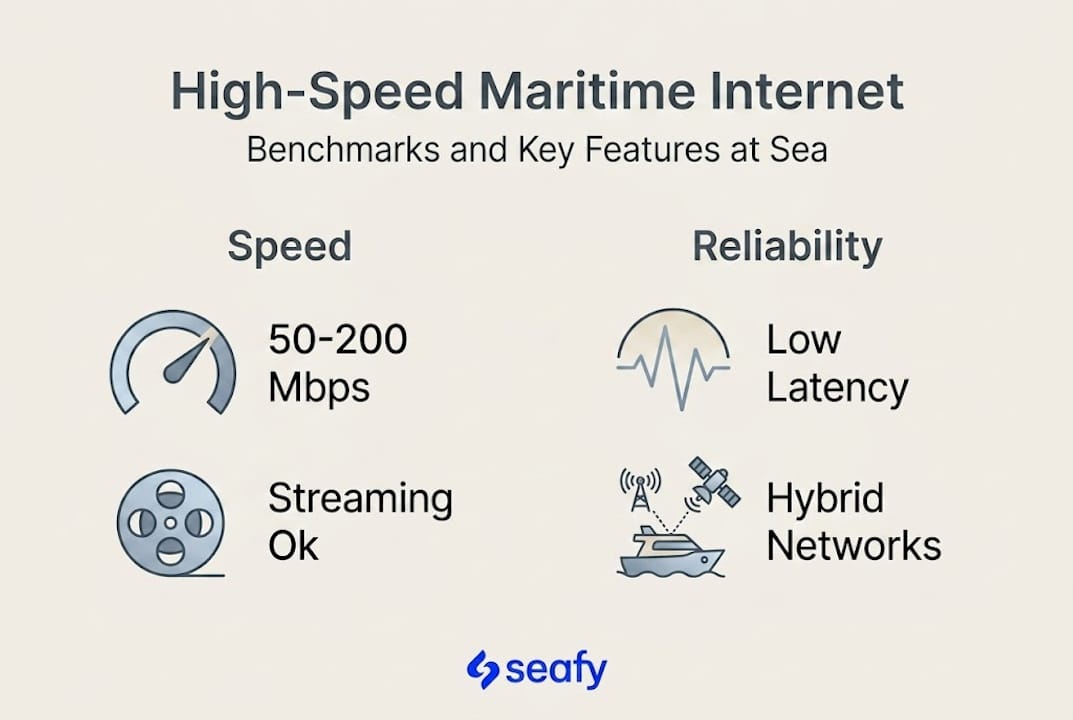
Here is a practical breakdown of what these numbers mean for you onboard:
| Speed metric | Acceptable at sea | High-speed at sea | Land-based comparison |
|---|---|---|---|
| Download | 5 to 15 Mbps | 50 to 200 Mbps | 100 to 500 Mbps |
| Upload | 1 to 5 Mbps | 10 to 30 Mbps | 20 to 100 Mbps |
| Latency | 400 to 800 ms | 40 to 100 ms | 10 to 30 ms |
Real-world data backs this up. Starlink-powered ships like the Holland America Zuiderdam record download speeds between 52 and 135 Mbps, upload speeds of 10 to 30 Mbps, and latency as low as 40 ms. That puts modern maritime internet firmly in the “high-speed” category for most everyday tasks.
⚡ Speed callout: Ships using Low Earth Orbit (LEO) satellites like Starlink regularly hit 50 to 200 Mbps download speeds onboard, a figure that would have seemed impossible on a ship just five years ago.
The real takeaway? “High-speed” at sea means you can do more than just check email. It means streaming, working, video calling, and staying genuinely connected throughout your crossing.
How does high-speed maritime internet work?
Now that we know the speed benchmarks, let’s reveal how these connections are delivered onboard. The technology behind maritime connectivity can sound complicated, but the core idea is straightforward: ships use satellites orbiting the Earth to send and receive data, just like a satellite dish at home, only far more sophisticated.
There are three main satellite types used at sea today:
-
VSAT (Very Small Aperture Terminal): The traditional workhorse of maritime internet. VSAT uses geostationary satellites that orbit roughly 35,000 km above Earth. These satellites stay fixed relative to the ship, ensuring consistent coverage over wide ocean areas. The downside is latency, because signals travel so far, round-trip times can reach 600 to 800 ms. VSAT is reliable and offers guaranteed bandwidth, making it ideal for global commercial shipping routes.
-
Starlink and LEO satellites: Low Earth Orbit satellites like those in Starlink’s constellation orbit just 550 km above Earth. That short distance dramatically reduces latency (down to 40 to 100 ms) and allows for much faster data speeds. For Mediterranean ferry routes and coastal cruise itineraries, LEO is a game-changer.
-
Hybrid networks: As VSAT vs. LEO comparisons clearly show, combining both technologies delivers the best overall result. Hybrid setups use LEO for speed and responsiveness in coastal waters, then switch seamlessly to VSAT when ships head into open ocean. The result is robust, continuous coverage.
You can explore the full range of onboard Wi-Fi solutions available today to understand which one suits your route best.
Key factors that affect performance onboard include:
- The number of passengers sharing the connection simultaneously
- The ship’s hardware age and recent upgrades
- Weather conditions (heavy rain can affect some satellite signals)
- The vessel’s location relative to satellite coverage zones
- Network management policies set by the ferry or cruise line
Pro Tip: When researching ferry or cruise lines, look specifically for vessels that advertise hybrid satellite networks. These ships consistently outperform those relying on a single satellite technology, especially on Mediterranean routes where coastal and open-water conditions alternate frequently.
Understanding the role of satellite internet at sea helps you set smarter expectations before you board.
What can you actually do with high-speed internet on a ship?
Understanding the technology is only part of the story. Now let’s see what you can actually do with high-speed internet at sea. The answer might surprise you.
Thanks to ships where Starlink-powered connections deliver download speeds up to 135 Mbps with improved latency, the following activities are all realistic options on a modern Mediterranean vessel:
- Stream movies and TV shows: Platforms like Netflix, Disney+, and YouTube work well at 50+ Mbps. Even HD and some 4K content loads smoothly during off-peak hours.
- Make video calls: A stable video call on Zoom or FaceTime typically needs just 3 to 5 Mbps with low latency. With 50 to 135 Mbps available, multiple people can call simultaneously without issues.
- Remote work: Cloud-based platforms like Google Workspace, Microsoft 365, Slack, and project management tools perform reliably. Uploading large files, attending virtual meetings, and accessing company VPNs all become manageable tasks.
- Social media and messaging: Posting photos, scrolling feeds, and sending voice messages work smoothly. Even short video posts on Instagram or TikTok upload without frustration.
- Online gaming (casual): With latency at 40 to 100 ms, casual browser games and turn-based titles are playable. Fast-paced multiplayer gaming is still challenging, but improving.
- Crew operations: For crew members, high-speed connectivity supports navigation software updates, logistics coordination, safety reporting, and communication with shore-based teams. These operational uses are just as important as passenger entertainment.
Find out more about how internet at sea is transforming remote work efficiency for maritime professionals.
Pro Tip: Connection speeds on ferries and cruise ships tend to be faster early in the morning and late at night, when fewer passengers are online. If you need to upload a large file or join a high-stakes video call, schedule it for those lower-traffic windows. Also, if your ship offers a wired connection option in any area, it will almost always outperform Wi-Fi.
Understanding why high-speed internet matters on ferries goes beyond just passenger comfort. It shapes the entire onboard experience.
Choosing the right maritime internet option for your journey
You’re nearly ready to set sail, but how do you ensure you pick the right ship or ferry for solid connectivity? Not all vessels are created equal when it comes to internet performance, and making an informed choice before you book can save you a lot of frustration mid-crossing.
Here are the most important factors to evaluate:
- Technology provider: Look for vessels that partner with recognized names like Starlink, Inmarsat, or other LEO and hybrid providers. Ferry lines that publicly advertise their satellite infrastructure are usually more invested in the quality of their service.
- Coverage on your specific route: Mediterranean coastal routes benefit most from LEO and hybrid setups. Research whether the ship has been recently upgraded with modern equipment.
- Pricing and packages: Compare cost-per-day and data-cap options. Some lines offer tiered plans (social, streaming, full) that let you match your needs and budget.
- Service level agreements (SLAs): Commercial operators and crew should ask about guaranteed bandwidth, especially for business-critical operations.
- Recent user reviews: Passenger forums and travel review sites are goldmines. Look for mentions of actual speeds, not just “Wi-Fi available” checkboxes.
As hybrid Starlink and VSAT systems continue to improve, they represent the best performance available for Mediterranean shipping lanes today.
Check out top ferry internet providers to see which companies are leading the field in 2026.
Pro Tip: Before boarding, use the ferry line’s website or customer service to ask one direct question: “Has this ship been upgraded with Starlink or a hybrid satellite system?” Lines that answer confidently and specifically are the ones worth your trust. Also, review the onboard internet checklist to make sure you’re fully prepared.
A fresh take: What most travelers get wrong about internet at sea
Here is the honest truth most travel guides skip over. Most passengers board a ferry or cruise ship with one of two wrong assumptions. Either they expect the internet to be terrible and don’t even try, or they expect it to perform exactly like their home fiber connection and get frustrated when it doesn’t.
Both attitudes miss the real opportunity. Ships with modern hybrid systems can genuinely compete with home broadband speeds for a wide range of tasks. Streaming, video calls, remote work, all of it is possible. But the experience still depends on how many people are sharing the connection at any given moment and how the ship’s network is managed.
The travelers who get the most value are the ones who do a little homework first. They check how internet impacts your journey, understand the ship’s setup, and adjust their habits accordingly. They book during promotions, plan their heaviest usage for off-peak hours, and choose ferry lines that are transparent about their infrastructure. That small amount of preparation makes a measurable difference.
Explore high-speed maritime internet solutions with Seafy
Ready to take your journey to the next level with guaranteed connectivity?
If you’ve been waiting for reliable, fast internet at sea to become a real option, that moment has arrived. Seafy specializes in making high-speed maritime connectivity easy to access for both passengers and crew across the Mediterranean.

Whether you’re crossing with Corsica Ferries, Grimaldi Lines, or GNV, Seafy connects you to onboard Wi-Fi packages powered by advanced satellite technology, including Starlink. Browse, stream, work, and stay in touch, all from one simple portal. Explore your maritime internet solutions today and go into your next voyage fully connected. Buon surf! 🌐
Frequently asked questions
How fast is high-speed internet on Mediterranean ferries or cruises?
High-speed maritime internet can reach 50 to 200 Mbps download speeds and 40 to 100 ms latency on modern ships equipped with advanced satellite systems like Starlink.
What type of internet is best for Mediterranean routes?
Hybrid solutions combining LEO satellites like Starlink with VSAT deliver the best overall speed and reliability for ferries and cruise ships traveling Mediterranean routes.
Can I stream movies or make video calls with high-speed maritime internet?
Yes, both are possible on ships with modern satellite setups. Vessels using Starlink regularly achieve speeds well above the 5 Mbps threshold needed for smooth HD streaming and video calls, especially during off-peak hours.
What affects internet quality while at sea?
Ship location, total number of users online at once, weather conditions, and the vessel’s specific hardware setup all play a role in the quality and consistency of your onboard internet connection.