Onboard news
Why Maritime Connectivity Is Different: A Clear Guide
Discover why maritime connectivity is different from land-based internet. Understand how unique challenges impact vessel communication at sea.
01 July 2026
Why Maritime Connectivity Is Different: A Clear Guide
TL;DR:
- Maritime connectivity relies on satellite and hybrid networks to keep vessels connected at sea. Reliability, traffic segregation, and automated recovery are more important than speed for operational safety and passenger experience. Modern deployments, like those by CMA CGM and CalMac Ferries, demonstrate that managed, resilient systems improve performance even in challenging environments.
Maritime connectivity is defined as the specialized communication system that enables continuous internet and data exchange for vessels operating at sea. It differs fundamentally from land-based internet because ships move through environments where fixed infrastructure does not exist, signal conditions shift constantly, and network failures carry real operational consequences. Whether you are a passenger on a Mediterranean ferry or a crew member managing remote work onboard, understanding how maritime connectivity differs from your home broadband shapes every expectation you bring aboard.
The gap between land and sea connectivity is not just about speed. It is about architecture, resilience, and the physics of keeping a moving vessel connected across open water. Seafy, which provides Wi-Fi services on ferry routes with partners including Corsica Ferries, Grimaldi Lines, and GNV, operates within these exact constraints every day.
Why maritime connectivity is different from land-based internet
The core technical difference is infrastructure. On land, your router connects to a fixed fiber or cable line that does not move. At sea, a vessel must maintain a live link to satellites orbiting hundreds or thousands of miles overhead, and that link must survive weather, vessel movement, and geographic transitions.
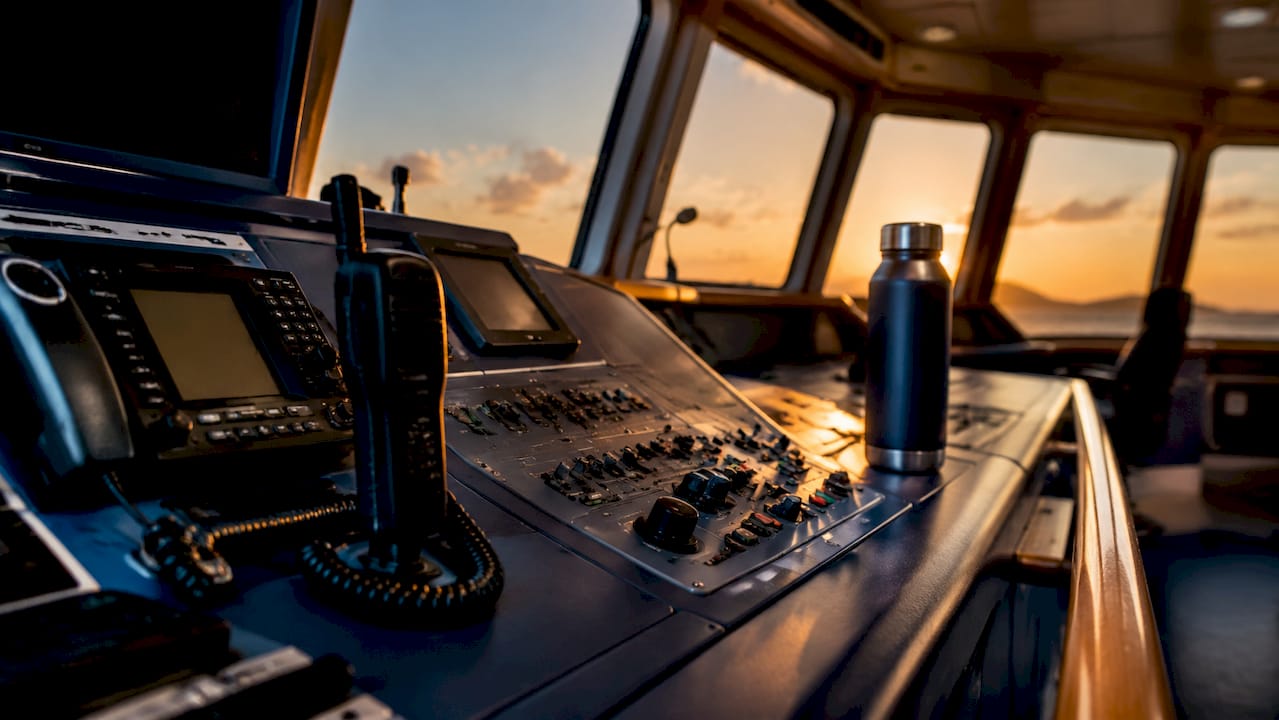
Satellite networks used at sea fall into three orbital categories: Low Earth Orbit (LEO), Medium Earth Orbit (MEO), and Geostationary Orbit (GEO). LEO satellites like those used in Starlink fly close to Earth and deliver lower latency. GEO satellites sit much higher and cover wider areas but introduce noticeable signal delay. Most modern maritime deployments use a hybrid approach, combining multiple orbit types to balance speed and coverage.
Environmental factors compound the challenge. Rain, heavy seas, and even the vessel’s own steel superstructure can degrade or block signals. Effective maritime network design requires professional planning to account for structural shielding, antenna placement, and the constant motion of the ship. A consumer Wi-Fi booster installed without that planning will not solve the problem.
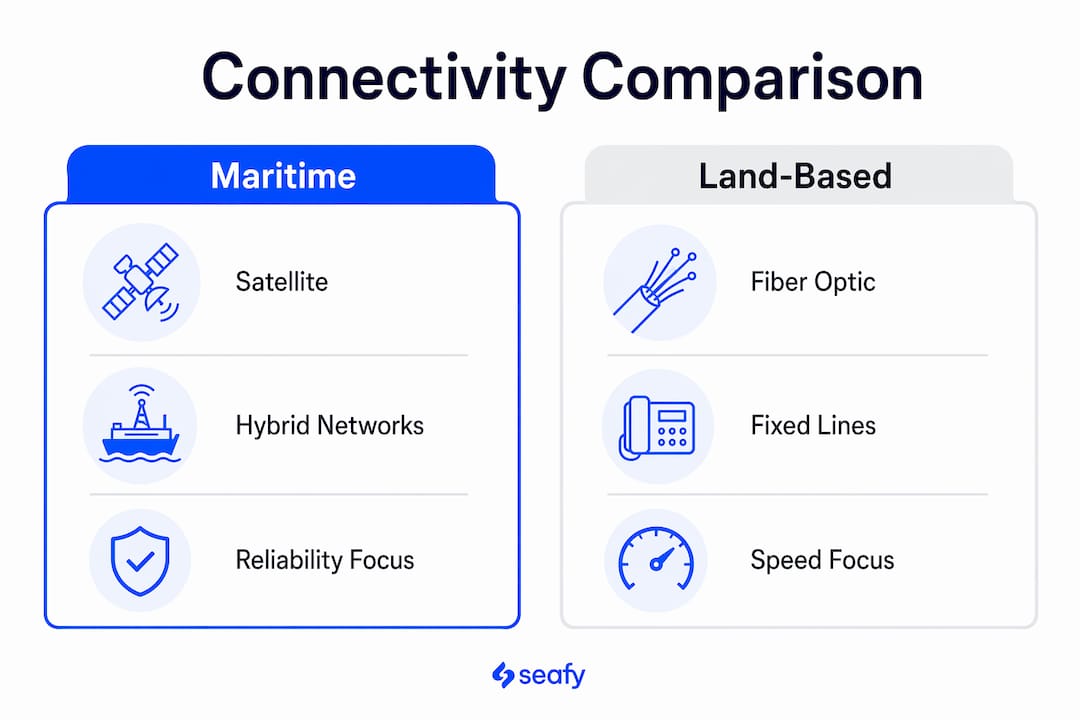
| Parameter | Maritime connectivity | Land-based internet |
|---|---|---|
| Infrastructure | Satellite and hybrid networks | Fixed fiber, cable, or cellular |
| Latency | Variable, 20–600ms depending on orbit | Typically 5–30ms |
| Signal continuity | Affected by weather and vessel movement | Stable in most conditions |
| Network design | Requires marine-grade equipment and planning | Standard consumer or enterprise gear |
| Coverage gaps | Possible in remote ocean areas | Rare in urban or suburban zones |
Pro Tip: When evaluating onboard Wi-Fi, ask whether the vessel uses a hybrid LEO and GEO setup. Hybrid systems maintain coverage when one satellite type loses signal, which is the single biggest factor in consistent performance at sea.
How maritime connectivity workflows support operations and passengers
A well-designed maritime network does not treat all traffic equally. Professional onboard networks separate owner, guest, and crew traffic into distinct zones. This segregation protects operational data from passenger activity and gives crew members private, reliable access for welfare communications.
Traffic prioritization is the second layer. When bandwidth is limited, the system routes critical navigation and safety data first, then crew communications, then passenger streaming. This hierarchy means the ship’s operations never compete with a passenger downloading a movie.
Modern systems also include breakpoint recovery. If a satellite link drops and reconnects, data transfers resume automatically without requiring the user to restart. That feature matters enormously for remote workers onboard who cannot afford to lose a video call or a file upload mid-transfer.
Key elements of a maritime connectivity workflow include:
- Traffic segregation: Separate networks for navigation, crew welfare, and passenger internet
- Bandwidth prioritization: Safety and operational data always takes precedence
- Breakpoint recovery: Automatic resumption of data transfers after link interruptions
- Seamless roaming: Passengers move around the vessel without losing their session
- Simple onboarding: Captive portal login lets passengers connect without technical setup
Passengers on modern ferries now expect connectivity comparable to an onshore office. Hybrid networks integrating land towers, satellite, and mobile networks can maintain latency below the video conferencing threshold even 200 miles offshore. That capability turns a ferry crossing into a productive work session rather than a connectivity blackout.
Pro Tip: If you plan to work remotely on a ferry, check whether the vessel uses a hybrid land-and-satellite network. That combination delivers the low latency that video calls and cloud applications require, even far from shore.
Examples of modern maritime connectivity deployments
Real-world deployments show how far maritime connectivity has advanced. These examples illustrate the importance of maritime connectivity for both fleet operators and the people aboard.
CMA CGM deployed OneWeb LEO connectivity across more than 300 vessels in nine months. That rollout combined multi-orbit satellite solutions with an edge networking platform, enabling real-time route optimization, industrial IoT, and cloud services fleet-wide. The network also supports decarbonization goals by allowing real-time speed adjustments that reduce fuel consumption and emissions.
Clarus Networks secured a contract to deliver fleet-wide Starlink services for CalMac Ferries, including dynamic bandwidth allocation, real-time diagnostics, and policy-based traffic shaping across multiple routes in challenging geographic areas. That level of management is impossible with a single static satellite subscription.
New ferry designs reflect the same shift. Vessels are being built as floating co-working spaces, with hybrid networks and simple onboarding portals baked into the design from the start. The passenger experience is no longer an afterthought. It is part of the vessel’s core specification.
Why reliability matters more than bandwidth at sea
Bandwidth is the metric most travelers focus on. Reliability is the metric that actually determines whether your connection works. Maritime connectivity degrades in multiple ways: weather disrupts signals, routing changes introduce latency spikes, and regional restrictions can block certain services entirely. A fast connection that drops every 20 minutes is less useful than a slower connection that holds steady for hours.
The industry has shifted its focus accordingly. Modern maritime connectivity treats assurance as a utility-grade requirement, not a bonus feature. Security, continuity, and automatic recovery are now foundational, not optional upgrades.
| Priority | Land-based internet | Maritime connectivity |
|---|---|---|
| Primary concern | Speed and bandwidth | Reliability and continuity |
| Failure mode | Rare, quickly restored | Weather and movement dependent |
| Security model | Standard firewall | Segregated traffic zones, marine-grade |
| Recovery | Manual reconnect | Automated breakpoint recovery |
The practical implication for you is straightforward. When choosing a reliable onboard Wi-Fi service, prioritize operators who describe their system’s resilience and recovery features, not just their advertised speeds.
Pro Tip: Ask your ferry operator whether their network includes automated failover between satellite types. That single feature prevents the most common cause of dropped connections at sea.
Key takeaways
Maritime connectivity requires specialized engineering, not just faster satellites, because the sea environment creates challenges that standard internet infrastructure cannot address.
| Point | Details |
|---|---|
| Infrastructure is fundamentally different | Ships rely on satellite and hybrid networks, not fixed cables, making design and resilience critical. |
| Reliability outranks bandwidth | Continuous, recoverable connections matter more than peak speed in a moving, weather-exposed environment. |
| Traffic segregation protects everyone | Separating passenger, crew, and operational networks keeps safety data secure and private. |
| Modern deployments prove the model | CMA CGM and CalMac Ferries show that fleet-wide, managed connectivity delivers real operational and passenger benefits. |
| Hybrid networks close the gap | Combining LEO satellites with land-based towers maintains low latency even hundreds of miles offshore. |
What I have learned from watching maritime connectivity evolve
I have watched a lot of travelers board ferries expecting their phone to behave exactly as it does at home. That expectation almost always leads to frustration, and the frustration is almost never the operator’s fault.
The real problem is that most people think maritime connectivity is just a weaker version of home broadband. It is not. It is a completely different engineering problem. The vessel moves, the weather changes, the satellite geometry shifts, and the network has to keep working through all of it. Throwing more bandwidth at that problem without addressing the underlying architecture is like adding lanes to a road with no pavement.
What I find genuinely impressive about recent deployments is the shift toward treating connectivity as a managed service rather than a hardware purchase. The CalMac and CMA CGM examples are not just about faster speeds. They are about continuous monitoring, dynamic allocation, and automated recovery. That is the right model.
For passengers and remote workers, the practical advice is simple: choose vessels and operators who invest in professional network design, not just satellite subscriptions. Seafy’s approach, integrating with technologies like Starlink and working with established ferry partners, reflects exactly that philosophy. The onboard Wi-Fi experience should feel effortless, even when the engineering behind it is anything but.
— Raffaele
Seafy brings reliable Wi-Fi to your ferry crossing
Getting connected at sea should not require a technical degree. Seafy makes it straightforward for passengers and crew on Mediterranean ferry routes to access high-speed internet through a simple onboard portal.

Seafy partners with Corsica Ferries, Grimaldi Lines, and GNV to deliver Wi-Fi packages you can purchase and activate directly onboard. The platform integrates with satellite technologies including Starlink to maintain stable connections even on longer crossings. Whether you are streaming, video calling, or catching up on work, Seafy gives you a dependable connection without the guesswork. Visit seafy.com to check coverage on your route and get connected before you board. ⚡
FAQ
What makes maritime connectivity different from home internet?
Maritime connectivity relies on satellite and hybrid networks instead of fixed cables, and must maintain a live link through weather, vessel movement, and geographic changes. That makes reliability engineering the central challenge, not just bandwidth.
Why does latency vary so much at sea?
Latency depends on which satellite orbit the vessel connects to. LEO satellites deliver latency as low as 20ms, while GEO satellites can reach 600ms. Hybrid systems switch between orbit types to keep latency as low as possible.
Can you work remotely on a ferry?
Yes. Modern ferry networks using hybrid land-and-satellite connections can maintain latency below the video conferencing threshold even 200 miles offshore, making remote work practical on longer crossings.
Why do onboard networks separate passenger and crew traffic?
Traffic segregation protects operational and safety data from passenger activity and gives crew members private access for welfare communications. It is a standard requirement in professional maritime network design.
Does more bandwidth solve maritime connectivity problems?
Bandwidth alone does not fix maritime connectivity. Reliability and assurance are more critical, because a fast connection that drops frequently is less useful than a slower connection with automated recovery and continuous monitoring.