Tech & Wi-Fi
Maritime Connectivity Trends 2026: What Operators Need to Know
Explore the trends in maritime connectivity 2026. Discover how AI and multi-orbit solutions are transforming maritime operations and boosting value.
16 June 2026
Maritime Connectivity Trends 2026: What Operators Need to Know
TL;DR:
- Maritime connectivity in 2026 relies on hybrid satellite networks managed by AI, enhancing resilience and operational efficiency. The industry adopts multi-orbit architectures combining LEO, GEO, and L-band, with AI optimizing bandwidth and safety communications. Effective management tools like SD-WAN and data governance are crucial for realizing these technological advancements at sea.
The trends in maritime connectivity 2026 are defined by one structural shift: vessels are moving from single-network satellite setups to multi-orbit hybrid architectures managed by artificial intelligence. The maritime connectivity market was valued at $2.5B in 2023 and is projected to reach $8.4B by 2033 at a 12% CAGR. That growth is not driven by more satellites alone. It is driven by smarter ways to combine them, route traffic across them, and extract operational value from the data they carry. If you manage a fleet, operate onboard services, or build maritime technology, these shifts are already changing what your network needs to do.
What are the trends in maritime connectivity 2026?
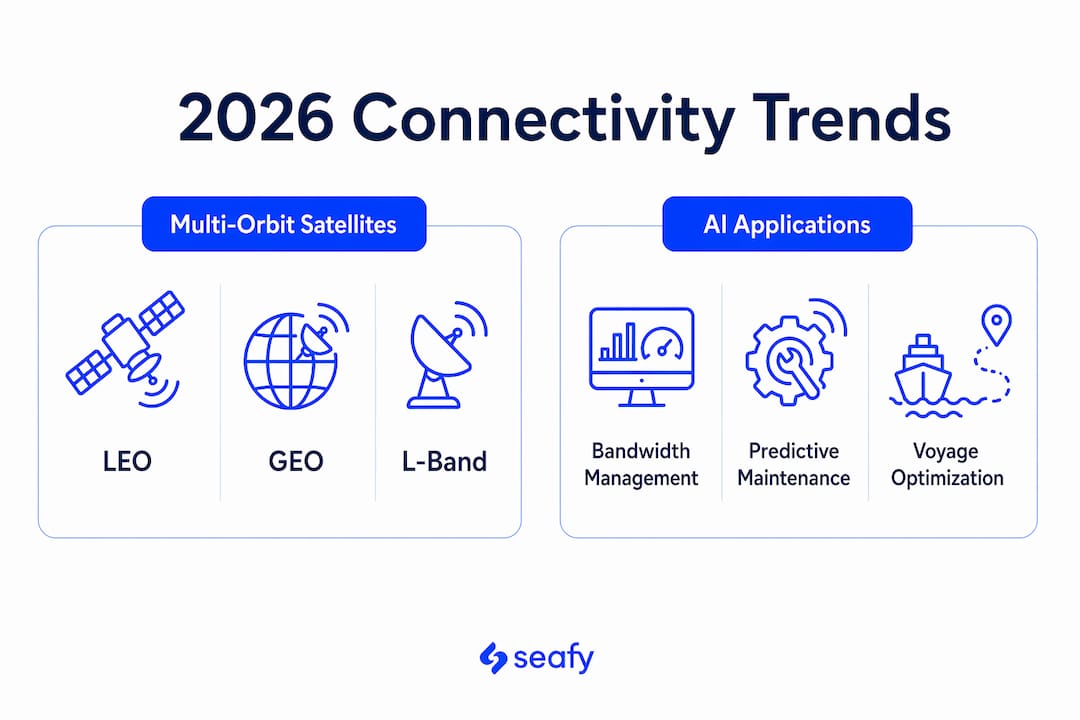
Multi-orbit hybrid satellite architecture is the defining technical shift of 2026. Instead of relying on a single VSAT or GEO provider, operators now combine Very Small Aperture Terminal (VSAT) geostationary satellites, Low Earth Orbit (LEO) constellations, and L-band backup networks into a single layered system. Each layer serves a different purpose: LEO delivers speed and low latency, GEO provides wide-area stability, and L-band acts as a reliable fallback in degraded conditions.

Starlink leads the LEO segment by a wide margin. Starlink covers 97.6% of LEO broadband vessels, with 66,866 vessels tracked in Q1 2026 datasets. That concentration reflects how quickly the maritime industry adopted flat-panel LEO terminals once they became commercially viable. KVH, a major VSAT provider, reported a 27% year-on-year revenue increase to $32.3M in Q1 2026, showing that GEO capacity is not disappearing. It is being layered with LEO rather than replaced by it.
Service providers are formalizing this approach. Marlink offers its Sealink Multi-LEO service, and Speedcast has built multi-orbit packages that combine Starlink with other constellations. These products reflect a market consensus: hybrid satellite networks improve resilience but add management complexity that requires centralized control.
The key benefits of multi-orbit architectures include:
- Higher uptime through automatic failover between satellite layers
- Lower latency from LEO constellations, with LEO satellites delivering 30–50 ms latency versus 600+ ms on legacy GEO systems
- Better bandwidth allocation by routing high-priority traffic to the fastest available link
- Improved crew welfare through stable, uncapped broadband for personal use and communication
Pro Tip: When evaluating multi-orbit providers, ask specifically how their system handles automatic link switching. Passive redundancy is not the same as intelligent failover. You want a system that routes by application priority, not just by availability.
| Satellite Layer | Primary Role | Latency Range |
|---|---|---|
| LEO (e.g., Starlink) | High-speed broadband, low latency | 30–50 ms |
| GEO / VSAT | Wide-area stability, high capacity | 500–700 ms |
| L-band | Backup, safety communications | Variable |
How is AI shaping maritime digitalization in 2026?
Artificial intelligence is now central to how maritime operators manage connectivity, vessel performance, and compliance. Maritime AI adoption reached 420 organizations as of April 2026, up from 276 the prior year. The maritime AI market was valued at $4.13B in 2024 and is projected to grow at a 23% CAGR over five years. That pace of adoption is faster than most sectors.
Lloyd’s Register’s Digital Maturity Index gives operators a structured way to assess where their fleet stands on AI readiness. The index measures data quality, integration depth, and governance frameworks. Operators who score well on the index are better positioned to deploy AI tools that actually improve safety and efficiency rather than just adding complexity.
The practical applications of AI in maritime operations include:
- Predictive maintenance: AI analyzes sensor data from engines and equipment to flag failures before they occur
- Voyage optimization: AI models factor in weather, fuel costs, and port schedules to recommend optimal routes
- Connectivity management: AI allocates bandwidth dynamically across applications based on priority and cost
- Compliance monitoring: AI tools track regulatory requirements and flag deviations in real time
One critical caution: generic AI models pose risks in complex maritime workflows. Shipping contracts, charter parties, and compliance documents contain highly specific language that general-purpose large language models often misinterpret. Specialized maritime AI tools built on domain-specific training data are far more reliable for these tasks.
Pro Tip: Before deploying any AI tool for operational decisions, verify it was trained on maritime-specific data. A general AI assistant is useful for drafting emails. It is not reliable for interpreting charter party clauses or CII compliance calculations.
How do hybrid networks and AI converge onboard ships?
The most significant development in 2026 maritime technology is not hybrid satellites or AI in isolation. It is their convergence. Connectivity, AI, and digital twins now form an integrated environment onboard ships, enabling autonomous functions and predictive capabilities that were not practical even two years ago. A digital twin of a vessel’s propulsion system, fed by real-time sensor data over a low-latency LEO connection, can flag anomalies and recommend corrective action before a human operator notices anything wrong.
The technology layer that makes this work is SD-WAN. Software-Defined Wide Area Networking routes traffic intelligently across multiple satellite links based on latency, cost, and bandwidth requirements. SD-WAN is critical for dual-LEO deployments because it prevents passive redundancy and replaces it with active, priority-based routing. Without SD-WAN, a dual-LEO setup is just two connections. With it, the system becomes a managed network that responds to conditions in real time.
Here is how a converged onboard technology environment typically functions:
- Sensor data collection: Onboard IoT devices gather continuous telemetry from engines, navigation systems, and cargo monitoring equipment.
- Real-time transmission: LEO satellites transmit this data to shore-based operations centers with minimal delay.
- AI analysis: Shore-side or onboard AI platforms process the data and generate alerts, recommendations, or automated adjustments.
- Digital twin updates: The vessel’s digital twin reflects current conditions, enabling simulation of future scenarios before decisions are made.
- Crew and passenger connectivity: The same network infrastructure supports crew welfare Wi-Fi and passenger internet services simultaneously.
“The convergence of connectivity, AI, and digital twins is not a future state. It is the operational baseline that leading maritime operators are building toward right now.” — ABS Report on AI, Digitalization, and New Energy Systems in Maritime
What practical benefits do these trends offer operators and crews?
The practical impact of these 2026 maritime internet trends is measurable across three areas: operational efficiency, crew welfare, and passenger experience. For operators, continuous telemetry over stable LEO connections means dynamic weather routing is now a standard tool rather than an occasional option. Fuel savings from optimized routing directly affect operating costs, and the data quality improvements from always-on connectivity support better compliance reporting.
For crew members, the shift to uncapped, stable broadband changes daily life onboard. Seafarers can video call family, stream content, and access banking or healthcare services without the bandwidth restrictions common on legacy VSAT plans. Crew welfare is a documented factor in retention, and reliable onboard internet directly addresses one of the top complaints from seafarers globally.
For passengers on ferries and cruise ships, the improvement is equally direct. Dual-LEO setups deliver the kind of consistent speeds that support video calls and cloud-based work, not just basic browsing. Platforms like Seafy, which partners with Corsica Ferries, Grimaldi Lines, and GNV, are built on this infrastructure to give passengers a straightforward way to purchase and activate Wi-Fi packages onboard.
Pro Tip: If you are evaluating onboard internet for a ferry route, check whether the provider uses LEO or legacy GEO. The difference in practical speed and reliability for passengers is significant, especially on routes with heavy demand during peak travel periods.
Key takeaways
The dominant trend in maritime connectivity for 2026 is the convergence of multi-orbit hybrid satellite networks with AI-driven management, delivering measurable gains in uptime, crew welfare, and operational intelligence.
| Point | Details |
|---|---|
| Multi-orbit is the new standard | Combining LEO, GEO, and L-band networks improves resilience and coverage across all vessel types. |
| Starlink leads LEO adoption | Starlink covers 97.6% of LEO broadband vessels, making it the default LEO layer in hybrid setups. |
| AI adoption is accelerating fast | 420 maritime organizations use AI as of April 2026, up from 276 the prior year. |
| SD-WAN enables smart routing | Without SD-WAN, dual-LEO setups deliver redundancy but not intelligent, priority-based traffic management. |
| Crew welfare depends on connectivity | Stable, uncapped broadband is now a retention factor for seafarers, not just an operational tool. |
The complexity no one talks about enough
Managing a multi-orbit satellite environment is genuinely hard. I have seen operators invest in dual-LEO setups and then struggle because their network management layer was not built to handle the switching logic. The hardware works. The software governance often does not keep up.
The same pattern shows up with AI. The enthusiasm is real, and the use cases are compelling. But the organizations getting actual value from maritime AI are the ones that started with data quality and governance before they touched any model. The ones that skipped that step are running expensive tools on unreliable inputs and wondering why the outputs are not actionable.
My honest read on 2026: the technology is ready. The operational frameworks at most shipping companies are not. The gap between what is technically possible and what is operationally deployed is where the real work is happening. If you are a maritime operator, the most valuable thing you can do right now is not evaluate another satellite provider. It is audit your data infrastructure and your network management capabilities. Build the foundation, then layer the technology on top.
The best onboard Wi-Fi solutions in 2026 are not just about raw speed. They are about how well the underlying architecture is managed. That distinction matters more than any spec sheet.
— Raffaele
Stay connected at sea with Seafy
The trends covered in this article are reshaping what passengers and crew expect from onboard internet. Seafy delivers on those expectations directly. On ferry routes with Corsica Ferries, Grimaldi Lines, and GNV, Seafy provides high-speed Wi-Fi packages you can purchase and activate through a simple onboard portal. No complicated setup. No waiting until you reach port.

Whether you are a passenger streaming content on a Mediterranean crossing or a crew member staying in touch with family, Seafy’s onboard internet packages are built for real use at sea. Seafy integrates with Starlink and other satellite technologies to keep your connection stable even on long routes. Visit seafy.com to explore available packages and get connected before your next voyage. ⚡
FAQ
What is multi-orbit satellite architecture in maritime?
Multi-orbit satellite architecture combines LEO, GEO, and L-band satellite networks on a single vessel to improve resilience and coverage. Each layer handles different connectivity needs, with LEO providing speed and GEO providing stability.
How fast is LEO satellite internet on ships?
LEO satellites deliver latency of 30–50 ms and support continuous high-speed broadband onboard. That is a major improvement over legacy GEO systems, which typically run at 500–700 ms latency.
Why is AI important for maritime connectivity in 2026?
AI manages bandwidth allocation, predicts equipment failures, and optimizes voyage routes using real-time data. The maritime AI market reached $4.13B in 2024 and is growing at a 23% CAGR.
What is sd-wan and why do ships need it?
SD-WAN is software that routes network traffic intelligently across multiple satellite links based on latency, cost, and priority. It turns a dual-LEO setup from simple redundancy into an actively managed, high-performance network.
How can passengers access wi-fi on ferries in 2026?
Passengers on partner ferry lines can purchase and activate Wi-Fi packages directly through the Seafy onboard portal. The process requires no technical setup and works across routes served by Corsica Ferries, Grimaldi Lines, and GNV.