Tech & Wi-Fi
Improve onboard connectivity on Mediterranean cruises
Discover proven ways to improve onboard connectivity on Mediterranean cruises and ferries in 2026. Compare hybrid networks, satellite systems, and 5G solutions.
20 March 2026
Improve onboard connectivity on Mediterranean cruises
Staying connected during Mediterranean ferry and cruise journeys often feels like a gamble. One moment you’re streaming a video, the next you’re staring at buffering screens or dropped calls. Whether you’re catching up on work emails, video chatting with family, or simply browsing social media, unreliable onboard Wi-Fi can turn a relaxing voyage into a frustrating experience. In 2026, advancements in maritime connectivity technologies offer practical ways to dramatically improve your internet access at sea. This article explores proven methods to enhance onboard connectivity, compares the best solutions available, and helps you choose the right option for your Mediterranean travel needs.
Table of Contents
- Criteria For Evaluating Onboard Connectivity Solutions
- Top Ways To Improve Onboard Connectivity In 2026
- Comparison Of Common Onboard Connectivity Methods
- Choosing The Best Connectivity Solution For Your Mediterranean Ferry Or Cruise
- Enhance Your Onboard Experience With Seafy’s Wi-Fi Solutions
Key takeaways
| Point | Details |
|---|---|
| Hybrid networks deliver superior coverage | Combining satellite with coastal 5G extends coverage to 80-90% in Mediterranean ferry corridors. |
| Multiple criteria matter for evaluation | Assess coverage consistency, connection speed, cost effectiveness, and latency for your specific needs. |
| Comparison tables simplify decision making | Side-by-side analysis of satellite-only, hybrid, and cellular systems clarifies trade-offs. |
| Personalized selection improves satisfaction | Matching connectivity solutions to your travel purpose (leisure vs remote work) ensures better experiences. |
Criteria for evaluating onboard connectivity solutions
Before exploring specific improvement methods, you need to understand what makes onboard internet truly effective. Not all Wi-Fi solutions deliver the same experience, and choosing the right one depends on several critical factors.
Coverage area and consistency rank as the most important criteria. Mediterranean routes vary widely, from short coastal hops to longer open-sea crossings. A solution that works perfectly near shore may fail completely mid-voyage. Hybrid networks combining satellite with coastal 5G achieve 80-90% coverage in key ferry corridors, making them far more reliable than single-technology approaches.
Connection speed determines what activities you can actually perform online. Basic email and messaging require minimal bandwidth, but video streaming, cloud file uploads, and video conferencing demand substantially more. Understanding maritime Wi-Fi basics helps you set realistic expectations and choose services that match your usage patterns.
Cost effectiveness balances quality against affordability. Operators must weigh infrastructure investments against passenger satisfaction and revenue potential. Passengers need to evaluate whether premium connectivity packages justify their price tags. The sweet spot lies in solutions that deliver strong performance without breaking budgets.
Latency affects real-time applications more than most passengers realize. High latency makes video calls laggy, online gaming frustrating, and cloud-based work tools sluggish. Satellite connections typically introduce 500-700ms latency, while hybrid systems leveraging coastal networks can reduce this to 50-150ms when in range.
Pro Tip: Test your connection immediately after boarding by loading a speed test website and checking both download speed and latency. This baseline helps you troubleshoot issues and choose the best times for bandwidth-intensive tasks.
Hybrid solutions combining multiple technologies consistently outperform single-source systems. They automatically switch between satellite, coastal cellular, and 5G networks based on availability and signal strength. This intelligent routing maximizes both coverage and speed throughout your journey.
Top ways to improve onboard connectivity in 2026
Several proven methods can dramatically enhance your internet experience on Mediterranean ferries and cruises. Each approach offers distinct advantages depending on your specific situation and needs.
Installing hybrid networks that combine satellite and coastal 5G represents the gold standard for 2026. These systems maintain satellite connectivity during open-sea passages while seamlessly switching to faster, lower-latency coastal networks when within range. Research shows hybrid networks achieve 80-90% coverage in Mediterranean ferry corridors, compared to 60-70% for satellite-only systems.

Fleet-based 5G relays offer a cost-effective alternative that improves both coverage and affordability. Instead of each vessel maintaining independent satellite links, ships in proximity create a mesh network that shares connectivity resources. This approach reduces infrastructure costs while extending effective range near coastlines and busy shipping lanes.
Upgrading onboard access points and routers improves signal distribution throughout the vessel. Many older ships use outdated Wi-Fi equipment that creates dead zones in cabins and public areas. Modern mesh network systems and strategically placed access points ensure consistent coverage from bow to stern, eliminating frustrating connectivity gaps.
Implementing bandwidth management and prioritization helps optimize limited resources. Smart systems can allocate more bandwidth to critical applications like video calls and work tools while throttling less time-sensitive activities like software updates. This ensures the best possible experience for passengers performing important tasks.
Pro Tip: When booking Mediterranean ferry or cruise tickets, specifically ask about their connectivity infrastructure. Vessels with recently upgraded hybrid systems will provide dramatically better experiences than those relying on older satellite-only setups.
Leveraging local cellular networks near coasts provides another improvement avenue. When your ferry passes within range of land-based towers, switching to your mobile carrier’s roaming service often delivers faster speeds and lower latency than onboard satellite systems. Understanding the top onboard Wi-Fi solutions helps you make informed decisions about when to use onboard versus cellular connectivity.
Comparison of common onboard connectivity methods
Understanding the differences between connectivity approaches helps you choose the best option for your Mediterranean travel needs. Each method offers distinct trade-offs in coverage, speed, cost, and reliability.
| Method | Coverage | Speed | Latency | Cost | Best For |
|---|---|---|---|---|---|
| Satellite-only | 95-100% open sea | 5-25 Mbps | 500-700ms | High | Remote routes, guaranteed coverage |
| Hybrid satellite/5G | 80-90% overall | 25-100 Mbps | 50-700ms | Medium | Balanced performance and coverage |
| Coastal cellular | 30-50% near land | 50-200 Mbps | 20-80ms | Low | Short coastal routes |
| Fleet-based 5G relay | 70-85% corridors | 40-150 Mbps | 100-300ms | Medium-low | Busy shipping lanes |
Satellite-only systems provide the most comprehensive coverage but come with significant limitations. While you’ll maintain connectivity even in the middle of the Mediterranean, speeds remain modest and latency stays high. This makes satellite ideal for basic browsing and messaging but frustrating for video calls or cloud-based work.
Hybrid systems combining satellite with coastal networks deliver the best overall experience for most passengers. Research confirms these networks achieve 80-90% coverage with significant cost efficiency gains compared to pure satellite deployments. When within range of land, you enjoy speeds comparable to home broadband with acceptable latency for video conferencing.
Coastal cellular networks offer excellent performance but limited coverage. If your route hugs the coastline with frequent port stops, cellular connectivity might meet your needs at the lowest cost. However, any significant open-sea passages will leave you disconnected, making this approach suitable only for specific short routes.
Fleet-based 5G relays represent an emerging middle ground. By sharing connectivity resources across multiple vessels, operators reduce costs while improving coverage in busy shipping corridors. Break-even analysis shows these systems pay for themselves within 18-24 months through reduced satellite bandwidth costs, making them increasingly attractive for ferry operators.
Understanding these types of onboard Wi-Fi solutions empowers you to ask informed questions when booking and set realistic expectations for connectivity during your voyage.
Choosing the best connectivity solution for your Mediterranean ferry or cruise
Selecting the right onboard internet approach depends on your specific needs, travel patterns, and priorities. A systematic evaluation process helps ensure you get the connectivity that matters most for your situation.
-
Assess your primary use cases and bandwidth requirements. Leisure travelers checking email and social media need far less capacity than remote workers attending video meetings or uploading large files. Be honest about your actual usage patterns rather than theoretical maximums.
-
Consider your route characteristics and expected coverage gaps. Short daytime crossings between Greek islands differ dramatically from overnight passages from Italy to Spain. Longer routes with extended open-sea segments benefit most from hybrid or satellite systems.
-
Evaluate your budget against desired service quality. Premium connectivity packages cost more but deliver dramatically better experiences for bandwidth-intensive activities. Calculate the value of staying productive or entertained versus accepting limited connectivity.
-
Research specific vessels and their connectivity infrastructure before booking. Not all ferries on the same route offer equivalent internet access. Newer vessels with recently upgraded systems provide superior experiences worth seeking out.
-
Plan critical connectivity needs around optimal coverage windows. If you must attend an important video call, schedule it during coastal passages when hybrid systems deliver peak performance rather than during open-sea segments.
“For Mediterranean ferry routes in 2026, hybrid networks offer 80-90% coverage with cost savings that benefit both operators and passengers. This technology represents the optimal balance between performance, reliability, and affordability for most travelers.”
Remote workers should prioritize ferries advertising hybrid connectivity systems and consider purchasing premium packages that guarantee bandwidth allocation. The modest additional cost typically proves worthwhile when your productivity and professional obligations depend on reliable internet access. Understanding Mediterranean ferry Wi-Fi coverage patterns helps you plan work schedules around connectivity availability.
Leisure travelers can often succeed with basic packages on vessels offering any modern connectivity solution. Your occasional social media posts and email checks don’t require premium bandwidth, so standard offerings usually suffice. Focus on choosing routes and vessels with good overall coverage rather than maximum speed.
Enhance your onboard experience with Seafy’s Wi-Fi solutions
After understanding what makes onboard connectivity effective, you might wonder where to find these advanced solutions for your Mediterranean voyages. Seafy provides reliable, hybrid onboard Wi-Fi specifically tailored for Mediterranean cruises and ferries, integrating various connectivity technologies to maximize both coverage and speed.
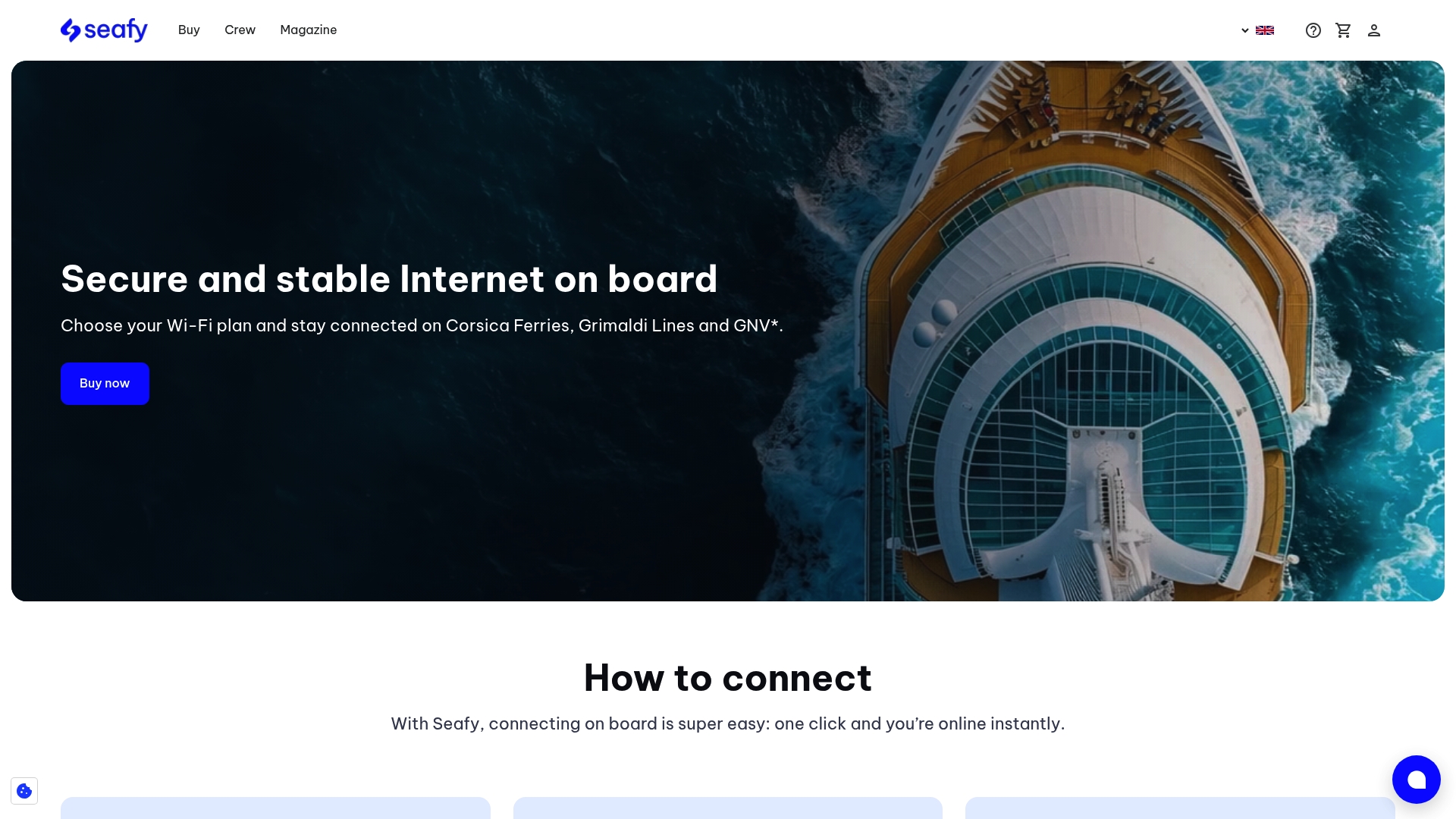
Their platform partners with major ferry lines to deliver seamless internet access throughout your journey. Whether you’re traveling for leisure or working remotely at sea, Seafy’s infrastructure ensures you stay connected when it matters most. Passengers can easily access services through the Seafy Onboard Portal, purchasing and activating Wi-Fi packages with just a few clicks. Explore Seafy’s connectivity solutions to discover how their technology can transform your next Mediterranean voyage from frustratingly disconnected to reliably online.
FAQ
How can I improve Wi-Fi coverage on Mediterranean ferries?
Choose ferries equipped with hybrid satellite and coastal 5G networks for the best coverage throughout your journey. When traveling near coastlines, your device may automatically connect to local cellular networks, providing faster speeds and lower latency. Upgrading to premium onboard packages often includes priority bandwidth allocation and access to better equipment, significantly improving your experience compared to basic free Wi-Fi offerings. Learning about getting Wi-Fi on Mediterranean ferries helps you maximize connectivity during your voyage.
What technology extends onboard internet coverage effectively?
Hybrid systems combining satellite with 5G and cellular networks provide the most effective coverage for Mediterranean routes. Research shows these networks achieve 80-90% coverage in key ferry corridors, far exceeding satellite-only alternatives. Fleet-based 5G relays further extend coverage by creating mesh networks between vessels, greatly reducing costs while improving signal strength and reliability in busy shipping lanes. Understanding seamless internet technologies helps you appreciate why hybrid approaches outperform traditional solutions.
Are there cost-effective ways to get better onboard connectivity?
Hybrid networks significantly reduce operational costs by combining satellite with cellular technology, and these savings often translate to more affordable passenger packages. Fleet-based 5G relays cut costs by about 40% compared to satellite-only solutions, allowing operators to offer better service at competitive prices. Choosing ferries with modern Wi-Fi infrastructure provides better value for money, as you’ll experience fewer connection issues and faster speeds without necessarily paying premium prices. The impact of Wi-Fi on ferry travel extends beyond connectivity to overall passenger satisfaction and productivity.
When should I use onboard Wi-Fi versus my mobile data?
Use onboard Wi-Fi during open-sea passages when your mobile signal disappears completely, as satellite connectivity remains your only option. Switch to your mobile carrier’s roaming service when traveling near coastlines where cellular towers provide coverage, as this often delivers faster speeds and lower latency than satellite connections. Consider purchasing onboard packages for extended voyages where you’ll spend significant time beyond cellular range, but rely on mobile data for short coastal routes with frequent port stops.
How do I know if a ferry has good onboard connectivity?
Research specific vessel names and check recent passenger reviews mentioning internet quality and reliability. Contact ferry operators directly to ask about their connectivity infrastructure, specifically whether they use hybrid satellite/5G systems or older satellite-only technology. Newer vessels and recently refurbished ships typically feature the latest connectivity equipment, while older ferries may still rely on outdated systems. Booking with operators that prominently advertise their Wi-Fi capabilities usually indicates they’ve invested in quality infrastructure.