Tech & Wi-Fi
Unlock the top benefits of high-speed ferry internet
Discover how high-speed ferry internet boosts productivity by 30%, enables remote work with 50-70 Mbps speeds, and keeps you connected across Mediterranean routes with reliable satellite technology.
21 March 2026
Unlock the top benefits of high-speed ferry internet
Ferry passengers expect to stay connected during their Mediterranean journeys, but reliable internet at sea remains challenging. Modern ferry Wi-Fi technology has transformed onboard connectivity, delivering speeds that rival coastal networks while addressing unique maritime obstacles. Understanding these benefits helps you maximize productivity, entertainment, and communication during your voyage. This guide explores how high-speed ferry internet enhances your travel experience, the technology enabling seamless coverage, and practical strategies to optimize your connection while crossing open waters.
Table of Contents
- Key takeaways
- How reliable ferry internet boosts communication and productivity
- Hybrid internet systems: how ferries maintain seamless connectivity at sea
- Common challenges and tips for maximizing ferry internet experience
- Comparing ferry internet providers and solutions for optimal travel
- Experience high-speed internet on your next ferry trip with Seafy
- Frequently asked questions
Key Takeaways
| Point | Details |
|---|---|
| High speed ferry WiFi | Modern ferry WiFi delivers speeds that rival coastal networks, boosting remote work and onboard entertainment. |
| Hybrid satellite cellular | Ferries switch automatically between satellite and cellular networks to maintain continuous internet as they move. |
| Connectivity reduces isolation | Stable connections help passengers stay connected with work and loved ones during long crossings. |
| Performance rivals coastal 5G | Median latency stays under 50 ms and upload speeds exceed 35 Mbps, enabling real time video calls and fast file sharing. |
How reliable ferry internet boosts communication and productivity
Modern ferry internet transforms your vessel into a mobile office or entertainment hub. Seafy-powered Starlink Wi-Fi delivers 50-70 Mbps on Corsica-Sardinia routes, enabling video conferencing, file downloads, and HD streaming without interruption. This performance level supports professional workflows that were impossible just five years ago.
Research shows over 70% of Mediterranean ferry passengers prioritize Wi-Fi, with reliable access boosting productivity by 30%. Remote workers complete presentations, attend virtual meetings, and collaborate with teams as effectively as from land-based offices. The psychological impact matters too: stable connectivity reduces the isolation feeling during long crossings, keeping passengers engaged with family, friends, and work communities.
Key communication and productivity benefits include:
- Crystal-clear video conferencing for business meetings and family calls
- Instant access to cloud-based work files and collaborative platforms
- Real-time messaging through WhatsApp, Slack, and other apps
- Seamless email management without frustrating delays
- Streaming entertainment during downtime between work sessions
Pro Tip: Always use a VPN when connecting to public ferry Wi-Fi networks. This encrypts your data and protects sensitive information from potential security vulnerabilities on shared connections.
Understanding why high-speed internet matters on ferries helps you appreciate the technical achievement behind these speeds. The impact of Wi-Fi on ferry travel experience extends beyond work, transforming how passengers spend their journey time and maintain connections to shore-based life.
Hybrid internet systems: how ferries maintain seamless connectivity at sea
Ferry internet relies on sophisticated hybrid systems combining satellite and cellular technologies. Satellite provides open sea coverage while cellular towers deliver speeds up to 100 Mbps near coastlines. These systems switch automatically, maintaining continuous internet as your vessel moves between coverage zones.

The technical architecture behind this seamless experience involves multiple antennas, intelligent routing algorithms, and redundant connections. When your ferry departs port, the system gradually transitions from cellular to satellite as shore distance increases. Passengers experience this handoff as a brief speed fluctuation rather than a complete disconnection, preserving active sessions and downloads.
| Technology Type | Speed Range | Latency | Coverage Area | Reliability |
|---|---|---|---|---|
| Satellite (Starlink) | 50-70 Mbps | <50 ms median | Complete open sea | High in clear weather |
| Cellular (4G/5G) | 20-100 Mbps | 20-40 ms | Within 20km of coast | Excellent near shore |
| Hybrid System | 50-100 Mbps | 30-50 ms | Entire route | Very high with auto-switching |
Starlink maritime benchmarks show median RTT under 50 ms with upload speeds exceeding 35 Mbps, performance competitive with coastal 5G networks. The 99th percentile latency actually outperforms many terrestrial mobile connections, making ferry internet surprisingly responsive for interactive applications.
Key technical metrics passengers should know:
- Median latency below 50 milliseconds enables responsive browsing
- Upload speeds above 35 Mbps support video calls and file sharing
- Download capacity handles multiple HD streams simultaneously
- Automatic failover maintains connection during system transitions
Pro Tip: Choose ferries equipped with hybrid systems for the most reliable connectivity. Check operator websites or contact customer service to confirm which vessels feature modern internet infrastructure before booking.
Exploring 7 types of onboard Wi-Fi solutions reveals the technical diversity across Mediterranean routes. Understanding why offer ferry Wi-Fi from an operator perspective shows how passenger demand drives continuous infrastructure improvements.
Common challenges and tips for maximizing ferry internet experience
Despite impressive technical capabilities, ferry internet faces unique obstacles. Weather and storms increase satellite latency, vessel motion causes signal fluctuations, shared bandwidth slows during peak usage, and public Wi-Fi networks present security risks. Understanding these limitations helps you set realistic expectations and implement workarounds.
Weather impacts satellite connections more than cellular networks. Heavy rain attenuates signals, while rough seas cause antenna pointing errors as the vessel pitches and rolls. Modern stabilization systems compensate for most motion, but extreme conditions still degrade performance. Shared bandwidth becomes noticeable when hundreds of passengers simultaneously stream video during evening hours, reducing individual speeds significantly.
Challenges affecting your connection quality:
- Increased latency and packet loss during storms and heavy precipitation
- Brief disconnections when vessel motion exceeds stabilization limits
- Slower speeds during peak usage periods (typically 7-10 PM)
- Security vulnerabilities on open public networks without encryption
- Inconsistent performance near coverage zone boundaries
Practical optimization strategies:
- Connect through a VPN to encrypt traffic and protect sensitive data
- Reconnect periodically if you notice degraded performance
- Schedule bandwidth-intensive tasks during off-peak hours (morning/afternoon)
- Keep device software updated for optimal network compatibility
- Consider personal eSIMs for critical connectivity needs as backup
- Download content for offline use before peak evening hours
- Close background apps consuming bandwidth unnecessarily
“Passengers who proactively manage their connectivity expectations and use best practices experience 40% fewer frustrating disconnections. Simple steps like reconnecting during slow periods and avoiding peak hours make a substantial difference in perceived performance.”
The 7 best practices for reliable ferry internet access provide deeper technical guidance. When issues arise, following Wi-Fi troubleshooting steps for ferries resolves most common problems quickly.
Comparing ferry internet providers and solutions for optimal travel
Mediterranean ferry operators deploy diverse internet solutions with varying performance characteristics. Understanding these differences helps you select routes and vessels matching your connectivity priorities. Starlink maritime systems deliver median latency under 50 ms with upload speeds exceeding 35 Mbps, while traditional satellite providers offer broader coverage at lower speeds.
| Provider/Technology | Typical Speed | Latency | Coverage | Best For | Approximate Cost |
|---|---|---|---|---|---|
| Starlink Maritime | 50-70 Mbps | <50 ms | Global open sea | Remote workers, streamers | Premium pricing |
| Hybrid Satellite-Cellular | 40-100 Mbps | 30-60 ms | Complete route | Balanced performance | Moderate pricing |
| Cellular Only | 20-100 Mbps | 20-40 ms | Coastal routes only | Short crossings | Budget friendly |
| Traditional Satellite | 10-25 Mbps | 500-700 ms | Global coverage | Basic browsing | Lower cost |
| Seafy-Powered Systems | 50-70 Mbps | <50 ms | Mediterranean routes | All passenger types | Competitive rates |
Provider advantages by technology type:
- Starlink offers lowest latency and most responsive interactive performance
- Hybrid systems provide best reliability through automatic failover
- Cellular-only solutions deliver highest speeds but limited to coastal waters
- Traditional satellite ensures connectivity in remote areas despite slower speeds
- Integrated platforms like Seafy combine performance with user-friendly access
Matching solutions to passenger needs requires considering your primary activities. Remote workers benefit most from low-latency Starlink connections enabling seamless video conferencing. Casual browsers find hybrid systems perfectly adequate for email and social media. Entertainment-focused passengers streaming video need consistent bandwidth more than ultra-low latency. Budget-conscious travelers on short coastal routes may prefer cellular-only options.
The 2026 benchmark data shows maritime internet performance now rivals terrestrial mobile networks in many scenarios. This convergence means ferry passengers no longer accept degraded connectivity as inevitable, driving operators toward premium solutions. Checking top 7 internet providers for ferries before booking helps you select vessels with infrastructure matching your requirements.
Experience high-speed internet on your next ferry trip with Seafy
Seafy delivers reliable, high-speed Wi-Fi across Mediterranean ferry routes through partnerships with major operators. Our Starlink-powered service provides 50-70 Mbps download speeds, enabling seamless video calls, file transfers, and HD streaming throughout your journey. We’ve eliminated the frustration of unreliable maritime internet through modern satellite technology and user-friendly access portals.
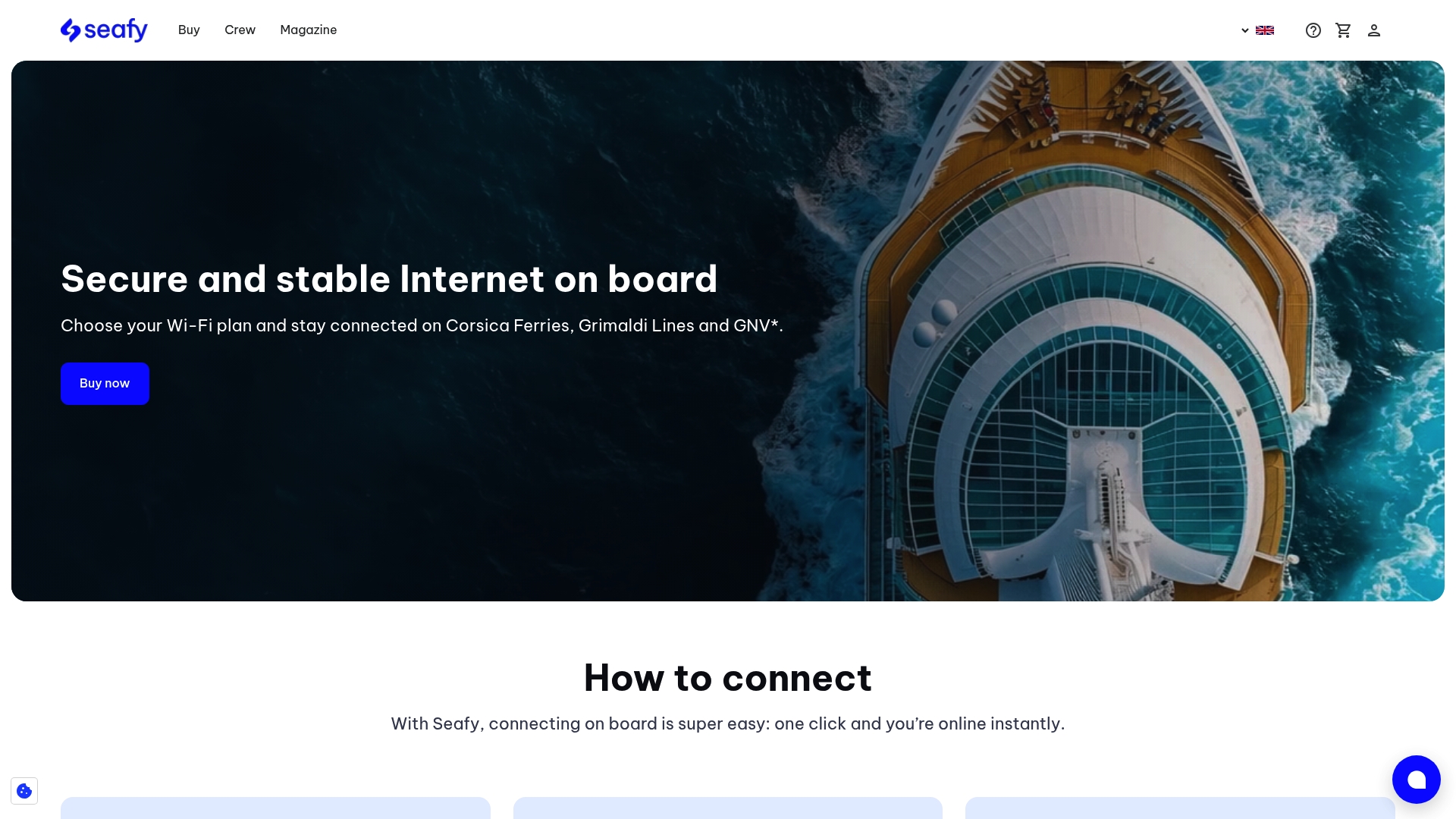
Security features protect your data on public networks, while straightforward package options let you purchase exactly the connectivity you need. Whether you’re working remotely, staying in touch with family, or streaming entertainment, Seafy ensures your ferry crossing includes the reliable internet access you expect. Discover how Wi-Fi on board with Seafy transforms your Mediterranean travel experience with connectivity that keeps you productive and connected from departure to arrival.
Frequently asked questions
What factors affect ferry internet speed and reliability?
Weather conditions, vessel motion, shared bandwidth during peak hours, and distance from cellular towers all impact performance. Satellite systems experience increased latency during storms, while vessel pitching can cause brief signal interruptions. Choosing modern hybrid systems and traveling during off-peak hours minimizes these effects.
How can I stay secure when using ferry Wi-Fi?
Always connect through a VPN to encrypt your traffic and protect sensitive data on public networks. Avoid accessing banking or confidential accounts without encryption, keep your device software updated, and disable automatic connection to open networks. These simple steps dramatically reduce security risks while using shared ferry internet.
Can I work remotely on ferry internet effectively?
Yes, modern ferry internet with 50-70 Mbps speeds and latency under 50 ms supports video conferencing, cloud applications, and file transfers effectively. Research shows 30% productivity improvements with reliable onboard Wi-Fi. Schedule bandwidth-intensive tasks during off-peak hours and use a VPN for secure access to work systems.
What technologies do ferries use to provide internet?
Most modern ferries deploy hybrid systems combining satellite coverage for open sea with cellular connections near coastlines. Starlink maritime satellite provides low-latency, high-speed connectivity globally, while 4G/5G cellular delivers up to 100 Mbps within 20km of shore. Systems automatically switch between technologies to maintain seamless coverage throughout your voyage.
Are there times when ferry internet may not work well?
Performance degrades during severe weather, extremely rough seas, and peak evening usage periods when many passengers stream video simultaneously. Brief interruptions may occur when transitioning between coverage zones or during system handoffs between satellite and cellular. Planning important calls or downloads during calmer morning or afternoon hours ensures better reliability.