Tech & Wi-Fi
What Is Maritime Broadband? A Clear Guide for 2026
Discover what maritime broadband is and how it revolutionizes internet at sea. Get the clear guide to better connectivity in 2026!
28 May 2026
What Is Maritime Broadband? A Clear Guide for 2026
TL;DR:
- Maritime broadband now combines satellites and cellular networks to provide high-speed, reliable internet at sea, improving crew welfare, operations, and passenger experience. Performance depends on equipment quality, distance from shore, weather, and suitable technology choices, with hybrid systems offering the best resilience. Platforms like Seafy simplify onboard connectivity, allowing passengers to access fast Wi-Fi without technical hassle.
If you’ve ever tried to send a message from a ferry and watched the loading spinner spin endlessly, you already know what the old days of maritime internet felt like. But what is maritime broadband, really, and why has it gotten so much better? Today’s marine broadband technology combines satellites, cellular networks, and smart hardware to deliver speeds that would have seemed impossible at sea a decade ago. This guide breaks down how it works, what affects its performance, and how to pick the right solution for your needs onboard.
Table of Contents
- Key takeaways
- How maritime broadband works: technology types explained
- What affects performance and reliability at sea
- Real-world benefits of maritime broadband
- Choosing the right maritime broadband solution
- My take on what people get wrong about maritime broadband
- Stay connected at sea with Seafy
- FAQ
Key takeaways
| Point | Details |
|---|---|
| Multiple technologies exist | Maritime broadband uses satellite (GEO, LEO, MEO) and cellular networks, often combined for best coverage. |
| Distance from shore matters | Cellular coverage typically works within 8 to 20 km of the coast; open-ocean routes require satellite. |
| Hardware quality is decisive | Marine-grade antennas and routers determine real-world performance more than advertised speeds alone. |
| Match your route to your system | Choosing the wrong technology for your operating area leads to higher costs and weaker connections. |
| Onboard platforms simplify access | Services like Seafy make it easy to activate and purchase Wi-Fi packages on ferries without technical setup. |
How maritime broadband works: technology types explained
Maritime broadband is the delivery of internet connectivity to vessels at sea using wireless communication technologies. Unlike land-based internet, there are no cables or cell towers in the water, so the signals must travel through the air via satellite or shore-based cellular systems.
Satellite broadband is the backbone of open-ocean connectivity. Three types of satellite orbits are used:
- GEO (Geostationary): These satellites orbit at roughly 36,000 km and cover wide areas. They are reliable but carry higher latency, around 600 milliseconds, which can feel slow for video calls or gaming.
- LEO (Low Earth Orbit): Systems like Starlink orbit at 500 to 1,200 km, offering much lower latency and speeds up to 340 Mbps that make real office-level internet possible at sea.
- MEO (Medium Earth Orbit): A middle ground. MEO satellites offer better latency than GEO with broader coverage than LEO.
Each satellite type also uses different frequency bands. Ku-band and Ka-band are widely used for high-throughput data but are more vulnerable to rain fade, the degradation of signal quality caused by heavy precipitation. C-band offers reliability but is restricted near coastlines (within roughly 300 km offshore) due to interference regulations, which shapes how maritime systems are designed.
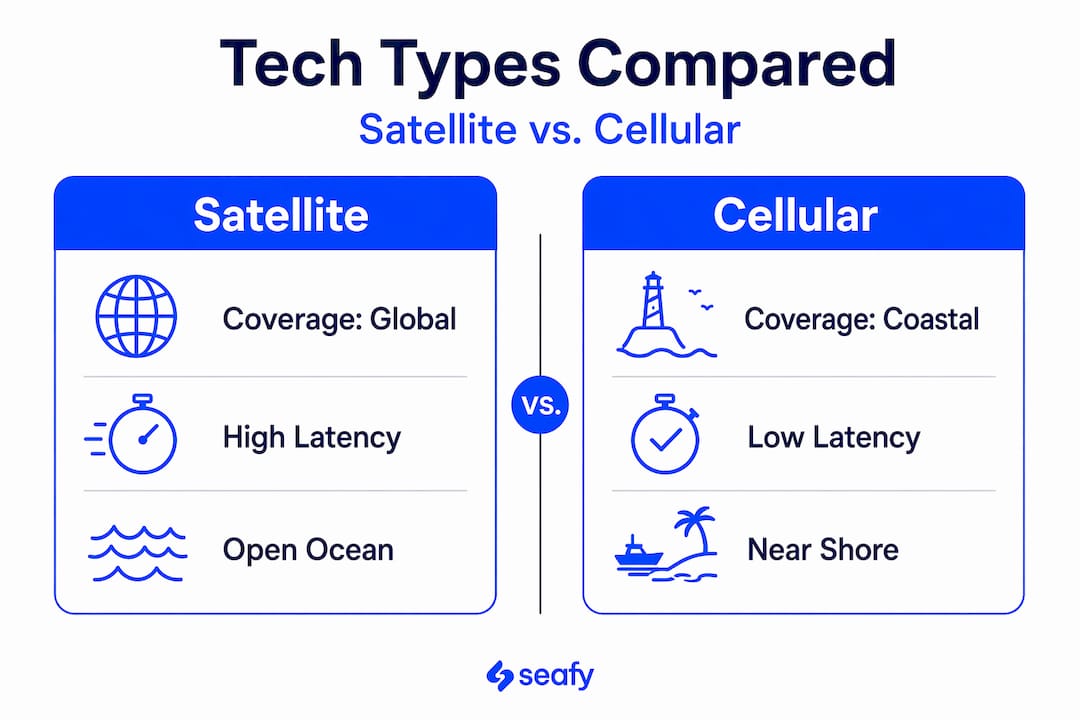
Cellular maritime broadband works differently. When your vessel is near shore, 4G LTE and 5G networks can deliver fast, affordable internet. Typical cellular range is 8 to 20 km from the coast, though specialized long-range antenna setups can push that further. A 4G LTE marine antenna can reach up to 150 Mbps download and 50 Mbps upload under good conditions near shore. ⚡
Hybrid systems are where things get smart. Modern hybrid setups combine satellite and cellular networks using multi-network SIMs and marine routers that automatically switch to the strongest available signal. This means you get affordable LTE speed near ports and satellite coverage when you head out to open water, all without lifting a finger.
| Technology | Coverage | Latency | Best for |
|---|---|---|---|
| GEO Satellite | Global | High (~600ms) | Remote ocean, wide area |
| LEO Satellite | Growing global | Low (<50ms) | High-speed open water |
| Cellular 4G/5G | Coastal (8–20 km) | Very low | Near-shore routes |
| Hybrid systems | Coastal + ocean | Variable | Mixed-route vessels |
What affects performance and reliability at sea
Understanding the technology is one thing. Knowing why your connection still drops on a sunny day is another.
Distance from shore is the most predictable factor. The further you sail from land, the weaker or nonexistent cellular signals become, making satellite the only real option for open-ocean connectivity. But satellite performance is not immune to conditions either.
Rain fade impacts Ku and Ka-band signals significantly, requiring antennas to track satellites with precision even as the vessel rolls and pitches. Marine-grade antennas use flat or phased-array designs specifically built for this, maintaining a stable link despite constant motion and harsh weather.
Pro Tip: Never use consumer-grade routers or antennas on a vessel. Marine-grade equipment rated IP67 for weather resistance is built to handle moisture, salt, vibration, and vessel motion. Consumer gear fails fast in these conditions.
Here is a quick summary of key performance factors:
- Vessel movement: Constant rolling and pitching disrupts signal lock, which is why specialized tracking antennas matter so much.
- Weather: Heavy rain, storms, and dense clouds degrade Ka and Ku-band satellite signals.
- Hardware quality: Configuration and antenna quality determine actual experience more than the advertised speeds on a spec sheet.
- Regulatory limits: C-band satellite use is restricted near coasts, which affects system design for vessels that operate in both nearshore and offshore zones.
For those curious about exactly what environmental and technical elements shape your internet connection speeds at sea, there is a lot more worth knowing beyond just the satellite tier you choose.
Real-world benefits of maritime broadband
Maritime broadband has crossed from “nice to have” to a genuine necessity. Connectivity is now transitioning from luxury to a basic operational requirement for vessels of all sizes.
Here is how it actually improves life and work onboard:
- Crew welfare. Sailors and ferry workers away from home can video call family, stream their favorite shows, and stay mentally healthy. This has a direct impact on crew retention and morale. The role of internet in crew welfare is now well-documented across maritime operators.
- Operational efficiency. Real-time route monitoring, weather data, engine diagnostics, and safety communications all rely on a stable broadband link. A dropped connection at the wrong moment is not just inconvenient. It is a risk.
- Remote work for travelers. Digital nomads and business travelers crossing the Mediterranean on a ferry no longer need to disconnect. With reliable maritime internet service, you can join a video call, answer emails, or upload files mid-crossing.
- Passenger experience. Streaming music, navigating travel apps, staying in touch with friends. Onboard Wi-Fi has become a core part of what passengers expect from a modern ferry or cruise ship experience.
Choosing the right maritime broadband solution
Picking the right maritime internet service is not about finding the fastest plan. It is about matching the technology to where your vessel actually operates.
Key considerations before you choose:
- Route type: Coastal routes that stay within 20 km of shore can rely heavily on cellular LTE, which is cheaper. Open-ocean crossings need satellite coverage.
- Bandwidth needs: Are you supporting one passenger device, a crew of thirty, or a full ship of hundreds? Bandwidth requirements scale dramatically.
- Budget: LEO satellite systems like Starlink offer excellent performance but at higher hardware and subscription costs than LTE-only setups.
- Redundancy: Hybrid antenna systems with automatic network switching provide failover protection, so a single network outage does not cut off the whole vessel.
Pro Tip: Matching coverage type to route is the most overlooked decision in maritime broadband. Many operators pay for global satellite plans when they only operate within 40 km of the coast, where LTE delivers faster speeds at a fraction of the cost.
For passengers on ferries and cruise ships, you do not need to manage any of this yourself. Platforms like Seafy handle the infrastructure, so you just connect and go. You can explore ferry Wi-Fi providers in 2026 to understand what to expect from onboard internet services before you board.
My take on what people get wrong about maritime broadband
I’ve talked to a lot of travelers and even some vessel operators who assume maritime broadband is still the sluggish, expensive satellite connection it was ten years ago. That assumption costs them. They either avoid using it entirely or overpay for a system that does not match how they actually operate.
In my experience, the single biggest mistake people make is treating this as a one-size-fits-all decision. A coastal ferry route and a trans-Atlantic crossing have almost nothing in common when it comes to connectivity needs. Buying an open-ocean satellite plan for a Mediterranean ferry route is like renting a four-wheel-drive truck to commute through a city.
What I’ve learned is that hybrid systems almost always win in practice. They are more resilient, more cost-effective over time, and they handle the messiness of mixed routes without requiring you to think about it. The technology has also matured to a point where managed services take most of the complexity off your plate entirely.
For passengers, my honest advice is simple: trust the platform. A service like Seafy, built specifically for ferry and cruise ship connectivity and integrated with technologies like Starlink, removes every layer of technical friction so you can just be online. That is what good maritime broadband should feel like.
— Raffaele
Stay connected at sea with Seafy
Ready to put this knowledge to use on your next voyage?

Seafy is a reliable, passenger-friendly platform that makes high-speed Wi-Fi onboard as simple as a few taps. Whether you’re crossing the Mediterranean for a vacation or working remotely mid-crossing, Seafy has you covered. With partnerships with major ferry lines like Corsica Ferries, GNV, and Grimaldi Lines, Seafy delivers flexible Wi-Fi packages you can purchase and activate directly onboard via an easy portal. No technical setup required. Just connect and enjoy the crossing. Visit seafy.com to explore available packages, or check out onboard Wi-Fi by operator to find the right option for your route.
FAQ
What is maritime broadband, exactly?
Maritime broadband is internet connectivity delivered to ships and vessels at sea using satellite signals, cellular networks, or a combination of both. It allows passengers, crew, and operators to access the internet while underway.
How fast is maritime broadband today?
Modern LEO satellite systems can deliver speeds up to 340 Mbps with low latency, while coastal 4G LTE setups can reach 150 Mbps near shore. Actual speeds vary based on hardware, weather, and vessel location.
Does maritime broadband work in the middle of the ocean?
Yes, satellite-based maritime broadband covers open ocean. LEO constellations like Starlink offer near-global coverage with high speeds. Cellular networks only work within 8 to 20 km of the coastline.
What is a hybrid maritime broadband system?
A hybrid system combines satellite and cellular networks using smart marine routers that automatically connect to the strongest available signal. Hybrid setups offer better reliability and cost efficiency than using satellite or cellular alone.
Do ferry passengers need to manage maritime broadband themselves?
No. On ferries that partner with platforms like Seafy, passengers simply purchase a Wi-Fi package through the onboard portal and connect. All the satellite and network infrastructure is managed behind the scenes.