Tech & Wi-Fi
How Wi-Fi transforms passenger engagement at sea
Discover how reliable Wi-Fi shapes your ferry and cruise experience, from streaming and remote work to satisfaction and smart connectivity choices at sea.
09 April 2026
How Wi-Fi transforms passenger engagement at sea
TL;DR:
- Passengers now expect reliable onboard Wi-Fi equal to their land-based internet.
- Good connectivity enhances satisfaction, engagement, and repeat bookings at sea.
- Preparing apps offline and understanding Wi-Fi options improve the onboard experience.
Somewhere between boarding and open water, something shifts. Passengers reach for their phones, not to take photos, but to check messages, queue up a playlist, or jump into a work call. Wi-Fi on ferries and cruise ships has quietly moved from a bonus amenity to a baseline expectation, and how well a ship delivers on that expectation shapes everything from mood to loyalty. This guide walks you through exactly how connectivity powers your onboard experience, what passengers actually do online, how it affects satisfaction, and how to choose the right setup before you set sail. 🌐
Table of Contents
- How Wi-Fi empowers today’s ferry and cruise passengers
- Ways passengers use Wi-Fi for leisure, communication, and work
- The impact of reliable Wi-Fi on engagement and satisfaction
- Comparing onboard Wi-Fi solutions: What to look for as a passenger
- The real secret to maximizing engagement at sea
- Level up your onboard experience with reliable Wi-Fi
- Frequently asked questions
Key Takeaways
| Point | Details |
|---|---|
| Wi-Fi is essential | Reliable internet is now expected for communication, entertainment, and work while at sea. |
| Boosts satisfaction | Great Wi-Fi is directly linked to better experiences and higher passenger engagement. |
| Know your options | Understanding Wi-Fi types ensures you choose the best service for your travel needs. |
| Prepare devices | Download content and secure your devices before boarding for the best online experience. |
How Wi-Fi empowers today’s ferry and cruise passengers
Not long ago, going offline for a ferry crossing felt normal. Today, it feels like a disruption. Passengers board expecting the same kind of connectivity they enjoy at home or in a coffee shop. That shift in expectation is real, and it matters more than most operators realize.
Most passengers consider Wi-Fi as essential as onboard food or entertainment. That is a significant benchmark. It means connectivity is no longer judged against “better than nothing” but against the everyday digital life passengers are used to.
What does that look like in practice? Here is what reliable Wi-Fi actually enables on board:
- Entertainment access: Streaming music, movies, or podcasts without buffering frustration
- Social sharing: Posting photos, updating stories, and sharing moments in real time
- Communication: Staying in touch with family, friends, or colleagues via messaging and video apps
- Remote work: Joining meetings, responding to emails, and accessing cloud tools mid-voyage
- Travel management: Checking itineraries, booking transfers, or updating travel documents on the go
When any of these break down, the frustration compounds quickly. A dropped video call or a frozen stream during a four-hour crossing feels much worse than it would on land, because there is no alternative. You cannot switch to mobile data when you are 50 miles offshore.
“Connectivity at sea is no longer a perk. It is the baseline passengers measure their entire experience against.”
The travel experience with Wi-Fi has fundamentally changed what passengers expect from maritime operators. And the impact of Wi-Fi on ferries goes well beyond convenience. It shapes how passengers feel about the entire journey, from the moment they board to the moment they disembark.
With expectations set high, it is important to see exactly how Wi-Fi is used and valued by passengers every day.
Ways passengers use Wi-Fi for leisure, communication, and work
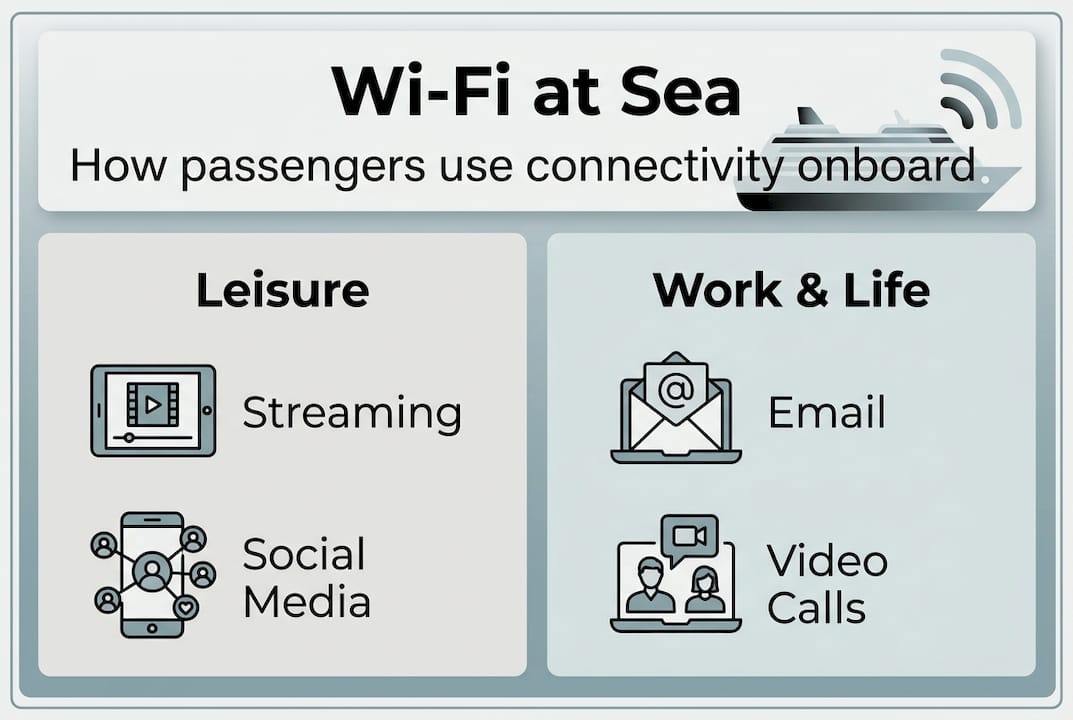
Knowing that passengers want Wi-Fi is one thing. Understanding what they actually do with it is where things get interesting. Passengers use Wi-Fi for streaming, messaging, work calls, and personal tasks, often switching between all of them within a single voyage.
Here are the most common ways passengers put onboard connectivity to work:
- Streaming entertainment: Movies, TV shows, live sports, and music playlists fill long crossings. A reliable connection turns a four-hour voyage into a personal cinema experience.
- Video calls and messaging: Whether it is a quick check-in with family or a full video call with a colleague, staying connected to people at home is a top priority for most travelers.
- Remote work tasks: Professionals on the move use ferry and cruise Wi-Fi to handle emails, join virtual meetings, and access shared documents. A stable connection makes the difference between a productive crossing and a lost workday.
- Managing travel logistics: Flight check-ins, hotel confirmations, transfer bookings, and itinerary updates all happen mid-voyage. Passengers who can handle these tasks on board arrive at their destination feeling organized and in control.
- Social media and content sharing: Posting a photo of the open sea or going live from the deck is a genuine part of how modern travelers document their trips. Real-time sharing requires real-time connectivity.
For entertainment over onboard Wi-Fi, the quality of the connection directly determines the quality of the experience. Buffering and dropped connections do not just annoy passengers. They create negative associations with the entire trip.
Pro Tip: Download your favorite shows, playlists, or podcasts for offline use before you board. Even on ships with excellent Wi-Fi, having offline content ready means you are never dependent on network conditions for your entertainment. Check cruise connectivity tips for more ways to prepare before departure.
Understanding how Wi-Fi is used every day begs the question: How does connectivity shape engagement and satisfaction for passengers?
The impact of reliable Wi-Fi on engagement and satisfaction
Passenger satisfaction is not just about comfort or food quality anymore. Good connectivity is directly linked to positive reviews and repeat bookings. That is a measurable business reality, and it has major implications for how operators invest in their onboard digital infrastructure.
When Wi-Fi works well, passengers engage more. They spend time on entertainment, participate in onboard activities, share content online, and generally feel better about the experience. When it does not work, frustration builds fast and shows up in reviews.

Here is a clear look at how Wi-Fi quality affects passenger satisfaction:
| Factor | Strong Wi-Fi experience | Poor Wi-Fi experience |
|---|---|---|
| Review sentiment | Positive, recommends to others | Negative, highlights frustration |
| Repeat booking intent | High | Low |
| Onboard spending | Higher (entertainment, extras) | Lower |
| Social sharing | Active, real-time posts | Minimal or delayed |
| Overall trip rating | Elevated | Reduced |
The pattern is consistent. Passengers who get reliable connectivity rate their trips higher, share more, and come back. Those who struggle with slow or spotty Wi-Fi are more likely to leave critical reviews and choose a different operator next time.
For maritime operators, this is not a soft metric. Wi-Fi’s effect on passenger satisfaction translates directly into revenue, brand reputation, and customer retention. Investing in strong onboard connectivity is not a cost. It is a competitive advantage. ⚡
While quality Wi-Fi unlocks new dimensions of engagement, the options and solutions available are not all created equal.
Comparing onboard Wi-Fi solutions: What to look for as a passenger
Not all onboard Wi-Fi is built the same. Onboard Wi-Fi ranges from basic hotspots to advanced networks, and knowing what is offered matters before you board. Understanding your options helps you set realistic expectations and make smarter choices.
Here is a quick comparison of the main types you will encounter:
| Wi-Fi type | Typical speed | Coverage | Best for | Cost |
|---|---|---|---|---|
| Basic public hotspot | Low (1-5 Mbps) | Limited areas | Light browsing, messaging | Free or low cost |
| Premium paid access | Medium (10-30 Mbps) | Most of the ship | Streaming, video calls | Moderate fee |
| App-based network | Varies | Specific zones | In-app content, onboard services | Included or bundled |
| Satellite-powered (e.g., Starlink) | High (50+ Mbps) | Full coverage | Remote work, HD streaming | Premium pricing |
Satellite-based systems like Starlink represent the newest generation of maritime connectivity. They use low-orbit satellites to deliver faster, more stable speeds even in open water, which is a significant upgrade over older systems that struggled mid-ocean.
Before booking, here is what you should confirm with your operator or Wi-Fi provider:
- Speed tiers available: Is there a basic and premium option? What are the actual speeds?
- Coverage zones: Is Wi-Fi available in cabins, on deck, and in common areas?
- Device limits: How many devices can connect per package?
- Access process: Do you need an app, a voucher, or a portal login?
- Customer support: Is there help available if the connection drops mid-voyage?
Knowing these details in advance means no surprises once you are at sea. The types of onboard Wi-Fi vary widely, and understanding Wi-Fi’s role in ship operations helps you appreciate why some networks perform better than others.
Equipped with this understanding of Wi-Fi solutions, here is what experience really teaches about passenger engagement at sea.
The real secret to maximizing engagement at sea
Here is something most connectivity guides skip: more bandwidth does not automatically mean happier passengers. We have seen it firsthand. Passengers on ships with fast networks still leave frustrated because they did not manage their devices well, connected to unsecured networks, or expected streaming quality that no maritime system can guarantee 100% of the time.
The real secret is preparation and awareness. Before you board, put your key apps in offline mode, download your media, and confirm the network is secure before entering any passwords or payment details. A VPN adds a useful layer of protection on public maritime networks.
Conventional wisdom says operators just need to offer more speed. But the passengers who report the highest satisfaction are usually the ones who arrived prepared, not the ones who had the fastest plan. Managing your own expectations and device settings can genuinely double how good the experience feels.
For a deeper look at how Seafy Wi-Fi game-changer thinking applies to modern maritime travel, the insight is clear: smart preparation beats raw speed every time.
Level up your onboard experience with reliable Wi-Fi
You now know what to expect, what to look for, and how to prepare for connectivity at sea. The next step is making sure you have access to a Wi-Fi solution that actually delivers.
Seafy onboard Wi-Fi is built specifically for ferry and cruise passengers who want reliable, high-speed connectivity without the guesswork. Whether you are traveling with Corsica Ferries, Grimaldi Lines, GNV, or another partner operator, Seafy lets you purchase and activate your Wi-Fi package before departure, so you are connected from the moment you step on board. No hunting for vouchers, no surprises at sea. Just smooth, stable connectivity for streaming, working, or staying in touch. Happy surfing! 🌐
Frequently asked questions
What can I do if my ship’s Wi-Fi is slow or unreliable?
Try connecting during off-peak hours when fewer passengers are online, limit the number of devices on your account, and download essential apps or media before departure to reduce your dependence on live streaming.
How can I securely use public Wi-Fi on a ferry or cruise ship?
Use a VPN, avoid logging into banking or sensitive accounts, and always log out when you are done. Public Wi-Fi networks on ships carry the same security risks as any public hotspot, so standard precautions apply.
Is Wi-Fi access typically included in the ticket price?
It depends on the operator. Some include basic Wi-Fi in the fare, while others offer tiered paid access for higher speeds or larger data allowances. Always check before you book.
Can I stream Netflix or make video calls from ship Wi-Fi?
Yes, on ships with premium or satellite-powered plans. Some onboard Wi-Fi plans support HD streaming and video calls, but quality depends on your plan tier and current network conditions.