Tech & Wi-Fi
What is maritime internet security? Guide for passengers
Learn what maritime internet security means for cruise and ferry passengers, the biggest cyber risks at sea, and practical steps to keep your data safe onboard.
10 April 2026
What is maritime internet security? Guide for passengers
TL;DR:
- Maritime networks pose risks like data theft, ransomware, and man-in-the-middle attacks.
- Passengers should use VPNs, verify networks, and avoid sensitive transactions onboard.
- Human error and poor digital hygiene are primary vulnerabilities over advanced security technology.
You board a ferry or cruise ship, connect to the onboard Wi-Fi, and assume everything is fine. Most passengers do. But that assumption is exactly what cybercriminals count on. Maritime networks carry real risks, from data theft to ransomware attacks that have cost the industry millions. This guide breaks down what maritime internet security actually means, which threats are most common on cruise and ferry networks, how ships defend themselves, and what you can do right now to protect your data. Whether you’re a vacationer checking email or a remote worker handling client files, staying safe at sea starts with knowing what you’re up against.
Table of Contents
- Defining maritime internet security: What’s at stake for passengers
- The biggest risks: Common threats on cruise and ferry networks
- How maritime networks defend themselves—and where gaps remain
- Staying secure at sea: Practical steps for passengers and remote workers
- Why digital hygiene beats high-tech solutions for maritime Wi-Fi security
- Staying safe and connected with Seafy
- Frequently asked questions
Key Takeaways
| Point | Details |
|---|---|
| Maritime networks are not foolproof | Even ships with strong defenses rely on passenger awareness and habits to prevent data breaches and cyberattacks. |
| Main threats are common public Wi-Fi risks | Shared shipboard Wi-Fi is vulnerable to familiar dangers like rogue access points, packet sniffing, and ransomware. |
| Simple safety steps work best | Using a VPN, staying alert to Wi-Fi names, and practicing basic digital hygiene are your biggest safeguards at sea. |
| Cruise and ferry security differs | Cruises focus on layered onboard defenses while ferries need extra vigilance near ports and with quick passenger turnover. |
Defining maritime internet security: What’s at stake for passengers
Maritime internet security covers everything involved in protecting your data, your privacy, and a ship’s critical operations while connected at sea. It’s not just an IT concern for the captain’s bridge. It affects every passenger who opens a browser, logs into an account, or sends a message from onboard Wi-Fi.
The maritime environment creates unique challenges that you won’t find in a typical office or hotel. Consider these factors:
- Shared networks: Hundreds or thousands of passengers share the same connection, creating a wide attack surface.
- Isolated environment: At sea, you can’t simply switch to a trusted mobile network. You depend entirely on what the ship provides.
- Multiple attack vectors: Onboard systems blend passenger Wi-Fi, crew communications, navigation, and operational technology, often on overlapping infrastructure.
- Limited oversight: Passengers have no visibility into how the network is managed or monitored.
These conditions make maritime Wi-Fi a tempting target. Internet and safety at sea are closely linked, and a compromised network can affect far more than someone’s social media feed. Ransomware attacks have disrupted ship operations, while privacy breaches have exposed passenger data on a large scale.
“Ships use layered defenses, and IMO 2021 guidelines now require cyber risk management to be integrated directly into a vessel’s Safety Management System.”
These regulations push shipping companies to treat cybersecurity as seriously as physical safety. But regulations cover the ship’s systems, not your personal device. That gap is where most passenger-level risks live.
For remote workers especially, the stakes are higher. Sending work files, joining video calls, or accessing company systems over a shared maritime network without proper precautions is a real exposure. A solid guide to secure maritime internet access can help you understand the full picture before you sail. Maritime communication security research continues to highlight how passenger-facing networks remain one of the most vulnerable layers aboard modern vessels.
The biggest risks: Common threats on cruise and ferry networks
Now that you understand the foundation, let’s look at the specific threats you’re most likely to encounter when connecting to maritime Wi-Fi.
The four most common attack types are:
- Man-in-the-middle attacks: A hacker positions themselves between your device and the network, intercepting data without you knowing.
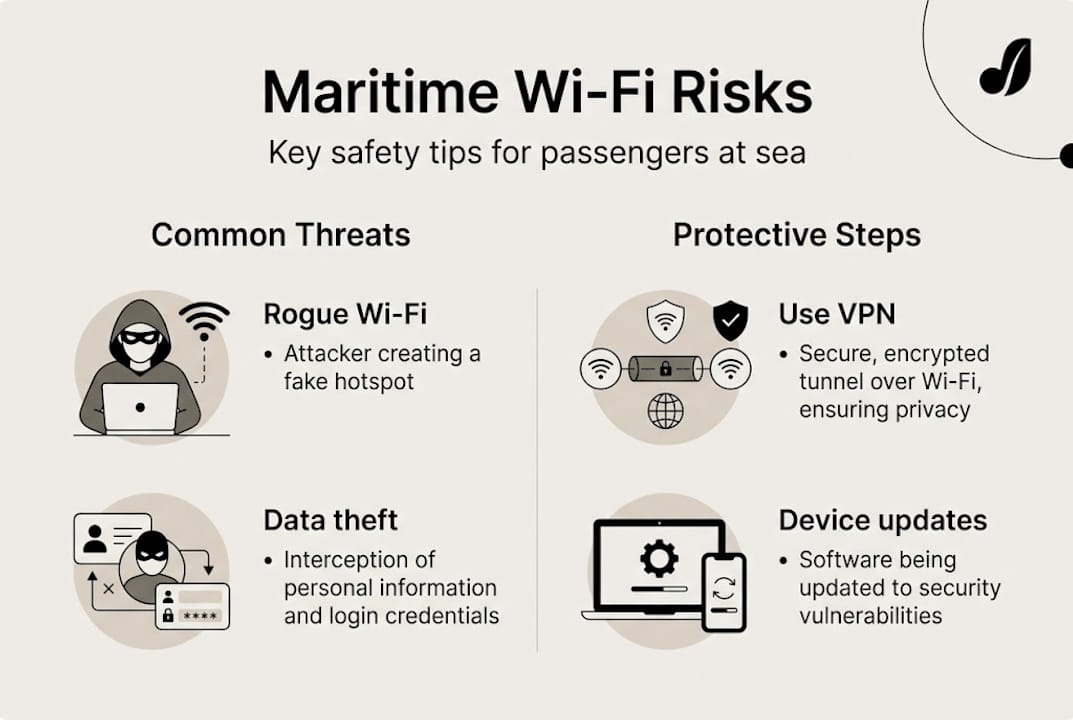
- Rogue access points (evil twins): A fake Wi-Fi network mimics the ship’s official one. You connect thinking it’s legitimate, and your traffic is captured.
- Network sniffing: On poorly secured networks, specialized tools can passively capture unencrypted data packets passing through the air.
- Ransomware: Malicious software locks systems or data and demands payment. This affects ship operations, not just personal devices.
Here’s a quick breakdown of how these threats play out:
| Threat type | Attack method | Who’s affected | Real incident |
|---|---|---|---|
| Ransomware | Malware injection | Ship operations, crew, passengers | Carnival Corporation, 2020 |
| Rogue access point | Fake Wi-Fi network | Individual passengers | Port Rijeka simulation |
| Man-in-the-middle | Traffic interception | Anyone on shared network | Widespread near ports |
| Network sniffing | Passive packet capture | Unencrypted sessions | Ongoing low-level risk |
The financial reality is striking. Maritime breaches average $3.6M per incident, and a single ransomware wave in 2023 hit over 1,000 vessels globally. These aren’t hypothetical scenarios.
“A simulated rogue access point near a busy port successfully lured passenger devices, capturing login credentials and browsing data within minutes.”
Risks also shift depending on where the ship is. Near port, you’re more exposed to rogue Wi-Fi signals broadcast from shore. Out at open sea, the threat shifts toward onboard network vulnerabilities and social engineering. Understanding Wi-Fi and ferry travel helps set realistic expectations for what you’re connecting to. For a deeper look at passenger-level precautions, safe cruise internet use practices are a smart starting point. Cruise Wi-Fi security analysis confirms that passenger data is a real and active target on these networks.
How maritime networks defend themselves—and where gaps remain
Shipping companies and ferry operators don’t ignore cybersecurity. Modern vessels use several defensive layers to protect both operations and passengers.
Common defenses include:
- Network segmentation: Passenger Wi-Fi is separated from navigation and operational technology (OT) systems to contain any breach.
- Encryption protocols: Data transmitted over satellite links uses encryption to prevent interception.
- Continuous monitoring: Network traffic is watched for unusual patterns that might signal an attack.
- Authentication controls: Access to sensitive systems requires verified credentials.
Here’s how cruise ships and ferries compare in their security approaches:
| Security factor | Cruise ships | Ferries |
|---|---|---|
| Network segmentation | High, multiple layers | Moderate, varies by operator |
| Time at sea | Extended, more isolated | Short routes, frequent port stops |
| Port exposure risk | Lower relative to time at sea | Higher due to frequent docking |
| Passenger volume | Very high | Moderate to high |
| Dedicated IT security staff | Common on large lines | Less consistent |
Research on VSAT satellite security recommends hybrid cryptography combining AES and ECC algorithms, along with threat modeling frameworks like STRIDE, to prevent breaches from reaching navigation and OT systems. The types of ferry Wi-Fi solutions available vary widely in their security maturity.
But here’s the gap that matters for you: even the best shipboard defenses don’t protect your personal device. If you connect to a rogue network, use weak passwords, or skip device updates, no amount of shipboard encryption helps. The future of maritime cybersecurity points toward stronger vessel-level protections, but passengers remain the weakest link in most real-world incidents.

Pro Tip: Treat your personal device as your first line of defense. Enable your firewall, keep your operating system updated, and never assume the ship’s network is doing all the work for you.
Staying secure at sea: Practical steps for passengers and remote workers
With ship-level defenses understood, here’s what you can actually do to protect yourself on every voyage.
- Use a VPN. A virtual private network encrypts your traffic before it leaves your device, making it unreadable to anyone on the same network. Even with HTTPS sites, a VPN on public networks adds a critical extra layer because maritime Wi-Fi is shared and monitored by many unknown parties.
- Verify the official network name. Before connecting, ask crew or check posted signage for the exact Wi-Fi network name. Avoid any network that looks similar but slightly different.
- Log out between sessions. Don’t stay logged into email, banking, or work accounts when you’re not actively using them.
- Update your devices before boarding. Security patches close known vulnerabilities. Updating mid-voyage on slow satellite internet is frustrating and often incomplete.
- Avoid sensitive transactions. Online banking, password changes, and confidential file transfers should wait for a trusted network.
- Use two-factor authentication. Even if someone captures your password, 2FA blocks unauthorized access.
For remote workers, the exposure is higher because work sessions are longer and the data is more valuable. Encrypt your work traffic, use company-approved VPN tools, and avoid accessing internal systems unless absolutely necessary. Secure communication at sea requires planning before you board, not improvising once you’re at sea.
The ongoing debate about whether HTTPS alone is sufficient misses the point. HTTPS protects the connection between your browser and a website. It does nothing to hide which sites you visit, your login timing, or metadata that attackers can exploit. Cruise Wi-Fi security tips consistently recommend VPNs as a non-negotiable layer on public maritime networks.
Pro Tip: Save your most critical work tasks for a trusted connection. Think of shipboard Wi-Fi the same way you’d think of a café hotspot: convenient, but not private.
Why digital hygiene beats high-tech solutions for maritime Wi-Fi security
There’s a lot of excitement in academic and industry circles about next-generation maritime cybersecurity. Quantum key distribution, blockchain-based authentication, AI-driven threat detection. These are genuinely promising technologies. But next-generation maritime cybersecurity research itself acknowledges that most current passenger incidents trace back to basic human error, not sophisticated hacking.
Reusing passwords. Connecting to the first available Wi-Fi. Ignoring software update prompts. These are the real entry points.
“The most effective security measure available to any passenger today costs nothing: consistent, simple digital habits applied every time you connect.”
Waiting for ships to deploy quantum encryption before you feel safe is not a strategy. The vessels you’ll sail on in the next few years will have incremental upgrades, not revolutionary ones. What you can control right now is your own behavior.
Our honest take: the passengers who stay safest at sea aren’t the ones with the most advanced security tools. They’re the ones who treat every maritime network with the same healthy skepticism they’d apply to a random airport hotspot. That mindset, paired with a VPN and basic securing maritime internet access habits, is more protective than any single technology upgrade a ship could deploy.
Staying safe and connected with Seafy
Knowing the risks is the first step. Choosing the right connectivity partner is the next one.
At Seafy, we believe reliable maritime Wi-Fi and strong security practices go hand in hand. Our platform integrates with advanced satellite technologies, including Starlink, to deliver stable, high-speed connections across Mediterranean ferry and cruise routes. We work with trusted partners like Corsica Ferries, Grimaldi Lines, and GNV to ensure passengers and remote workers get a connection that’s both fast and responsibly managed. Whether you’re streaming, working, or just staying in touch, maritime Wi-Fi solutions from Seafy are built with your digital safety in mind. Explore our packages and travel smarter on your next voyage. 🌐
Frequently asked questions
Is using a VPN necessary on cruise or ferry Wi-Fi?
Yes, a VPN is recommended because maritime Wi-Fi networks are public and shared, making them vulnerable to snooping even if HTTPS is used.
What should I avoid doing on public shipboard Wi-Fi?
Avoid online banking, accessing sensitive accounts, or transmitting confidential information, as rogue access points near ports can intercept this data without you realizing it.
Has a cruise line ever been hit by a cyberattack?
Yes, Carnival’s 2020 ransomware attack disrupted operations, and a 2023 ransomware campaign hit over 1,000 vessels, confirming that maritime cyber risks are very real.
Are there security differences between cruise ships and ferries?
Yes, ferries face greater exposure near ports due to frequent docking, while cruise ship segmentation tends to be more layered given longer voyages and larger dedicated IT resources.