Tech & Wi-Fi
How Starlink Revolutionizes Internet on Ferries: 50 Mbps+
Discover how Starlink delivers 50-70 Mbps on Mediterranean ferries, boosting passenger satisfaction and enabling remote work at sea with Seafy's Wi-Fi solutions.
12 April 2026
How Starlink Revolutionizes Internet on Ferries: 50 Mbps+
TL;DR:
- High-speed Starlink internet is transforming connectivity on Mediterranean ferries for passengers and crew.
- It offers faster speeds, lower latency, and better coverage than older satellite and cellular systems.
- Reliable onboard Wi-Fi enhances passenger satisfaction, operational efficiency, and industry competitiveness.
Slow, patchy internet on ferries used to be a given. You’d pay for a connection, watch the loading spinner spin, and eventually give up. That frustration is now becoming a thing of the past. High-speed, low-latency internet via Starlink is reshaping what passengers and crew can expect onboard Mediterranean ferries. Whether you’re streaming a movie on a night crossing, joining a video call between ports, or managing fleet logistics from the bridge, the rules have changed. This guide walks you through how Starlink works at sea, what performance you can realistically expect, where its limits lie, and why this technology matters for everyone on board. 🌐
Table of Contents
- Why connectivity at sea matters more than ever
- How Starlink-powered systems deliver reliable internet onboard
- Performance: What passengers and crew can expect
- Limitations and best practices: What to know before you connect
- The deeper impact: How Starlink transforms ferry life
- Ready to experience high-speed internet at sea?
- Frequently asked questions
Key Takeaways
| Point | Details |
|---|---|
| High-speed ferry Wi-Fi | Starlink brings stable, high-speed internet to Mediterranean ferries for both leisure and remote work. |
| Seamless hybrid technology | Systems switch automatically between satellite and cellular for the best coverage at sea or near shore. |
| Reliable for productivity | Starlink supports video meetings, streaming, and operational tasks for passengers and crew. |
| Weather resilience | Although severe storms may degrade signal, Starlink outperforms older satellite systems in reliability. |
| Best practices matter | Smart use and timing can help maximize your connection speed and experience onboard. |
Why connectivity at sea matters more than ever
Not long ago, asking for reliable Wi-Fi on a ferry felt like asking for a five-star meal in a roadside diner. Today, passengers board with the same connectivity expectations they have at home or in the office. That shift in expectation is real, and it’s putting pressure on every ferry operator in the Mediterranean.
For passengers, the need is clear. People want to:
- Stream movies and music during long crossings without buffering
- Stay in touch via messaging apps and social media
- Work remotely from the lounge or cabin, joining calls and uploading files
- Navigate using real-time maps and travel apps
For crew and operators, the stakes are even higher. Reliable internet supports navigation systems, real-time logistics coordination, crew communications, and passenger service platforms. A dropped connection isn’t just annoying. It can disrupt operations.
The numbers back this up. Starlink-powered ferries have seen passenger satisfaction rise by 25% and complaints drop by 60%. Those aren’t small gains. They reflect a genuine shift in how people experience travel at sea.
“Reliable internet onboard transforms a ferry crossing from dead time into productive, enjoyable time. Passengers notice. So do operators.”
Understanding why ferry Wi-Fi matters goes beyond convenience. It’s about staying competitive. Ferries that offer fast, stable connections attract repeat travelers and business passengers who have options. Those that don’t are already falling behind.
The older generation of maritime internet, typically slow VSAT (Very Small Aperture Terminal) satellite systems or patchy 4G cellular, simply can’t keep up. VSAT offered speeds that felt acceptable in 2010 but are laughably slow by today’s standards. Cellular coverage drops the moment you leave coastal waters. Neither option supports the kind of ferry Wi-Fi transformation that modern passengers demand.
The Wi-Fi travel impact is also psychological. When passengers know they can stay connected, they feel less anxious about the crossing. They settle in. They spend more at onboard cafes and shops. Connectivity drives revenue beyond the Wi-Fi package itself.
Pro Tip: If you plan to work remotely during your crossing, set up your VPN, download key files, and test your video conferencing app before boarding. A few minutes of prep onshore saves real frustration once you’re underway.
How Starlink-powered systems deliver reliable internet onboard
With connectivity becoming essential, understanding how Starlink enables this ability onboard reveals what sets it apart from everything that came before.
Starlink is a low-Earth orbit (LEO) satellite network operated by SpaceX. Unlike traditional VSAT systems that rely on satellites 35,000 km above Earth, Starlink satellites orbit at roughly 550 km. That proximity is what makes the difference. Signals travel a shorter distance, which means lower latency and faster response times.
Onboard a Seafy-equipped ferry, the system works as a hybrid nautical Wi-Fi setup. Here’s how it typically operates:
- In open water, the vessel connects primarily through Starlink’s LEO satellite network for maximum speed and coverage.
- Near shore, the system automatically switches to cellular networks (4G/5G) where signal strength is stronger.
- A smart router onboard manages the transition between networks without interrupting your session.
- Passengers connect through a simple captive portal, the kind you’d find at an airport, in under five minutes.
- Coverage spans the entire vessel, including cabins, lounges, restaurants, and open decks.
Here’s a quick comparison of how Starlink stacks up against older systems:
| Feature | Starlink (LEO) | Legacy VSAT | Cellular (4G) |
|---|---|---|---|
| Typical download speed | 50 to 70 Mbps | 5 to 15 Mbps | 10 to 30 Mbps |
| Latency | 50 to 99 ms | 600 to 800 ms | 30 to 80 ms |
| Open-water coverage | Excellent | Good | Poor |
| Near-shore coverage | Good | Good | Excellent |
| Setup complexity | Low | High | Low |
The one-click portal for passenger access is a deliberate design choice. No complicated logins, no hunting for network names. You connect, choose a package, and you’re online. It’s that straightforward.

For operators, the hybrid setup also means redundancy. If one network path degrades, the system falls back to the other automatically. That kind of resilience is something older single-technology systems simply can’t offer.
Pro Tip: For the most stable connection, find a seat near the center of the vessel or in an enclosed lounge. Walls and decks can slightly reduce signal strength. Early morning crossings also tend to have lighter network traffic, which means faster speeds for you.
Follow best practices for ferry Wi-Fi to get the most from your session, whether you’re a first-time traveler or a regular commuter.
Performance: What passengers and crew can expect
Now that we’ve covered the tech stack, let’s examine just how well Starlink performs where it matters, in daily use.
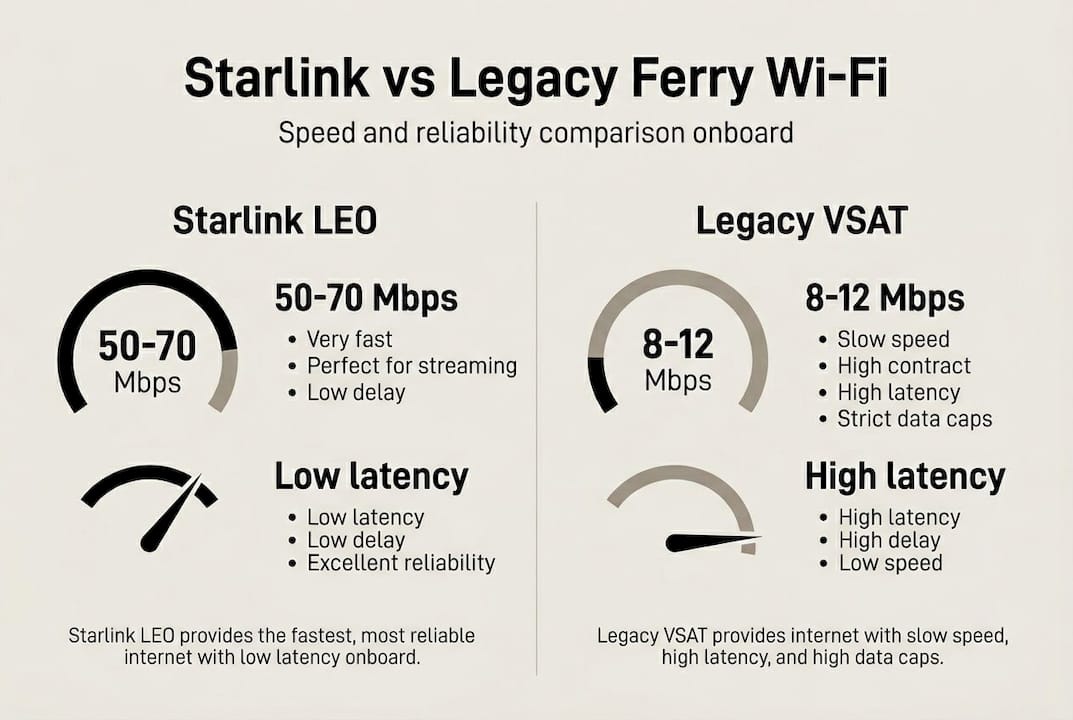
The headline numbers are encouraging. Starlink on Mediterranean ferries delivers download speeds of 50 to 70 Mbps with latency between 50 and 99 ms. To put that in context, Netflix recommends 25 Mbps for 4K streaming. A typical video call needs less than 5 Mbps. These speeds are more than sufficient for most passenger needs.
Here’s how that performance translates across different use cases:
| Use case | Minimum speed needed | Starlink on ferries | Experience |
|---|---|---|---|
| HD video streaming | 5 to 10 Mbps | 50 to 70 Mbps | Smooth, buffer-free |
| Video conferencing | 3 to 5 Mbps | 50 to 70 Mbps | Clear, stable calls |
| File uploads/downloads | Variable | 50 to 70 Mbps | Fast, reliable |
| Social media and messaging | Under 1 Mbps | 50 to 70 Mbps | Instant |
| Crew operations | 10+ Mbps | 50 to 70 Mbps | Fully supported |
Latency deserves a special mention. Legacy VSAT systems had latency of 600 to 800 ms. That’s why video calls on older ferry Wi-Fi felt like talking through a tin can with a delay. Starlink’s 50 to 99 ms latency is close to what you’d experience on a home broadband connection. Remote meetings actually work. Voice calls don’t echo and stall.
For remote workers, what impacts speeds at sea is worth understanding. Factors like the number of simultaneous users, vessel location, and time of day all play a role. But even under moderate load, Starlink-equipped ferries consistently deliver a 30% productivity boost for remote workers compared to older systems.
Here’s what high-speed maritime internet means in practice:
- Leisure travelers can stream full HD content for an entire overnight crossing without interruption
- Remote workers can attend back-to-back video meetings without dropped connections
- Crew members can access real-time weather data, port logistics, and communication tools
- Families can keep kids entertained with streaming apps and online games
- Business passengers can upload large presentations or access cloud-based tools seamlessly
“For crew managing operations at sea, reliable internet isn’t a comfort. It’s a core tool. Starlink delivers the kind of uptime that makes that possible.”
Limitations and best practices: What to know before you connect
Having seen the benefits, it’s just as crucial to be aware of Starlink’s limitations and how to manage them.
No technology is perfect, and Starlink at sea is no exception. Being realistic about where it struggles helps you plan better and stay satisfied.
Weather and signal degradation. Strong storms can weaken the signal, though Starlink handles rough conditions significantly better than legacy VSAT systems. Heavy rain and dense cloud cover can cause brief slowdowns, but full outages are rare.
Peak-hour congestion. When every passenger on a crowded summer ferry tries to stream at the same time, speeds can dip. This is a shared-bandwidth reality, not a flaw unique to Starlink. Operators can manage this with traffic prioritization tools.
Vessel structure interference. Metal hulls and thick walls can reduce signal strength in certain areas. Coverage is generally excellent in open lounges and on deck, but deep cabin areas may see slightly reduced performance.
Here’s a comparison of how the main technologies perform under challenging conditions:
| Condition | Starlink | Legacy VSAT | Maritime 5G |
|---|---|---|---|
| Open water | Excellent | Good | Poor |
| Heavy weather | Moderate | Poor | Poor |
| Peak hours | Good | Poor | Good |
| Near-shore areas | Good | Good | Excellent |
| Latency (median) | Under 99 ms | 600 to 800 ms | Under 50 ms |
Research confirms that median RTT under 50 ms is achievable in maritime broadband networks, with upload speeds exceeding 35 Mbps, placing Starlink well within competitive range for most real-world tasks.
Best practices for passengers and operators:
- Download large files and updates before peak hours (typically evening crossings)
- Use the Seafy portal to choose the right package for your data needs
- Sit in open or central areas for the best signal
- Operators should deploy traffic management to protect bandwidth for all users
- Check coverage maps before your route for satellite internet at sea expectations
Following reliable ferry internet tips makes a real difference in your experience, especially on longer crossings.
Pro Tip: Download your work files, software updates, or entertainment content before you board. Once onboard, you’ll have a much smoother experience when you’re not competing with peak-hour traffic for bandwidth.
The deeper impact: How Starlink transforms ferry life
With a clear outline of both features and challenges, it’s worth stepping back to consider what reliable connectivity really means for ferry life and the industry as a whole.
Here’s a view you won’t often hear stated plainly: connectivity is no longer a perk. It’s a competitive differentiator. Ferry operators who treat Wi-Fi as an optional add-on are already losing ground to those who’ve made it a core part of the onboard experience.
The always-on expectation is reshaping passenger behavior. People no longer mentally “disconnect” during a crossing. They expect to stay productive, entertained, and reachable. That’s not a bad thing for operators. It’s an opportunity. Passengers who are comfortable and connected spend more time onboard and are more likely to return.
Starlink outperforms legacy VSAT and cellular roaming, setting a new industry standard that operators can no longer ignore. The operators who lag on upgrading will face a double hit: lost revenue from dissatisfied passengers and a reputation gap that’s hard to close.
Looking ahead, hybrid multi-orbit setups combining LEO satellites like Starlink with 5G and future satellite constellations will become the standard. Single-technology bets are risky. Resilience comes from layering networks. Understanding why offering ferry Wi-Fi is now a business imperative, not just a nice-to-have, is the mindset shift the industry needs. ⚡
Ready to experience high-speed internet at sea?
If you’re ready to bring these benefits to your next journey or fleet, here’s how to get started.
Seafy makes it simple to access Starlink-enabled Wi-Fi on Mediterranean ferries. Whether you’re a passenger planning your next crossing or an operator looking to upgrade your onboard digital services, Seafy has a solution built for you.
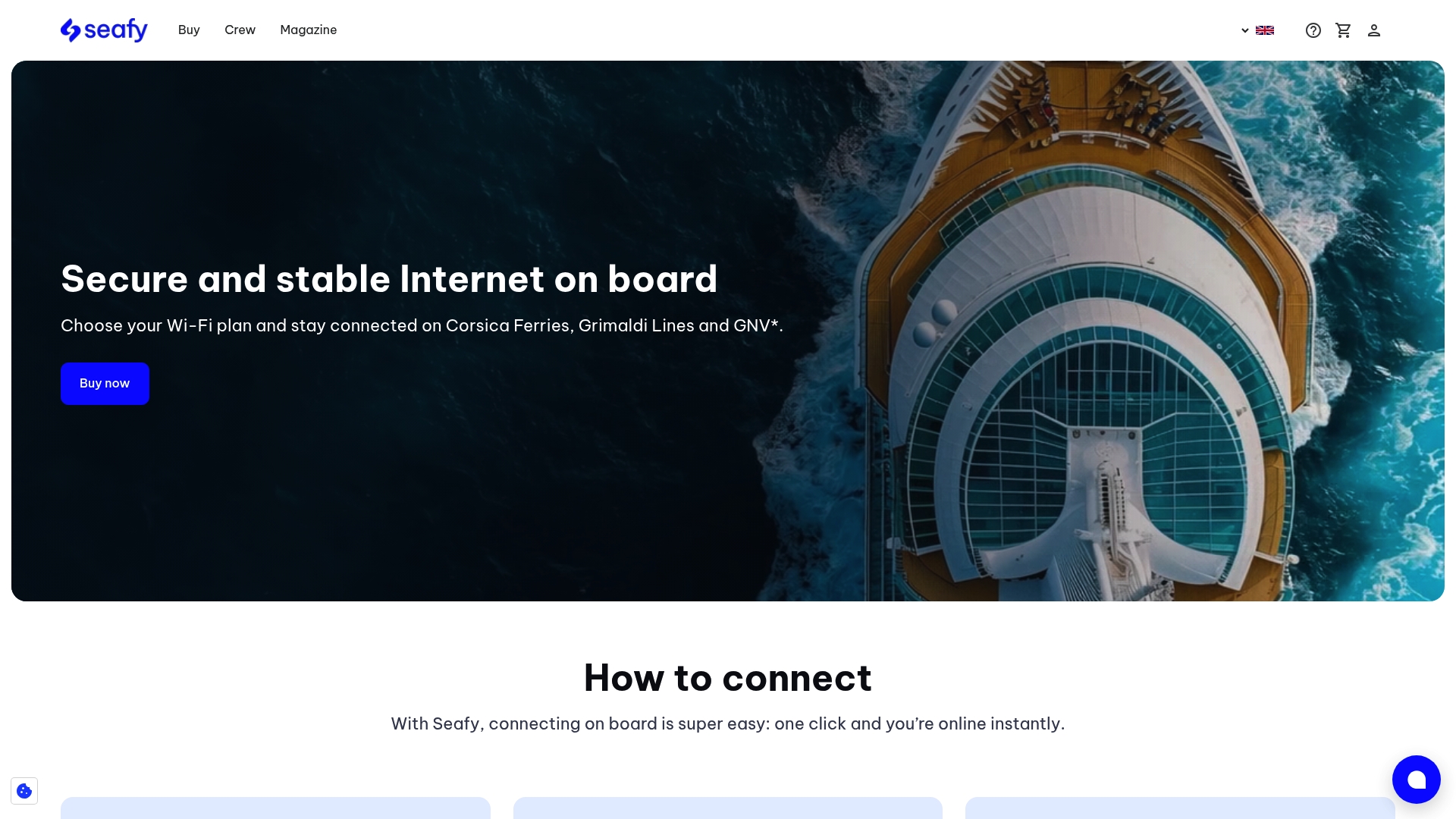
With Starlink Wi-Fi solutions from Seafy, activation takes under five minutes, support is ongoing, and coverage reaches every corner of the vessel. Seafy partners with major ferry lines including Corsica Ferries, Grimaldi Lines, and GNV to deliver seamless connectivity across the Mediterranean. Browse available packages, connect instantly, and enjoy the crossing the way it should be. Buon surf con Seafy! 🌐
Frequently asked questions
How does Starlink improve ferry internet compared to older systems?
Starlink outperforms legacy VSAT and cellular roaming by delivering 5 to 10 times greater speed and dramatically lower latency, making streaming, calls, and remote work genuinely usable at sea.
Is the connection available everywhere onboard?
Coverage spans cabins, lounges, and decks on Starlink-equipped ferries, with activation through a simple portal taking under five minutes from any passenger area.
Does bad weather affect internet reliability?
Strong storms can temporarily weaken the signal, but Starlink handles adverse weather far better than legacy maritime satellite technologies, with full outages being rare.
Can I use ferry Wi-Fi for video meetings or streaming?
Yes. Starlink supports HD streaming, video conferencing, and large file transfers with enough bandwidth and low enough latency to make them all work smoothly during your crossing.